[SPONSOREDNUBIVANCE]
Rapid7 deployed right the first time.
Full-platform Rapid7 rollouts - InsightVM, InsightIDR, event sources, agents, tuning - by a Registered Partner who has done it at state-agency scale, including OT/SCADA.
Talk deployment
In a surprising move, the House Armed Services Committee voted 31-26 against an amendment that would have restricted Judge Advocates to only military duties, allowing them to continue serving in crucial civilian roles. This decision means that these specialized resources can keep tackling a broader range of challenges, beyond just military operations.

In a powerful show of bipartisan support, the US House of Representatives has passed the Ukraine Support Act, delivering a strong message that it stands with the Ukrainian people and will hold Russia accountable for its actions. The landmark bill, which passed with a 226-195 vote, provides $8 billion in military financing to Ukraine and introduces fresh sanctions against Russia.

The House Armed Services Committee is pushing for answers on the Navy's ambitious plan to build 15 new nuclear-powered battleships, known as the Trump Class, at a hefty $17 billion each, and wants assurance that the massive project won't derail existing shipbuilding programs. Members are demanding a formal risk assessment to prove the Navy can handle the enormous undertaking without compromising its nuclear shipbuilding capacity.

In a surprising move, an effort to slash funding for the Trump-class battleship program was shut down, with Rep. Adam Smith's amendment to strip $1 billion in advanced procurement failing 26-30. The congressman had argued that the hefty $20 billion price tag of the lead battleship could be better spent elsewhere.
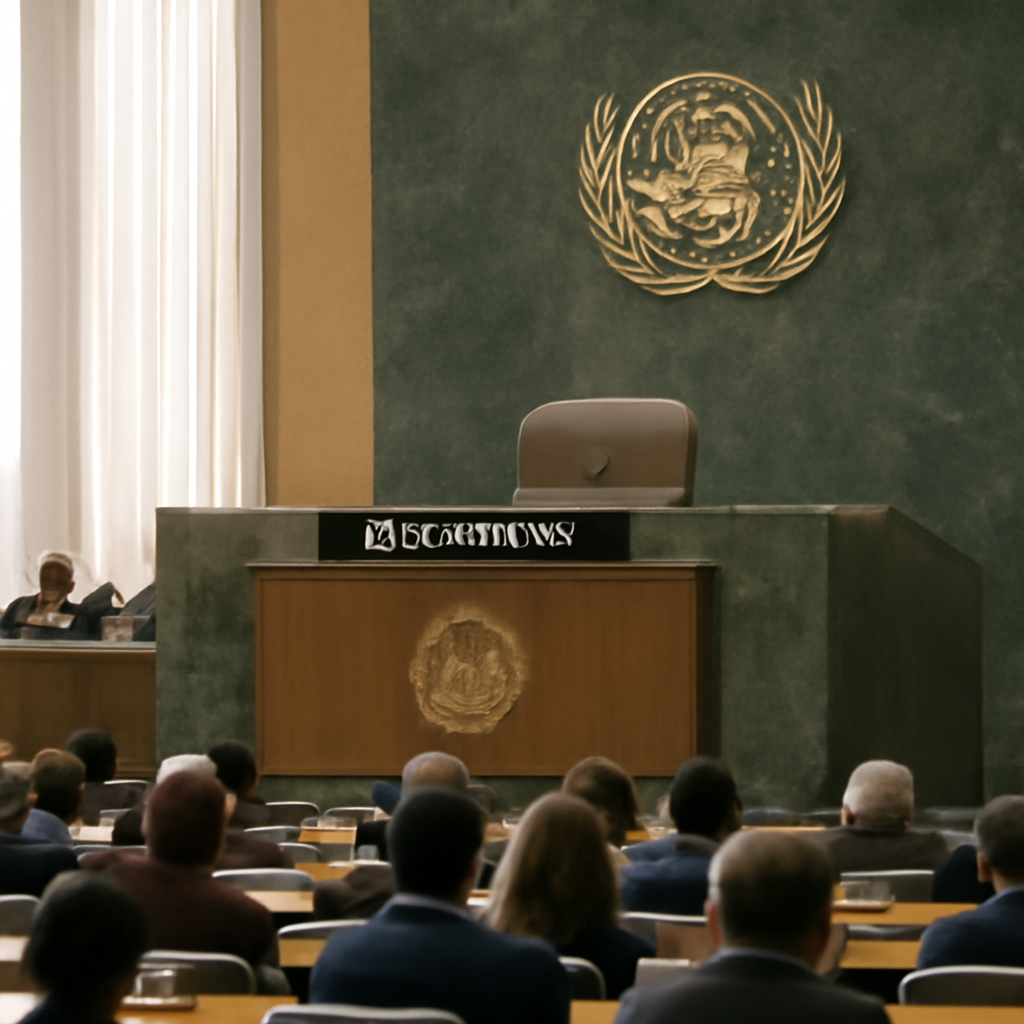
Kyrgyzstan has secured the Asia-Pacific seat on the UN Security Council for 2027-2028, defeating the Philippines in a decisive 142-49 vote after a surprise fourth-round collapse. This unexpected margin has sparked intrigue about the dynamics at play in the UN General Assembly.

President Trump's surprise pick for intel chief, William Pulte, has thrown a wrench into a fragile deal to extend a critical surveillance authority, sparking concerns from lawmakers that his appointment could put politics over national security. With Pulte's lack of experience and questionable past, some are worried that the nation's intelligence operations may be weaponized for personal gain.

The US military is considering a game-changing move: creating a standalone Cyber Force by 2028, but its success hinges on a crucial decision from Congress or the White House this year. A recent report outlines a bold plan to overcome longstanding structural challenges in cyber operations and make this vision a reality.

In a move that affects nearly 8,000 federal workers, President Trump has signed an order converting their positions to at-will jobs, stripping them of civil-service protections and placing them in a new category called Schedule Policy/Career. This change allows for easier removal of employees, and marks a significant shift in the way these workers are treated.
Full-platform Rapid7 rollouts - InsightVM, InsightIDR, event sources, agents, tuning - by a Registered Partner who has done it at state-agency scale, including OT/SCADA.
Talk deployment
Department of Homeland Security Secretary Markwayne Mullin aims to boost the Cybersecurity and Infrastructure Security Agency's effectiveness with a targeted workforce of 2,800 personnel, leveraging public partnerships and strategic grant usage to fortify national security.

Democratic lawmakers are raising red flags over a $620 million Pentagon loan to Vulcan Elements, a small North Carolina startup, after it emerged that a top White House aide, and friend of Trump Jr., intervened to secure the deal. The loan has sparked questions about favoritism and undue influence at the highest levels.

The US Treasury has sanctioned Nobitex, Iran's largest crypto exchange, and several top executives, citing its role in supporting the regime and processing over 50% of Iranian digital asset inflows. This move is part of a broader effort to crack down on terrorism financing through cryptocurrency.

The Antarctic Treaty, meant to keep the continent out of global conflicts, is showing signs of fraying as geopolitical tensions rise, with recent talks in Hiroshima failing to yield consensus on crucial issues like protecting emperor penguins and regulating tourism. Despite a gathering of over 400 international delegates, key measures were left unadopted, leaving the treaty's future uncertain.

In a major crackdown on illegal streaming crime, authorities have dismantled nine organized crime groups and made 29 arrests in a seven-month operation that targeted the entire criminal ecosystem. The coordinated effort, involving 13 countries, identified 86 suspects and referred 59 cases to judicial authorities.

President Trump has tapped William Pulte, a seasoned expert with a track record of handling America's most sensitive matters, to lead national intelligence on an acting basis. Pulte brings unparalleled experience to the role, having spearheaded the administration's mortgage fraud efforts and managed high-stakes initiatives.

The Philippines is vying for a non-permanent seat on the UN Security Council, with a vote on June 3 in New York, and its bid is centred on pushing for stronger enforcement of global rules. Defence Secretary Gilberto Teodoro is leading the charge, urging the international community to take a stand and call out breaches of international rules.

Senator Kirsten Gillibrand is taking a stand against the Pentagon's rapid deployment of powerful AI technology without safeguards, introducing the Secure and Accountable Military AI Act to impose stricter regulations and prevent potentially catastrophic consequences. The proposed legislation aims to restrict AI use in autonomous weapons, domestic surveillance, and nuclear applications.
Evidence in spreadsheets, controls drifting between audits, frameworks multiplying on flat headcount. Nubivance runs continuous compliance on Rapid7 Cyber GRC - SOC 2, HIPAA, ISO 27001, PCI, CMMC.
End the scramble
The Pentagon is revolutionizing its approach to cyber operations, shifting away from treating it as a separate entity and instead weaving it into every military operation from the ground up. By doing so, the Defense Department aims to harness the full power of information on the battlefield, with AI security at the forefront of this strategic evolution.

The USPS is pushing forward with a plan to boost mail-in ballot security and transparency by introducing uniquely serialized barcodes that allow for individual ballot tracking. This move would enable the Postal Service to scan and monitor absentee ballots as they're sent to and from voters, providing an added layer of accountability.

Australia and Japan are bolstering their defense ties, recognizing their growing importance to each other's strategic success. By joining forces, they're set to leverage their unique strengths, from industrial might to geographical advantage and networks.

Tina Peters, the convicted election clerk, is vowing to fight her felony record, despite Governor Polis commuting her prison sentence. In her first public interview since the commutation, Peters remained unapologetic, reasserting her claims about elections and hinting at a new legal battle to clear her name.

The Pentagon drastically cut its workforce by 78,000 civilian employees in 2025, achieved through a combination of layoffs, resignations, and a hiring freeze that significantly reduced new hires. This swift and extensive reduction, ultimately affecting 14% of its civilian workforce, was implemented with surprisingly little analysis or planning.

France has imposed strict limits on Israel's participation in the Eurosatory defense exhibition, barring government reps, restricting display items to air defense products only, and shutting down the Israeli national pavilion. The move comes as the biennial event prepares to open outside Paris from June 15-18.

In the face of growing regional tensions, Indo-Pacific nations are doubling down on their commitment to a rules-based order, with Australia's deputy prime minister calling it an imperfect but essential framework for global stability. The unified message was clear at the Shangri-La Dialogue in Singapore, where a notable absence was felt - that of senior Chinese leaders.

Japan's Defense Minister Shinjiro Koizumi hit back at China's militarism allegations, calling them "strange" and reaffirming Tokyo's commitment to international law and the UN charter. He emphasized Japan's goal of supporting regional stability through defense cooperation, not aggression.