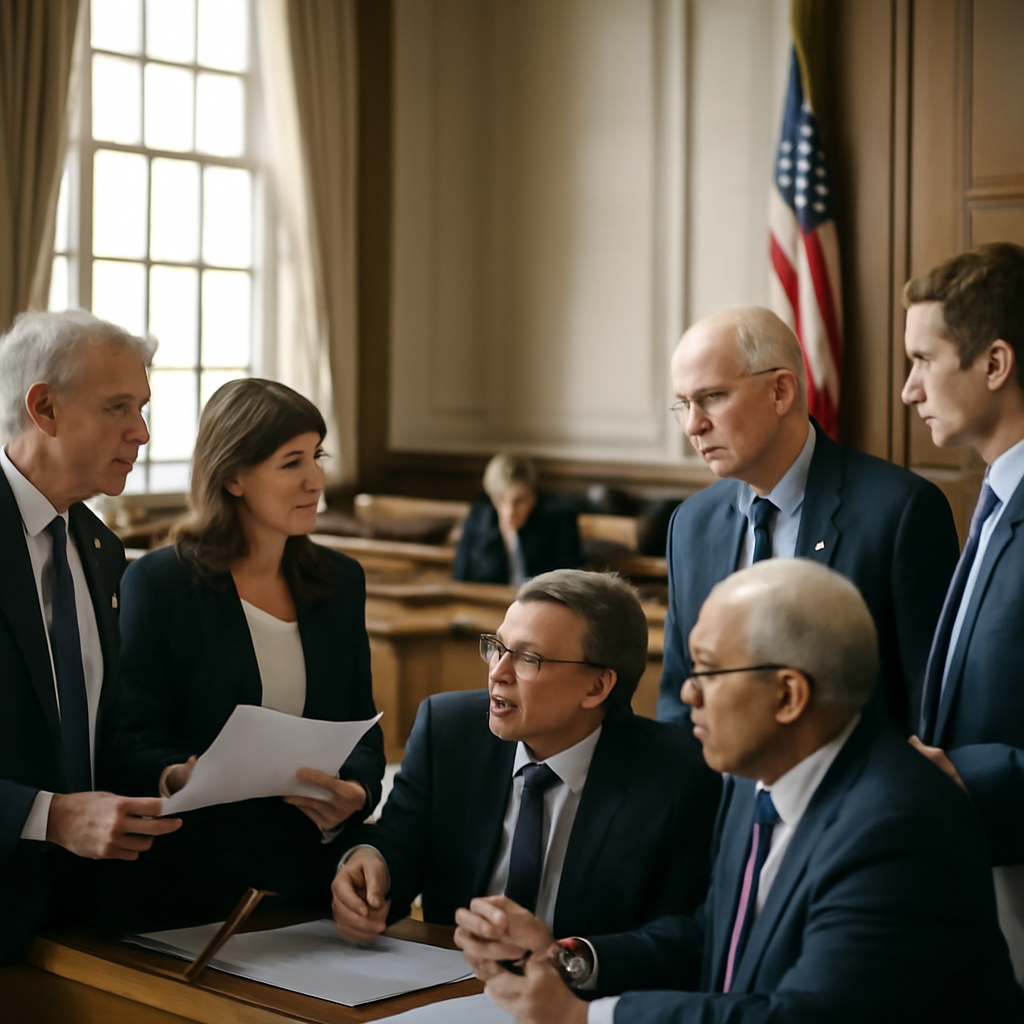
"Today’s bipartisan vote to pass the Ukraine Support Act demonstrates that the House stands with the Ukrainian people and that we will hold the criminal Russian regime accountable for its illegal war," Rep. Gregory Meeks said after the House approved the bill late Thursday.
House vote: 226-195 advances the Ukraine Support Act
The House of Representatives voted 226-195 to pass the Ukraine Support Act, moving a package that pairs new sanctions targeting Russia with additional military financing for Ukraine. The legislation authorizes $8 billion in military finance loans to Ukraine and extends the Ukraine Security Assistance Initiative (USAI) through 2027. The measure’s passage represented a rare moment of bipartisanship in a chamber otherwise marked by division, with 18 Republicans joining most Democrats to secure passage despite the Trump administration’s opposition for further funds for Ukraine.
Key provisions: $8 billion in loans and USAI extended to 2027
The text advanced by the House formalizes two central elements. First, it authorizes $8 billion in military finance loans to Ukraine, a direct financing mechanism that the bill’s sponsor framed as necessary support. Second, it extends the Ukraine Security Assistance Initiative through 2027, preserving an existing framework for U.S. security assistance to Ukraine for multiple additional years. Those provisions were cited repeatedly by sponsors and supporters as the core of the package.

Audit-ready is a season. It shouldn't be.
Evidence in spreadsheets, controls drifting between audits, frameworks multiplying on flat headcount. Nubivance runs continuous compliance on Rapid7 Cyber GRC - SOC 2, HIPAA, ISO 27001, PCI, CMMC.
End the scrambleRepublican supporters: 18 crossed the aisle, notable names
The 18 House Republicans who voted to advance the bill included several members of the House Armed Services Committee: Reps. Joe Wilson (South Carolina), Mike Turner (Ohio), Don Bacon (Nebraska), Carlos Gimenez (Florida) and Jennifer Kiggans (Virginia). The roll call also included Rep. Brian Fitzpatrick (Pennsylvania), co-chair of the Congressional Ukraine Caucus, and House Foreign Affairs Committee Chairman Emeritus Michael McCaul (Texas).
Several of those Republicans framed their votes in stark terms. Bacon said the vote presented “a Churchill vs. Chamberlain moment. Stand on the side of freedom and democracy, or show weakness to an invading thug who wants to restore Russian domination over a free people. Tonight, we chose Churchill.” Fitzpatrick described support for Ukraine as “a matter of American security, allied strength, and moral clarity.”
Discharge petition and Kevin Kiley’s decisive signature
The bill’s route to the floor was unusual. Introduced last year, the Ukraine Support Act came to the House floor only after a discharge petition forced a vote. California Rep. Kevin Kiley, an Independent who typically votes with Republicans, became the 218th signature on that petition, ensuring the measure could be brought up. The record shows that Reps. Don Bacon and Brian Fitzpatrick had previously signed the petition as well.
Rep. Meeks, the top Democrat on the House Foreign Affairs Committee and the bill’s sponsor, framed the successful petition and subsequent vote as a demonstration of bipartisan will, urging the Senate to act next and to help deliver a comprehensive package “to the President’s desk for his immediate signature.”
How the Senate, the President, and the Trump administration are positioned
- Senate: The source reports that bipartisan support for Ukraine in the Senate remains strong, but it is unclear whether Republican leadership will greenlight a vote on the House bill. Separate Senate legislation that would impose new sanctions and tariffs on Russia was described as in limbo, according to the Associated Press.
- The President: Meeks specifically called on the Senate to work with the bipartisan House group to deliver the package to the President for immediate signature, signaling the House sponsor’s intent to move the text toward executive approval.
- The Trump administration: The source notes the administration opposed further funds for Ukraine, a stance referenced as part of the political context around Thursday’s vote.
The House vote leaves a clear pathway but not a guaranteed outcome. Passage in one chamber established a congressional statement of support for Ukraine in legislative form, while shifting the decisive moments to the Senate and to inter-branch negotiation over sanctions, tariffs and the final package. Meeks’ appeal to the Senate and the President, the presence of cross-party Republican backers, and the use of a discharge petition are all concrete signals that proponents of the measure are prepared to press forward — even as uncertainty remains about whether a full Senate vote will be scheduled and whether the separate Senate sanctions measure will coalesce from its current limbo.