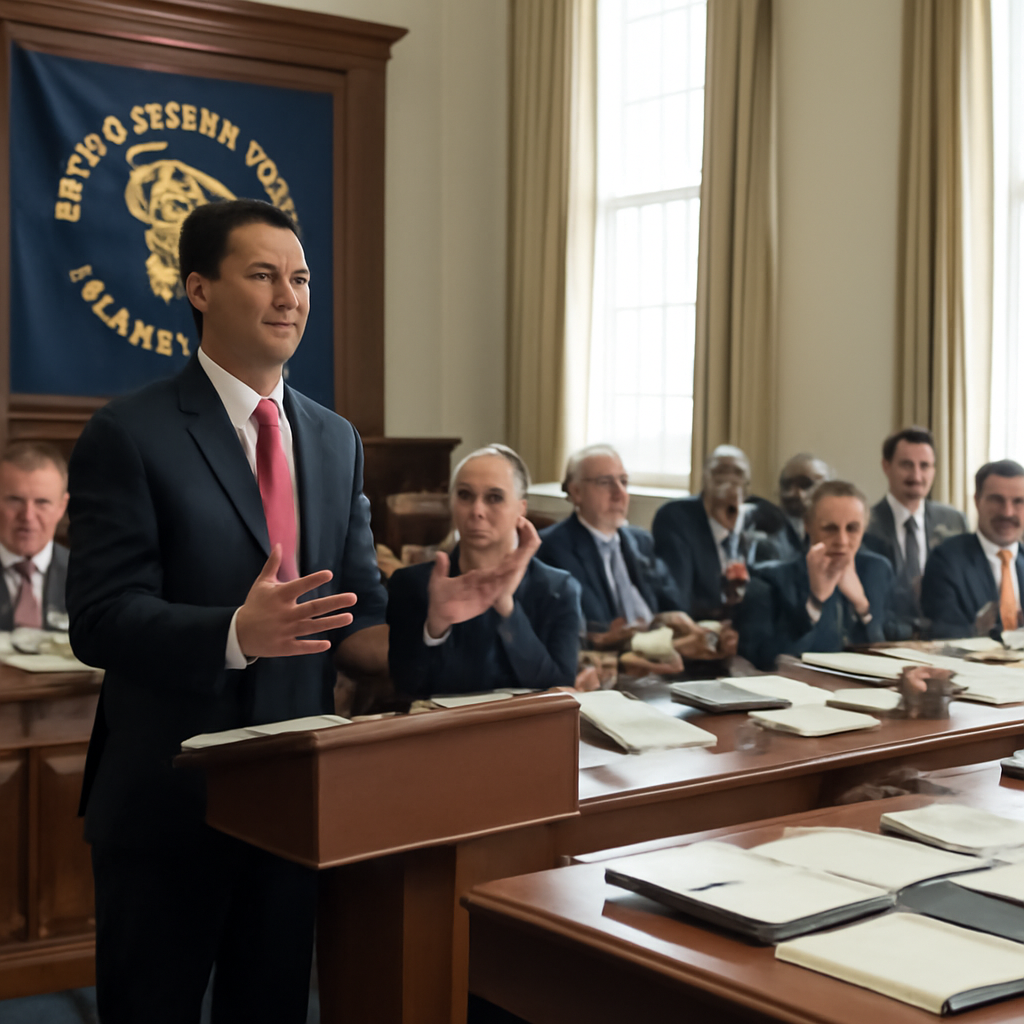
“They are a limited and specialized resource. Their time should be focused on matters that directly affect military operations, unit cohesion, command authority, and mission effectiveness,” Rep. Jason Crow said, arguing that judge advocates should be returned to strictly military duties.
Rep. Jason Crow’s amendment and the 31‑26 House Armed Services Committee vote
On Thursday afternoon during markup of the National Defense Authorization Act, Rep. Jason Crow, D‑Colo., offered an amendment to clarify U.S. law so that the judge advocate general (JAG) corps could be assigned only to military‑related duties. The House Armed Services Committee defeated the measure on a 31‑26 vote, according to the committee’s website. The committee roll call left unresolved whether the Senate will take up a similar restriction.
What the amendment sought to halt: expanded civilian roles for uniformed lawyers
The amendment targeted a recent practice under the Trump administration of detailing uniformed military lawyers into civilian roles. Defense One reported that the administration has shifted “dozens of military lawyers to temporary jobs as immigration judges, special attorneys.” Former uniformed attorneys told Defense One those details have placed heavy burdens on the JAG corps.
Examples cited in the reporting include JAGs assigned to oversee immigration courts, appointed as special U.S. attorneys to investigate “fraud and abuse” in Minneapolis, and JAGs prosecuting violent crimes during domestic National Guard deployments. Advocates of the amendment argued those uses take time and expertise away from military‑specific legal duties.

Audit-ready is a season. It shouldn't be.
Evidence in spreadsheets, controls drifting between audits, frameworks multiplying on flat headcount. Nubivance runs continuous compliance on Rapid7 Cyber GRC - SOC 2, HIPAA, ISO 27001, PCI, CMMC.
End the scrambleDefense Department changes and internal scrutiny under Defense Secretary Pete Hegseth
Defense One reported that “this year, Defense Secretary Pete Hegseth has scrutinized the JAG corps with a series of wide‑ranging reforms and has fired the military's top lawyers and trimmed the civilian legal staff.” Members of Congress and former JAGs referenced those personnel and structural changes as context for the debate over how the corps should be deployed.
Republican defense of the broader use of JAGs: Mike Rogers and Pat Fallon
Republican committee members, including HASC Chairman Mike Rogers, defended the administration’s expanded use of uniformed lawyers. Rogers said, “This is a direct attack on the administration, which has used judge advocates in multiple ways to protect national security priorities for the president. Judge advocates have served as special assistants to U.S. attorneys for years… I trust that the Secretary of Defense, with the help of the Joint Staff, may deploy judge advocates across the United States and the world to ensure the rule of law is followed.”
Rep. Pat Fallon, R‑Tex., echoed that rationale, saying Hegseth “has determined that the homeland mission is essential” and arguing that the extra lawyers provide needed capacity. Fallon added, “The National Security Strategy places a great deal of emphasis on homeland defense, and in order to meet these needs, an increase in attorneys has been needed to litigate in U.S. courts and aid in the administrative hearings across the Department of Justice and Homeland.”
Former JAGs and legal scholars voice legal and mission concerns
Retired and former uniformed lawyers who spoke with Defense One framed the amendment as an effort to restore long‑standing limits on military involvement in civilian law enforcement. Steve Lepper, a retired Air Force lawyer and member of a group of former JAGs speaking out about the administration’s legal actions, said, “When you come right down to it, using the military in a prosecutorial or judicial capacity for cases that have nothing to do with the military is basically a violation of posse comitatus.”
Aaron Brynildson, a University of Mississippi law professor and retired Air Force JAG, said uniformed attorneys should be detailed to special assistant U.S. attorney roles only to prosecute civilians committing offenses on military bases. “JAGs should not be used to prosecute immigration crimes or as fill‑ins for overburdened federal prosecutors,” he said.
Both Lepper and Brynildson framed the amendment as aligned with Defense Secretary Hegseth’s own complaint that “military lawyers are sometimes stuck doing civilian side work,” and Lepper added that Crow’s proposal was “basically a way to achieve what Hegseth said he wants, which is JAGs to do JAG jobs.”
What this means for military lawyers, the Department of Defense, and the Department of Justice/Homeland
- Military lawyers (JAGs): Former and current JAGs interviewed by Defense One characterized their corps as overworked when detailed to civilian roles; the failed amendment would have reduced those details and kept uniformed lawyers focused on military missions.
- Department of Defense: The committee vote leaves intact the administration’s authority, as defended by HASC Republican leaders, to deploy JAGs broadly, even as the department’s leadership under the Secretary of Defense has been reshaping legal staffing through firings and cuts.
- Department of Justice and Homeland: Republican defenders framed JAG details as a surge capacity to “litigate in U.S. courts and aid in the administrative hearings across the Department of Justice and Homeland,” signaling continued reliance on uniformed lawyers where civilian prosecutors or immigration dockets have needed support.
The HASC vote captured a clear divide: committee Republicans endorsed continued, expanded use of uniformed lawyers in civilian roles to meet homeland and prosecutorial needs, while Democrats and former JAGs argued for restoring limits to preserve military legal capacity and guard against potential conflicts with statutes like the Posse Comitatus Act. It remains to be seen whether the Senate will take up a comparable measure; for now, the committee’s decision preserves the Trump administration’s practice and the Defense Department’s discretion to detail uniformed attorneys to civilian assignments.