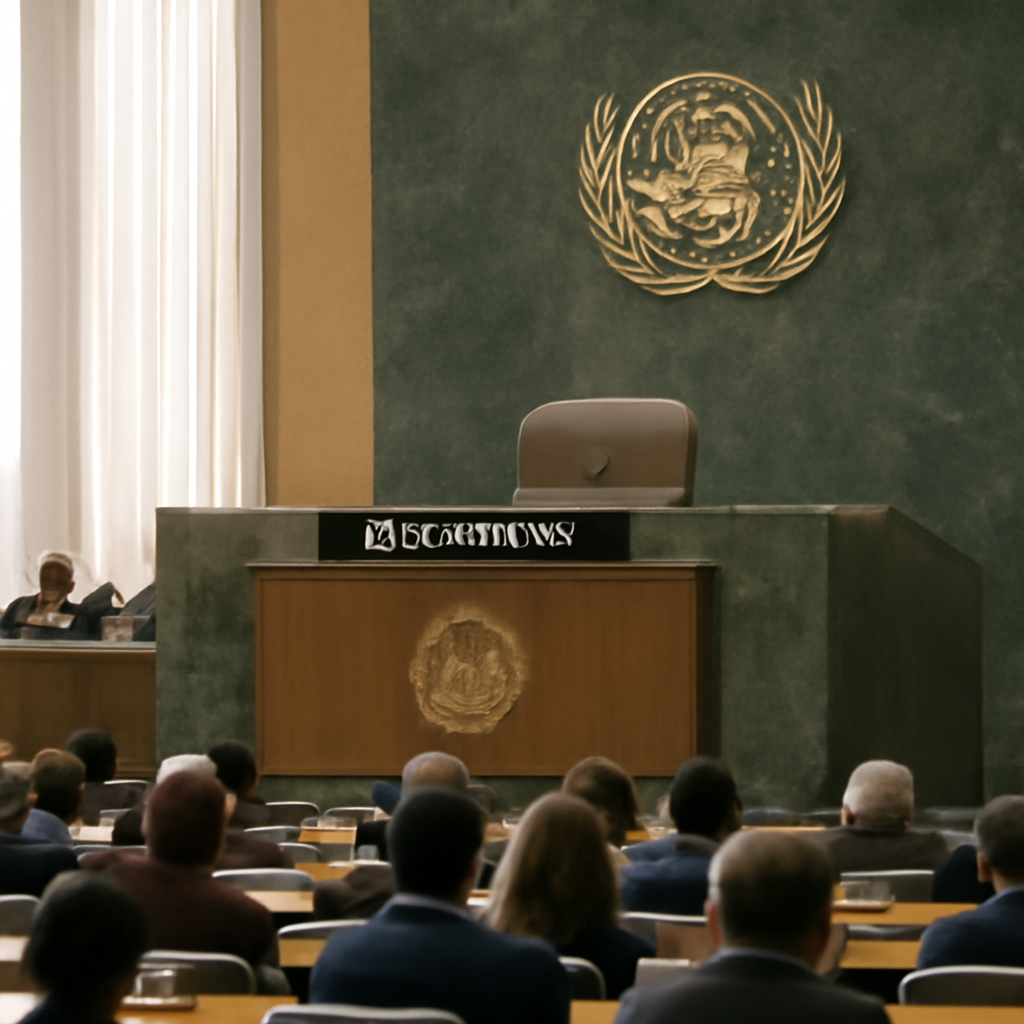
Kyrgyzstan took the Asia‑Pacific seat for 2027 and 2028, defeating the Philippines 142 to 49 in a fourth round of voting after leading from the first ballot.
The UN General Assembly balloting and the unexpected margin
The United Nations General Assembly vote on 3 June produced a decisive outcome: Kyrgyzstan beat the Philippines 142–49 to win the Asia‑Pacific seat on the Security Council for 2027–28. The contest went to a fourth round; the source reports that the Philippines had led early on but ultimately “collapsed in the last.” The scale of the margin — and the multiple rounds of secret ballots — is presented in the source as central to interpreting what the result reveals about the Assembly’s dynamics.
What the vote signalled about law, coercion and secret ballots
The source frames the loss not as a plain assessment of Manila’s qualifications but as a test of whether the Assembly would back a state that had litigated and prevailed on an international legal question. The Philippines “took Beijing’s nine‑dash line to arbitration and won,” yet the General Assembly declined to seat it. The article argues that the secret ballot environment does not erase pressure but can “launder” it, and gives the “honest interpretation”: “some governments withheld their votes not on the merits, but from a calculation about the cost of crossing China.”
That interpretation rests on two linked claims made in the source: first, that a universal forum lacking enforcement mechanisms is prone to default to the lowest‑risk option for the median member; second, that when enforcement carries a penalty, consensus institutions will reliably find reasons to look away rather than impose costs.

Audit-ready is a season. It shouldn't be.
Evidence in spreadsheets, controls drifting between audits, frameworks multiplying on flat headcount. Nubivance runs continuous compliance on Rapid7 Cyber GRC - SOC 2, HIPAA, ISO 27001, PCI, CMMC.
End the scrambleWhy minilaterals are presented as the response
The source argues the Assembly’s decision strengthens the case for minilateralism — small, capable coalitions that can act where universal institutions do not. These minilaterals are described as capable of sharing intelligence, setting enforceable standards among members, and imposing “real costs on coercion” because membership is conditional on contribution rather than open to capture. The article lists the Quad, AUKUS, the Squad and Five Eyes as examples and notes a key datum: “China opposes the Quad and Squad, campaigns against AUKUS, and treats Five Eyes as a threat precisely because these are the formats it cannot neutralise through the leverage it can exercise in the General Assembly or bilaterally.”
The piece underscores that the United States, “along with Australia,” is a core member of each of these minilaterals, framing them as the practical instruments left to convert principle into action.
Australia, Richard Marles and the logic of capability
The source points to remarks at the Shangri‑La Dialogue as a proximate context. It says Deputy Prime Minister Richard Marles “appropriately outlined at Shangri‑La that nations that fail to invest in credible capability become more exposed to coercion and more constrained in their sovereignty.” The article extends that logic from capabilities to institutional architecture: just as states must invest in credible defence, the architecture of the rules‑based order requires investment in formats that can enforce rules.
What this means for the Philippines, minilateral partners, and China
- The Philippines: Despite winning an arbitration on the nine‑dash line and litigating “against the largest grey‑zone campaign in the Indo‑Pacific,” the country lost a high‑visibility seat on the Security Council. The article reads that loss as a signal about the limits of universal institutions to translate legal victories into institutional protection.
- Minilateral partners (United States, Australia and others): The vote is a catalyst to deepen partnerships, impose “harder standards” among willing states and make public which states will stand where. The source concludes that “the investment that now pays the most is in the formats that can still enforce: deeper minilateral partnerships, harder standards and a willingness to say publicly which states stand where.”
- China: The article treats Beijing’s hostility to minilaterals as evidence of their value — because these formats are harder for China to neutralise through the leverage it exercises in universal fora or bilaterally.
The General Assembly’s vote, in the source’s reading, did not merely reject one candidate; it charted where enforcement of the rules‑based order will be sustained in practice. “The Philippines lost a vote. The lesson is that the work of holding the line has moved decidedly to the groupings willing to stand for enforcement,” the article concludes — an argument for realism about multilateral capacity and for investing political capital in minilateral formats that can impose costs when universal institutions cannot.
https://www.aspistrategist.org.au/philippines-un-loss-strengthens-case-for-minilateralism/