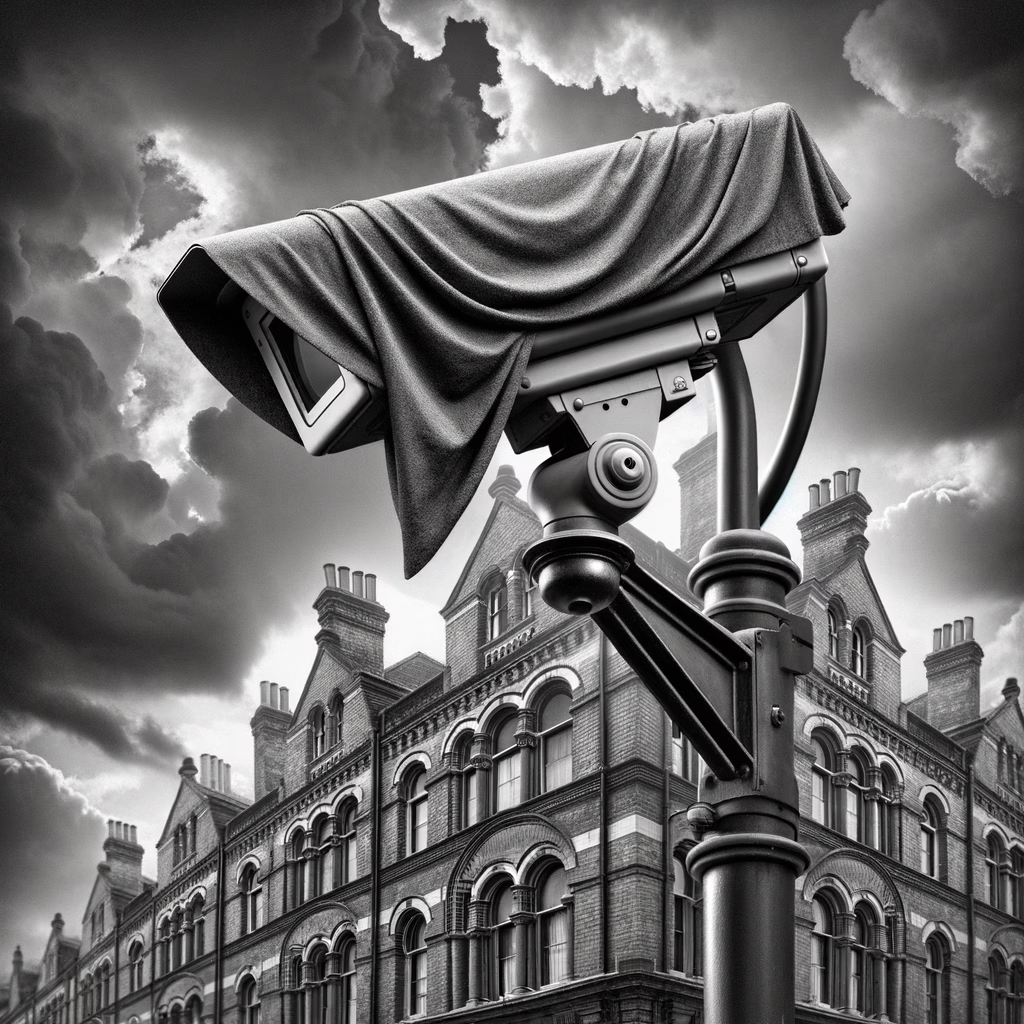
UK Policing Minister Defers Nationwide Facial Recognition
Introduction: balancing safety and rights with live facial recognition
Live facial recognition has resurfaced at the centre of a heated debate in UK policing: ministers are encouraging forces across England and Wales to adopt the technology, but they are stopping short of a nationwide mandate. That split decision — praise for a successful deployment in Croydon set against repeated judicial and regulatory warnings — highlights a deeper dilemma: how to reconcile public safety gains with civil‑liberties protections.
H2: Live facial recognition — what happened in Croydon and why it matters
The Metropolitan Police hailed its Croydon deployment of live facial recognition as a triumph, claiming targeted use helped disrupt serious offending and deliver operational results. Proponents point to rapid suspect identification, faster case resolution and the deterrent effect of visible surveillance. Yet the UK’s legal record is mixed: the 2020 Court of Appeal ruling in R (Bridges) v Chief Constable of South Wales Police declared a previous automatic facial recognition deployment unlawful because of governance and deployment failings. Regulators, notably the Information Commissioner’s Office (ICO), have repeatedly demanded robust data‑protection safeguards, clear legal bases and transparent governance.
What is at stake goes beyond gadgetry. Live facial recognition is a form of biometric surveillance that matches live camera feeds against watchlists or image databases in real time. As a tool it shapes policing practices, reallocates resources and affects everyday freedoms — turning public spaces into potential zones of identification by default. That raises constitutional questions about privacy, equality and proportionality.
Legal, ethical and technical flashpoints
Supporters argue that improving algorithms, better audit frameworks and strict operational rules can mitigate earlier concerns. Vendors and technologists highlight falling error rates and the potential to reunite missing people or identify violent offenders quickly. Police leaders stress practical benefits: targeted patrols, reduced investigation times and clearer intelligence.
Sceptics and civil‑liberties groups warn of several persistent problems. Research shows many facial‑recognition systems historically perform less accurately on women and people with darker skin tones, increasing the risk of wrongful stops and discriminatory outcomes. Privacy advocates such as Liberty and Big Brother Watch argue that normalising mass biometric identification transforms the relationship between citizens and the state and risks entrenching surveillance by stealth.
Regulatory bodies have consistently pressed for strong protections: legal clarity about when and how live facial recognition may be used, data‑minimisation, narrow retention windows, independent auditing and meaningful public‑interest justifications. Without these, critics say, limited pilots can become a slippery slope to widespread, poorly governed surveillance.
The government’s soft approach: guidance, not compulsion
Rather than imposing a national programme, ministers plan to publish guidance later this year and to encourage forces to adopt live facial recognition where appropriate. This strategy reflects political sensitivity: promoting a potentially powerful policing tool while avoiding the legal and reputational fallout of a top‑down roll‑out.
The problem with this incremental model is that it may produce inconsistent practice. Police capabilities, training levels and governance maturity vary widely between forces. A central guidance document can set standards, but enforcement and local culture determine outcomes. The risk is a patchwork of deployments: some forces may institute rigorous oversight; others might use LFR without sufficient transparency or safeguards.
Practical and operational questions that remain unanswered
– How will guidance define acceptable use cases and assess proportionality for specific deployments?
– What independent auditing and oversight mechanisms will be mandatory, not optional?
– Will there be a public register of LFR deployments, watchlist composition and documented error rates?
– How will the government measure performance and bias, and will those metrics be published regularly?
There is also a security dimension. Systems can be spoofed or evaded, and adversarial actors may attempt to exploit vulnerabilities. That creates a continuous need for technical resilience, investment and expertise — something not all forces can sustain equally.
Public trust, policing legitimacy and the path forward
For citizens, the core trade‑off is stark: surveillance that reduces crime at the cost of fairness and trust may not enhance public safety in the long term. For police, the lure of rapid identification must be balanced against operational risk and reputational harm from errors that disproportionately affect minority communities. For technologists, the challenge is ethical: building systems that are transparent, auditable and demonstrably fair.
If the government’s guidance is to be credible it must include legal clarity, enforceable oversight, independent auditing, clear bias‑mitigation measures and public transparency. A genuine public conversation — not merely technical briefings to chiefs and ministers — is essential to test whether the public accepts identification‑by‑default in its streets.
Conclusion: assessing live facial recognition’s place in a democracy
Live facial recognition can be a useful policing tool, but its deployment raises profound legal and ethical questions. The minister’s decision to promote guidance rather than impose a national programme reflects those tensions. To avoid turning today’s Croydon “triumph” into tomorrow’s cautionary tale, any expansion of live facial recognition must be accompanied by binding safeguards, independent oversight and open public debate so that security gains do not come at the expense of civil liberties.



