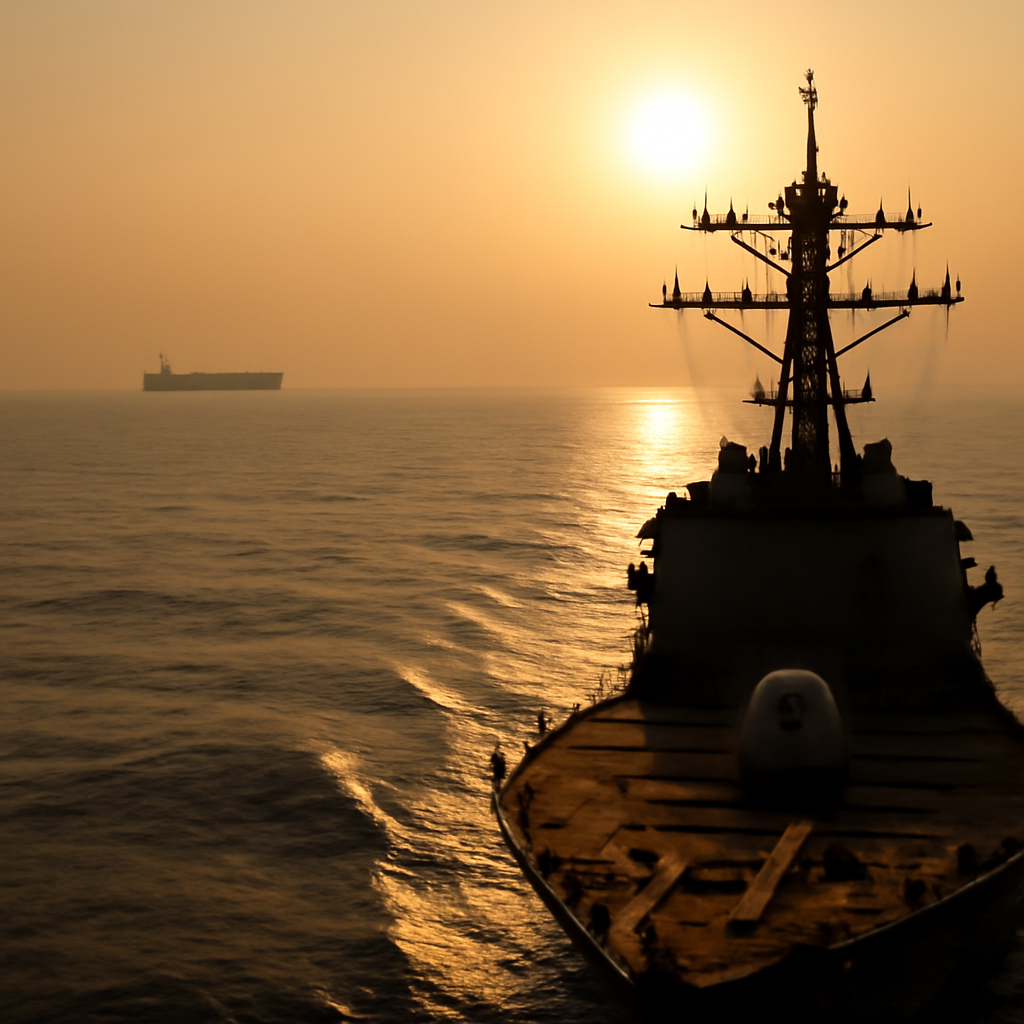
"The collapse of negotiations between the US and Iran can be traced to a single point of failure: the inability of the US military to keep the Strait of Hormuz open in the face of Iranian opposition," wrote Mark Cancian, a retired Marine colonel now with the Center for Strategic and International Studies (CSIS).
The immediate stake: commerce, oil markets, and a fragile equilibrium
Cancian frames the crisis in unambiguous terms: if the Strait were secure, "oil and natural gas would flow, with prices soon declining and shortages disappearing" and the US and global economies would rebound. He argues the United States could tolerate the broader military and political balance — citing damage to Iran's nuclear program, military forces, defense industry and ballistic-missile manufacturing, plus the loss of experienced leaders and "24,000 US and Israeli strikes" — provided sea lanes remained open. Instead, bilateral blockades and reciprocal strikes have reopened the choke point, making any transit contingent on approval or acquiescence by both sides.
Mine warfare: the capability gap and procurement choices
Cancian places much of the operational failure on a long-term, self-inflicted Navy weakness in mine warfare. He notes the last of the Avenger-class mine countermeasure vessels has retired while planned replacements — mine-clearance modules on LCVs — "have been few, delayed and plagued with problems." He adds that even the Navy's large fiscal 2026 and 2027 budgets "contain no ships for this neglected mission" and that the Navy's 30-year shipbuilding plan "does not even mention the mission." The piece points to a historical pattern of criticism inside the Navy — referencing failures in Korea (1951), the Persian Gulf (1985) and Desert Storm (1990–1991) — and concludes that reliance on allies for countermine capability has been inadequate.

This site is the portfolio.
OSINTSights runs on Cloudflare Workers, D1, R2, and Vectorize, with an AI pipeline on Hetzner ARM. Nubivance designed, built, and operates it. We do the same for clients.
See what we buildConvoy doctrine and Project Freedom: which model will defend chokepoints?
The Navy's operational approach to escorting merchant traffic is also under scrutiny. Cancian says the service has "long neglected convoy operations," trading the convoy-escort skills of the world wars for a focus on sea control in the open ocean. He contrasts a traditional escort model — where escorts sail with cargo ships to provide close-in protection — with the Navy's new concept of creating a "safe corridor from a distance" that does not tie warships to particular convoys. He notes one small convoy run under Project Freedom operated with escorts, but asks whether the new distant-corridor concept "will work."
Countering drones: an unsustainable economics and integration challenge
Another operational shortfall Cancian highlights is the cost and integration of counter-drone defenses at sea. He frames the arithmetic bluntly: firing a $5.3 million SM-3 interceptor at a roughly $30,000 Iranian Shahed drone "is not sustainable." On the technical side, he says adding counter-drone batteries ashore is "relatively straightforward," while integrating such systems into a ship's fire-control systems "is complicated, but necessary." He also cites the Navy's early use of uncrewed vessels for minesweeping as promising, but argues these approaches require deployment "at scale."
What this means for the Navy, the administration, and global commerce
- The Navy: Cancian calls for rebuilding countermine capabilities, testing convoy doctrine, and developing an "in-stride minesweeping capability" able to clear channels in hours or days rather than weeks or months. He suggests options such as refining minesweeping packages on existing platforms, designing a new class of ships, or scaling uncrewed sweeping vessels.
- The administration and Pentagon budget planners: the article urges adjustments to the FY27 budget proposal to fund countermine and convoy capabilities, and warns that political constraints — including earlier fears of casualties and assumptions of a short conflict — limited naval preparations.
- Global commerce and allied partners: Cancian warns that if Iran establishes the precedent that neighbors can control constricted waterways, "other straits worldwide might come under national control," hurting global trade — an outcome he says would "badly damage our commerce and affect every American."
Cancian rejects the notion that criticism of capability choices demeans sailors' sacrifices. Rather, he argues the failure rests at higher levels of planning, procurement and doctrine: the Navy's mission statement to "keep the seas open and free" has not been matched by investments and concepts required for constrained-water operations. The prescription in his view is concrete: rebuild countermine forces, settle convoy doctrine with realistic tests, scale uncrewed sweeping where effective, and revise budget priorities so the Navy can clear the Strait of Hormuz "in hours or days, not weeks or months." The unresolved question he leaves policymakers is stark — if Washington cannot assure passage through this single choke point, who will?



