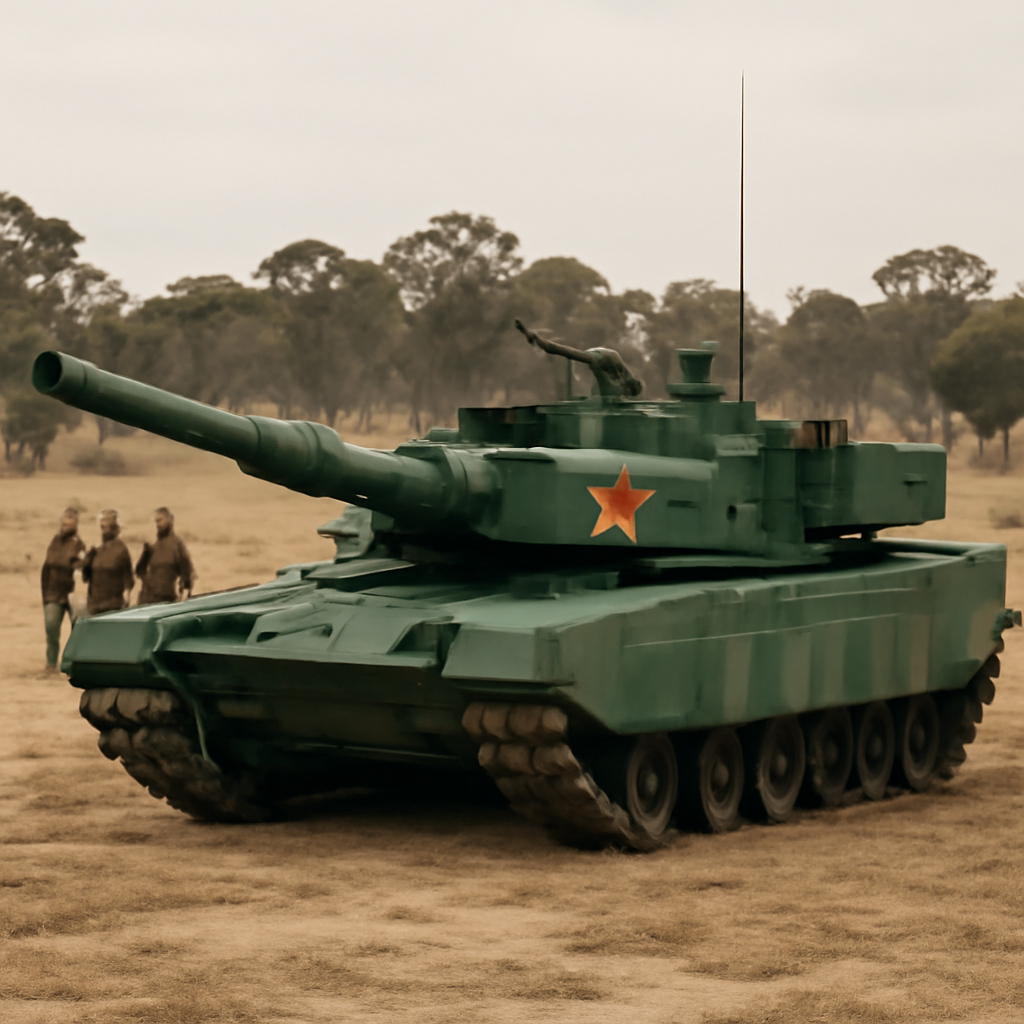
"Good luck to the junior officers as they attempt to outmaneuver a seasoned enemy commander," the Australian Army School of Armor declared alongside photos on its Facebook page showing an M1A2 Abrams painted and fitted to look like a People’s Liberation Army main battle tank.
Australian Army School of Armor at Puckapunyal
The images were posted by the Australian Army’s School of Armor, located at the Puckapunyal Military Area in Victoria, southeastern Australia. The School of Armor is described as the army’s center of excellence for mounted combat and armored fighting vehicle training and is responsible for courses such as the Royal Australian Armored Corps Officer Basic Course (ROBC), which includes field training assessments.
B Squadron, 3rd/4th Cavalry Regiment prepared the OPFOR Abrams
According to the School, soldiers from B Squadron, 3rd/4th Cavalry Regiment prepared the M1A2 Abrams as part of the Opposing Force (OPFOR) element for the latest ROBC. The modified Abrams is intended as a surrogate enemy platform — visually representative rather than a technical duplicate — and will take part in the course’s culminating combined-arms tactical training event, Exercise Tungsten Forge/Gauntlet Strike.

This site is the portfolio.
OSINTSights runs on Cloudflare Workers, D1, R2, and Vectorize, with an AI pipeline on Hetzner ARM. Nubivance designed, built, and operates it. We do the same for clients.
See what we buildHow the M1A2 was altered to look Chinese
The most obvious changes are visual: a People’s Liberation Army-style "digital" camouflage scheme composed of prominent blocks in four colors, including bright green, has been applied over the tank’s standard three-tone camouflage. The turret rear is fitted with dummy external fuel tanks — a common feature on Russian and Chinese tank designs — which on many adversary tanks sit on the rear of the hull but are placed on the Abrams’ turret because hull placement is not possible due to the Abrams’ exhaust outlet. The overall visual result is described as similar to a Type 99, which the source calls China’s first mass-produced third-generation main battle tank and “the most important in the People’s Liberation Army inventory.”
The OPFOR Abrams even appears to carry the slogan "Bing Chilling," a likely reference to a video meme in which John Cena says “ice cream” in Mandarin. The School emphasized that surrogate platforms are meant to replicate appearance, not exact capabilities; they can, however, be fitted with training devices such as the Instrumentable-Multiple Integrated Laser Engagement System (I‑MILES) to simulate firing effects and vulnerabilities.
Training context: ROBC, Exercise Tungsten Forge/Gauntlet Strike, and VISMOD practice
The altered Abrams is part of integrated training ahead of Exercise Tungsten Forge/Gauntlet Strike 2026, the capstone event for junior officers learning mechanized warfare and tank command. The Australian Army has used visually modified vehicles to add realism to Opposing Force units; the report contrasts the Australian use of a frontline Abrams that can be quickly returned to service with more bespoke VISMOD surrogate fleets used elsewhere, such as the U.S. Army’s National Training Center, which modifies M113s and Humvees to emulate Russian-made T‑72s and BTR‑90s.
The account also notes that surrogate vehicles are cost-effective ways to replicate foreign systems without acquiring them, and that their visual realism can be combined with digital simulation for performance and effects during exercises.
Procurement context: LAND 907 Phase 2, deliveries, and older Abrams transfers
The modified vehicle is an M1A2 SEPv3, the variant Australia is acquiring under the Main Battle Tank Upgrade program (formally LAND 907 Phase 2). Under a roughly $2.5‑billion deal Australia is receiving 75 M1A2 SEPv3 Abrams tanks together with armored support vehicles; the U.S. government approved the sale via Foreign Military Sales channels in 2021. The first of the new tanks were delivered to Australia in 2024.
The report also notes Canberra agreed to provide Ukraine with 49 of its older M1A1 Abrams main battle tanks. Australia had previously operated 59 M1A1 (AIM) variants acquired second‑hand from the U.S. Army and Marine Corps, and the SEPv3 is characterized in the source as a development by the U.S. Army that addressed lessons from Operation Iraqi Freedom and represents a major advance over the older M1A1 (AIM) variants.
What this means for the Australian Army, junior officers, and regional observers
- Australian Army and trainers: Visually representative surrogates let instructors practice target recognition, vehicle identification, and battlefield observation under more realistic conditions, while preserving frontline Abrams for operational use because the modifications are largely cosmetic and reversible.
- Junior officers and trainees: The ROBC capstone exercise will present scenarios that include peer-threat visuals, testing mechanized command and decision-making against an OPFOR that looks like a contemporary adversary tank.
- Regional observers and planners: The choice of a Type‑99 look‑alike surrogate is presented in the source as a signal of Australia’s training orientation toward high‑end conflict in the Indo‑Pacific, reflecting broader force‑modernization priorities described in Australia’s 2023 Defense Strategic Review and National Defense Strategy.
The School of Armor’s Facebook photos are both a practical training step and a visible emblem of Australia’s shifting readiness priorities: a frontline M1A2 SEPv3 made to look like a People’s Liberation Army tank, then returned to service as needed. The report notes it is unclear how many Abrams have been adapted — the school describes "in‑service armored fighting vehicles" (plural) as having been modified — and that future exercises might include additional surrogates such as infantry fighting vehicles or self‑propelled artillery.



