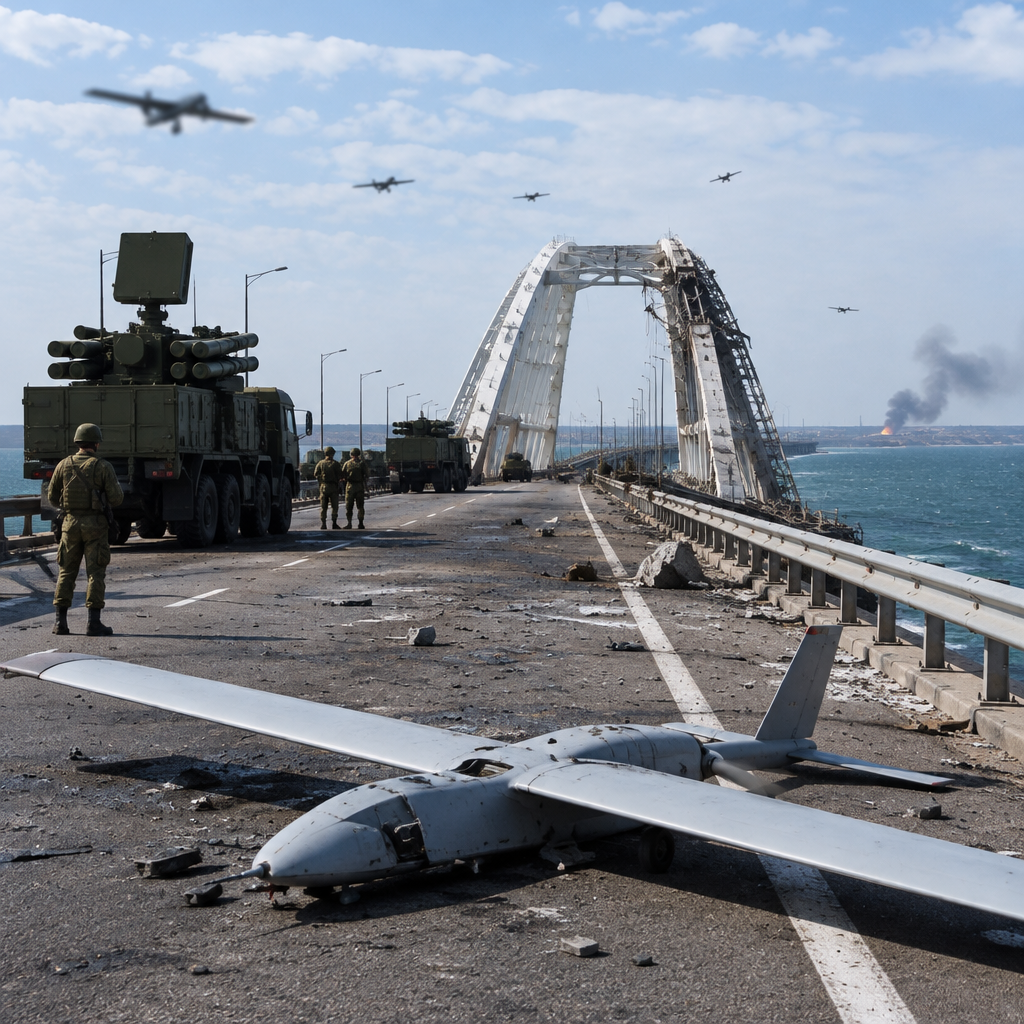
“Russia’s Ministry of Defense said its air defenses intercepted or destroyed 1,336 Ukrainian drones overnight,” the latest official tally that frames a strikingly large, multi-region attack that included a direct strike on the Kerch Bridge.
The strike: when, how, and what imagery shows
According to Russian and open-source reporting compiled by TWZ, the latest attack on the Kerch Bridge occurred at approximately 5:38 a.m. local time, when a Ukrainian one‑way attack drone struck one of the bridge’s arches. Russian air defenses were reportedly engaging incoming drones around the structure at the time. Video circulated on social media and broadcast briefly on Russian television shows a straight‑winged, propeller‑driven drone with twin booms and an inverted‑V tail — a configuration that the report says is a feature of several Ukrainian strike drones.
TWZ published a satellite image provided by Vantor showing the bridge after the attack, and additional satellite imagery cited in reporting — including material credited to Maxar and posted by users such as @absreliable — confirms visible damage around the arch of the road crossing and dark marks on the main road span. The extent to which core structural elements were compromised is not determined in those images.
Damage, traffic disruption, and Russian official reactions
Russian‑installed head of occupied Crimea, Sergey Aksyonov, confirmed the crossing — which carries both automotive and rail lanes — had been targeted and announced temporary traffic restrictions while authorities assessed the situation. The Kremlin’s spokesman Dmitry Peskov described the damage as “minor.” Still, reporting says roughly 2,000 vehicles were stranded in queues on either side of the crossing, and rail services experienced delays.
By the afternoon, Russian media reported a partial reopening of the bridge to alternating, one‑direction road traffic. Accompanying footage avoided showing the damaged arch; other clips released by regional authorities reportedly cropped the damaged area and focused on intact segments. Aksyonov later reported a second attack on the bridge in less than 24 hours.

Audit-ready is a season. It shouldn't be.
Evidence in spreadsheets, controls drifting between audits, frameworks multiplying on flat headcount. Nubivance runs continuous compliance on Rapid7 Cyber GRC - SOC 2, HIPAA, ISO 27001, PCI, CMMC.
End the scrambleRussian claims on scale: 1,336 overnight, 2,049 over 24 hours
The Russian Ministry of Defense described the events as one of the largest Ukrainian drone attacks of the war, saying its forces intercepted or destroyed 1,336 drones overnight across multiple regions including occupied Crimea and areas around the Black Sea and Sea of Azov. Moscow later reported a 24‑hour total of 2,049 drones intercepted, and added four Flamingo cruise missiles and seven guided aerial bombs to that tally. Those figures have not been independently verified; the report notes they represent Russian official claims rather than a confirmed count of drones launched by Ukraine.
Moscow Mayor Sergei Sobyanin separately claimed about 600 drones had been directed toward the capital and its surrounding region. The reported barrage also coincided with fires at industrial and energy facilities in Russia’s Rostov region and elsewhere, including an oil depot ablaze in Azov.
History of strikes on the Kerch Bridge and defensive measures
The Kerch Bridge has been a recurring Ukrainian target since Russia’s 2014 annexation of Crimea and the 2022 invasion. Reported prior operations include a truck bombing on October 8, 2022 that damaged roadway sections and ignited fuel tankers on an adjacent rail span; a July 17, 2023 attack using domestically produced Sea Baby uncrewed surface vessels that damaged the road section; and an underwater demolition operation claimed by Ukraine’s Security Service (SBU) on June 3, 2025, which Kyiv said involved explosives equivalent to more than 1.1 metric tons of TNT and damaged underwater structural elements.
After the 2022 and 2023 incidents, Russia added air defense systems and maritime barriers — floating booms, barges and other obstacles — around the crossing. Satellite imagery cited in current reporting shows multiple smoke‑generator vehicles positioned on the bridge to obscure parts of the roadway and span.
What this means for the Kremlin, the SBU, and Shenzhen summit leaders
- The Kremlin: Russian authorities face immediate logistical strain from the disruption — reported vehicle queues and rail delays — and a political test in public messaging. Officials characterized the damage as minor even as imagery showed visible deformation and regional governors released footage that omitted the damaged arch.
- The SBU (Ukraine’s Security Service): The recurrent targeting of the bridge underscores Kyiv’s continued focus on an infrastructure link that Russia uses to move personnel and materiel to occupied Crimea. The reporting notes past SBU operations that targeted underwater supports and maritime approaches to the crossing.
- Shenzhen summit leaders (Putin, Xi Jinping, Donald Trump): The attack occurred days before a trilateral summit in Shenzhen scheduled for November 19; reporting says U.S. officials indicated Russia’s war in Ukraine was not expected to be a formal topic, but the barrage provides a political and security backdrop as the leaders meet.
The attack on the Kerch Bridge adds a fresh, visible episode to a campaign that has repeatedly demonstrated the crossing’s vulnerability despite layered defenses. Satellite and broadcast imagery points to clear damage around the road arch; whether that damage will translate into longer‑term structural failure remains unconfirmed. For now, the episode leaves two certainties: Russian authorities are managing immediate disruption and messaging, and Ukraine’s campaign — by air, underwater and at sea — has again reached a strategically and symbolically significant target.
Source: TWZ — Russia’s Prized Kerch Bridge Struck In Ukrainian Drone Onslaught (Updated)