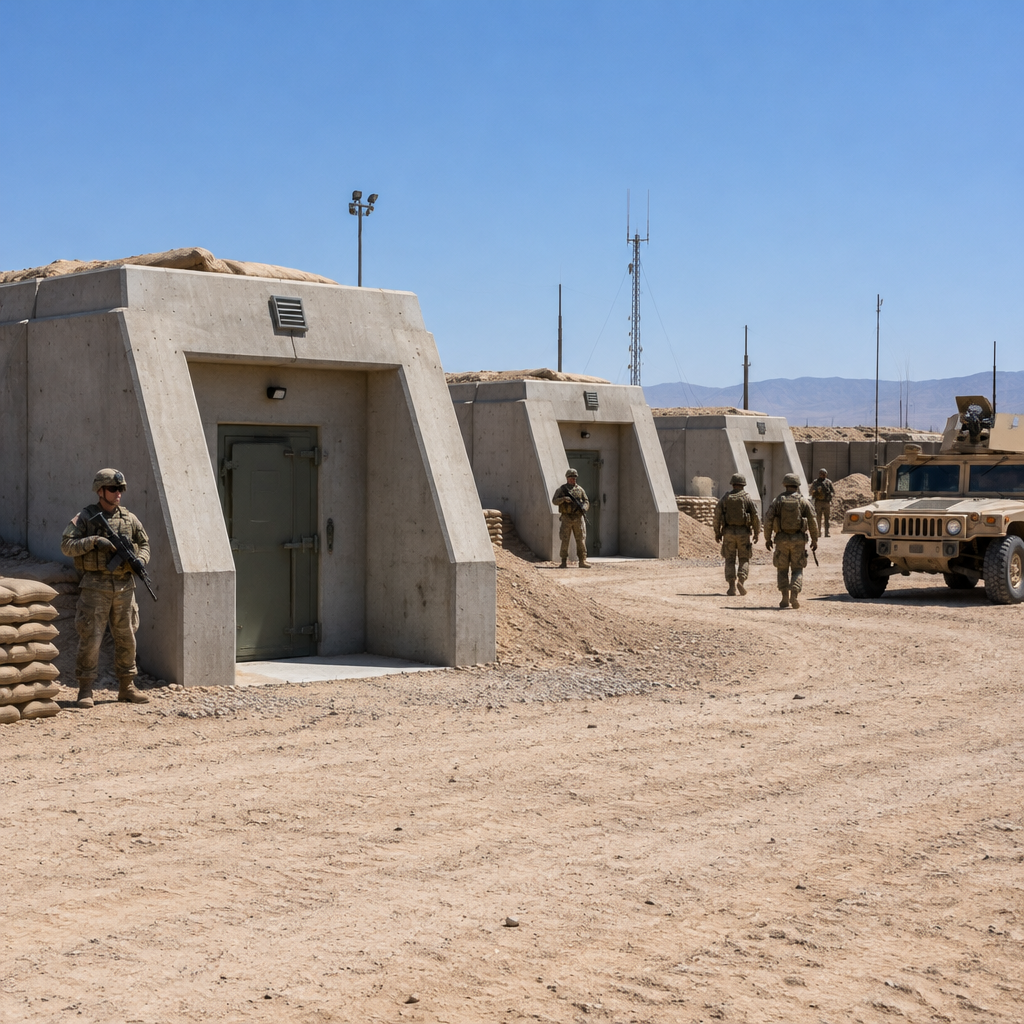
“Due to elevated regional force protection conditions, there is an urgent, high-priority requirement to replace non-standard personnel protection shelters (e.g., converted shipping containers) and provide standardized precast reinforced concrete Indirect Fire (IDF) bunkers,” according to a sources sought synopsis posted Nov. 13 on the U.S. government’s main online contracting portal.
ARCENT’s urgent request and compressed timeline
U.S. Army Central (ARCENT) issued the synopsis on Nov. 13 seeking companies to build hardened personnel bunkers across multiple countries in the U.S. Central Command (USCENTCOM) Area of Responsibility. Interested parties have eight days from the posting to respond. The synopsis states an “extreme operational urgency,” and anticipates an expedited three-day quote turnaround once the solicitation is released. Selected builders will have 45 days to finish the work. The synopsis does not name specific base coordinates in public text; it says “specific base installation names and coordinates will be provided to verified, eligible offerors upon solicitation release.”
Bunker design: concrete culverts, sandbags, and 6.1-ton barriers
The proposed bunkers will be constructed from “three sections of precast, reinforced concrete C-channel/3-sided culverts,” per the synopsis. Units must be joined tightly with no gaps, reinforced with metal rebar, and fitted with steel bulkhead protective entrance doors. Roofs are to be covered by at least three overlapping interlocking courses of sandbags providing a minimum of 18 inches of overhead cover; sides will have four feet of sandbag revetment. For blast and fragmentation protection the design calls for 3-meter-high “Alaska barriers,” each weighing 6.1 tons, to be placed at entry and exit points roughly 1 meter from bunker entrances.
The synopsis links the term “Indirect Fire (IDF)” to a range of threats—mortars, rockets, artillery, submunitions, and near hits from ballistic missiles—and notes the bunkers would also offer protection against close hits by one-way attack drones and possibly some direct strikes.

Audit-ready is a season. It shouldn't be.
Evidence in spreadsheets, controls drifting between audits, frameworks multiplying on flat headcount. Nubivance runs continuous compliance on Rapid7 Cyber GRC - SOC 2, HIPAA, ISO 27001, PCI, CMMC.
End the scramblePlanned sites: Israel, Saudi Arabia and Lebanon (air base emphasis)
ARCENT seeks 10 bunkers at one location in Israel, five bunkers across two locations in Saudi Arabia, and one bunker at each of two locations in Lebanon. The solicitation’s statements of work (SOWs) for sites in Israel, Saudi Arabia and Lebanon include language indicating placement at air bases—for example, the Israeli SOW requires “valid approval or permits equivalent to Israel regulatory standards” for disposal sites and forbids contractors from depositing materials in air base trash without prior approval by the base Directorate of Public Works (DPW). The synopsis leaves open whether some bunkers might be built for host-nation forces, noting needs for “U.S. and Coalition service members.”
The paper trail and related reporting place U.S. assets and activity at several regional air bases: Israel has hosted U.S. refueling aircraft and air defense systems; Saudi Arabia hosts a major U.S. air base; and Lebanon’s Hamat Air Base and other Lebanese facilities have been described in local coverage as hubs for aid and military deliveries.
Operational context: attacks, damage, and earlier hardening efforts
The request follows months of attacks and damage across the region. The source cites a direct Iranian drone strike in Kuwait that killed six U.S. troops when it hit an operations center housed in a converted trailer. Iranian-targeted strikes have also damaged aircraft, radars and other equipment and inflicted billions in damage on infrastructure used by the U.S. military, according to the report. At Prince Sultan Air Base in Saudi Arabia, five KC-135 aerial refueling tankers were damaged and an E-3 Sentry AWACS aircraft was destroyed in an Iranian attack in March; imagery of the destroyed E-3 has circulated online. Muwaffaq Salti Air Base in Jordan was targeted in attacks that killed two soldiers and hit an AN/TPY-2 missile defense radar.
This ARCENT solicitation is not the first U.S. effort to acquire hardened shelters since Operation Epic Fury began. On March 23, the U.S. Space Force sought sources for prefabricated, transportable hardened shelter systems for rapid delivery to Jordan; on March 25 the U.S. Army Corps of Engineers issued a notice about planned hardened underground facilities at Al Udeid Air Base in Qatar, a longer-term project expected to start in 2028.
What this means for the U.S. military, allied base operators, and contractors
- U.S. military commanders: The bunkers are a short-term mitigation to replace containerized housing units (CHUs) and other “non-standard” shelters; ARCENT’s schedule prioritizes rapid fielding and plans for completion “about two months” at the earliest after award.
- Allied base operators and host-nation authorities: The SOWs require host-nation-equivalent permits and DPW approvals for disposal and on-base work, making local regulatory and base coordination a gating factor for contractors.
- Construction firms and defense contractors: The synopsis imposes compressed response and build windows—eight days to respond to the synopsis, an anticipated three-day quote turnaround, and a 45-day construction timeline—creating a premium for firms able to mobilize precast reinforced-concrete systems and heavy Alaska barriers quickly.
CENTCOM declined comment about the request. Defense Secretary Pete Hegseth, after a March visit to the region, said rapidly fielding bunkers and improving positions “is a theater priority,” and media coverage in November — including 60 Minutes interviews — has renewed scrutiny of force protection at bases where U.S. troops and allied assets have been attacked. The ARCENT solicitation makes clear these bunkers are for personnel protection, not for aircraft shelters; it also leaves open several operational details until the formal solicitation is released to verified offerors.