This account frames a rare logistical win in a long, costly repair program: Janicki produced a replacement bow sonar dome for the heavily damaged Seawolf‑class submarine USS Connecticut in roughly 10 months and delivered it to the Navy in 2024, according to the company. The component — essential to the Seawolf’s 24‑foot bow sonar array and built to exacting tolerances — is a critical element in the Navy’s effort to return Connecticut to service following a 2021 collision with an underwater seamount.
Janicki Industries’ production and the 24‑month acceleration
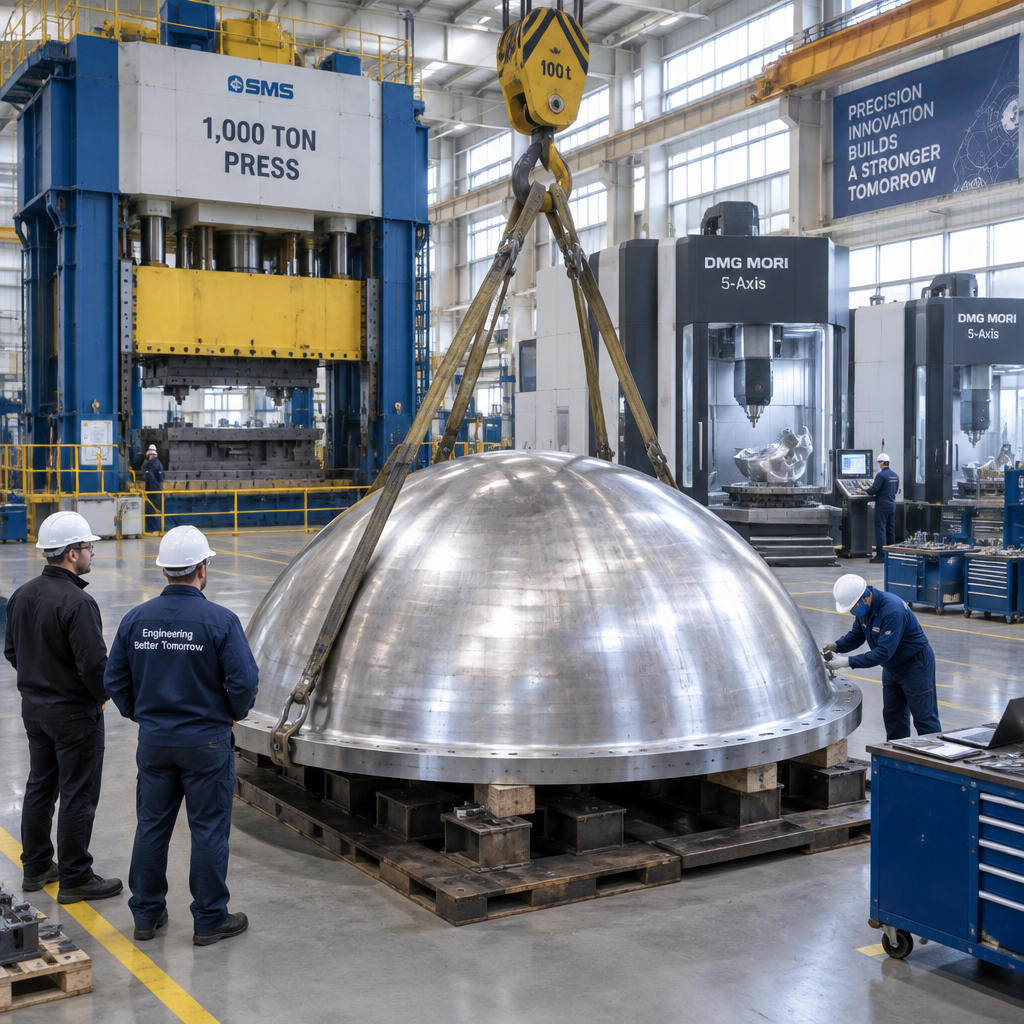
Janicki Industries says it completed the dome in approximately 10 months and attributes the speed to having large, specialized capability under one roof: five‑axis milling machines that can handle hemispheres, metrology equipment to verify dimensions, and a 1,000‑ton press to form double‑curved plate. The company also highlighted its history producing “sonar domes and precision machined hardware” for U.S. nuclear submarine programs and supporting high‑profile aerospace programs including the B‑21 Raider and F‑35 Joint Strike Fighter, per its website.
After the story’s initial publication, Janicki requested that an image of the dome be taken down while an additional review was conducted; TWZ honored that request and said it would repost the image if and when it is fully approved.
USS Connecticut: collision, transit, and PSNS‑IMF repairs
The Connecticut collided with an underwater seamount in the South China Sea in 2021. A heavily redacted Navy accident report indicated the bow had initially remained attached to some degree; the entire bow structure later separated as the submarine limped to Guam. The boat subsequently moved to San Diego and then to the Puget Sound Naval Shipyard & Intermediate Maintenance Facility (PSNS‑IMF) in Washington State, where it has remained while undergoing structural and systems restoration.
The Navy has repeatedly revised the repair schedule: an original goal pegged the return to service at September 2025; later updates set a target of summer 2027. A Navy official told TWZ in September, “The Navy’s target completion date for the availability is the summer of 2027. PSNS & IMF is dedicated to executing this work with the highest standards of safety, technical accuracy, and craftsmanship to ensure the ship returns to the fleet ready to take its place at the tip of the spear in defense of our nation’s interests.” If the current schedule holds, the Navy has also announced plans to retire Connecticut in 2031, leaving the boat with roughly four years of service after re‑entry.

This site is the portfolio.
OSINTSights runs on Cloudflare Workers, D1, R2, and Vectorize, with an AI pipeline on Hetzner ARM. Nubivance designed, built, and operates it. We do the same for clients.
See what we buildThe bow sonar dome — size, complexity, and congressional funding
The scale and tolerances for the Seawolf bow sonar system are substantial: the bow sonar array measures 24 feet in diameter, and the dome that must encase it has to meet precise specifications for the sonar to function. That complexity and the Seawolf program’s shrinkage drove early congressional attention to the cost of replacing the dome. In 2021 lawmakers approved $10 million specifically for the dome and $40 million for other “emergent repairs.”
In its Fiscal Year 2025 budget proposal, the Navy requested funds to procure one additional Seawolf‑class bow dome because the sustainment strategy originally did not include provisioning replacements. The budget documents stated the dome has a “three plus year lead time,” matching Janicki’s claim that the “next‑best option” would have taken roughly two more years than Janicki’s schedule.
Seawolf class constraints, planned retirement in 2031, and SSN(X) timing
The Seawolf program’s small size and out‑of‑production design compound repair challenges. The Navy originally planned 29 boats but acquired just three, raising unit costs; the source cites a unit price of just over $10 billion in 2025 dollars. The class remains highly capable and in demand for specialized tasks, which the article cites as a reason for continuing to invest in Connecticut’s return.
The Navy is pursuing a new class of nuclear attack submarines, currently called SSN(X). At the Naval Submarine League conference, Navy Rear Adm. Andrew Miller, head of the Undersea Warfare Division in the Office of the Chief of Naval Operations, said a “clean sheet design is required” to meet mid‑century high‑end threats and listed desired capabilities including higher speed, improved availability, decisive lethality, superior stealth, and organic robotic/autonomous systems hosting. The first SSN(X) boats are not expected to enter service until the mid‑2040s at the earliest. Meanwhile, the Navy will continue to build Virginia‑class variants — including stretched Block IV and V versions with Virginia Payload Modules reclassified as guided‑missile submarines (SSGN) and a one‑of‑a‑kind seabed warfare Virginia that could take over some roles of the USS Jimmy Carter.
What this means for PSNS & IMF, Janicki Industries, and Navy procurement
- PSNS & IMF: The shipyard remains the focal point for structural restoration and lifecycle maintenance, tasked with completing the availability by summer 2027 and returning Connecticut to operational status under strict technical and safety standards.
- Janicki Industries: The company’s rapid delivery — roughly 10 months — demonstrates a niche industrial capability that can compress what budget documents list as a three‑plus year lead time for domes, offering a potential short‑term mitigation to sustainment gaps for rare, out‑of‑production hull forms.
- Navy procurement and planners: The FY25 budget move to purchase a spare bow dome acknowledges the programmatic risk of long lead times and the operational value of having at least one replacement on hand for Seawolf‑class contingencies.
Connecticut’s new dome is a tangible piece of hardware that short‑circuited an otherwise multi‑year production lead time. Yet the submarine’s full recovery remains bound to a complex schedule of structural repairs, systems restoration, and lifecycle maintenance at PSNS & IMF. If the Navy’s summer 2027 target holds, Connecticut will rejoin the fleet for a relatively brief period before the retirement planned in 2031 — a compressed timeline that underlines why the service is also investing in future hulls and strategic spares now.