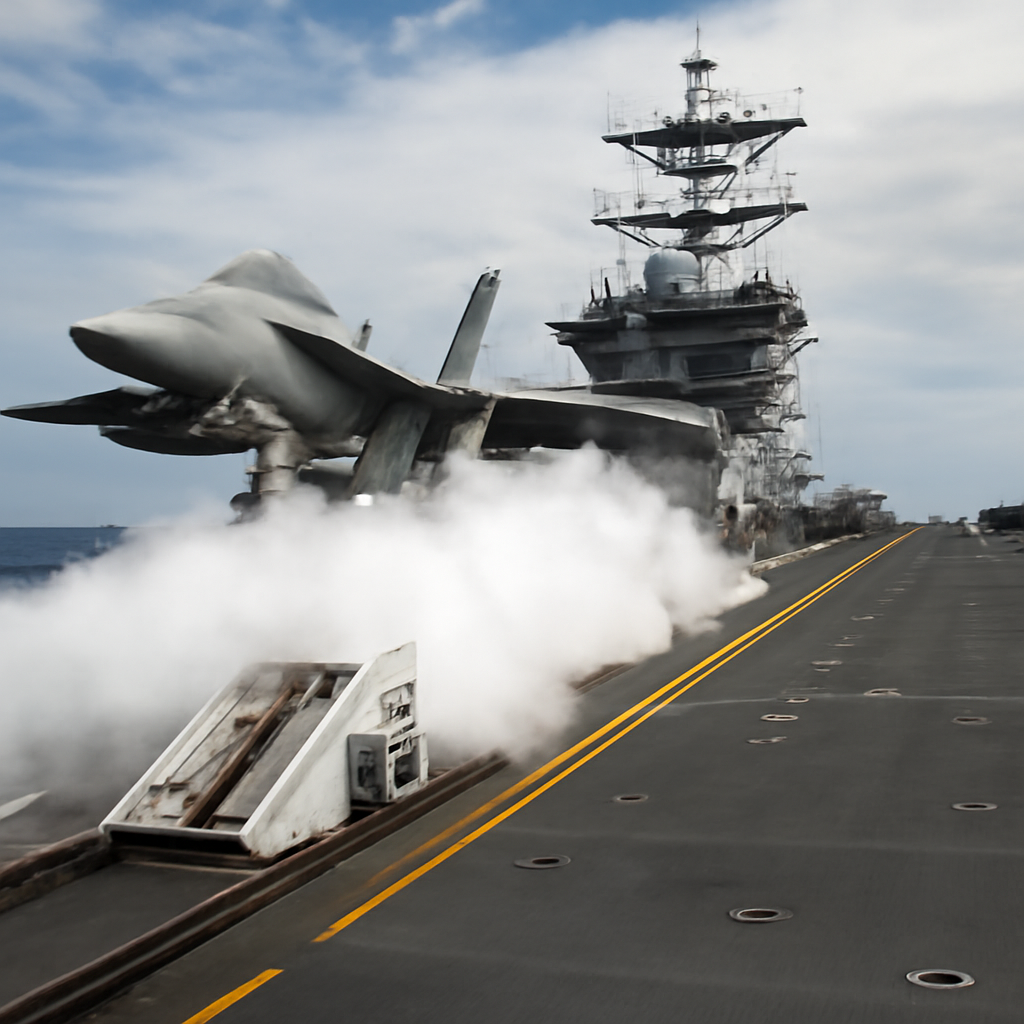
“Seriously, I’m putting out an order. I’m going to sign an executive order. When we build aircraft carriers, it’s steam for the catapults and it’s hydraulic for the elevators. We’ll never have a problem,” President Donald Trump said in October — and on Aug. 14, 2026 he signed a National Security Presidential Memorandum that does exactly that, ordering a return to steam catapults on Ford-class carriers and directing a plan for an additional public shipyard to handle submarine work, a White House official confirmed to Breaking Defense.
The National Security Presidential Memorandum: orders and immediate tasks
The memorandum signed today directs a set of concrete actions. It orders that Ford-class carriers such as the Doris Miller, being built at HII’s Newport News Shipbuilding, include traditional steam-powered catapults and the hydraulic elevator systems used on Nimitz-class ships. The USS Ford, the class lead, currently uses the Electromagnetic Aircraft Launch System (EMALS), which the memorandum effectively displaces for future ships in the class.
The memo also instructs Secretary of Defense Pete Hegseth to deliver a report to the president within 120 days. That report must propose measures to bolster submarine and carrier readiness using both private-sector capacity and an additional public shipyard. The memorandum specifies what the plan must address, including:
- sufficient drydock capacity to service planned growth of the fast attack submarine fleet over the next two decades;
- locations proximate to the United States Pacific Fleet, “including in the continental United States, Alaska, Hawaii, and the United States territories;”
- site options that “include up to three new drydocks designed and built to hold the ranges of every current and projected class of submarine;”
- innovative financing mechanisms such as public-private partnerships; and
- timelines and resourcing requirements.
Steam catapults, EMALS, and the redesign question
The president’s order returns to hardware last widely used more than two decades ago. That will carry design and industrial implications: Hudson Institute Center for Defense Concepts and Technology director Bryan Clark told Breaking Defense that Ford-class carriers rely on electricity rather than steam for a host of functions — “cooking, heating, and water purification,” in addition to powering the catapults and arresting gear — and that restoring steam lines “to at least the catapults will require extensive redesign of the ship.”
Clark also warned that the Navy has not purchased a steam catapult in more than 20 years, making supplier reconstitution a significant task: “it is unlikely the suppliers are able to build them without substantial up-front investment and time to establish the necessary production lines,” he said.

Audit-ready is a season. It shouldn't be.
Evidence in spreadsheets, controls drifting between audits, frameworks multiplying on flat headcount. Nubivance runs continuous compliance on Rapid7 Cyber GRC - SOC 2, HIPAA, ISO 27001, PCI, CMMC.
End the scrambleGeneral Atomics’ warning: cost, schedule and capability risks
General Atomics, the builder of EMALS, pushed back in a formal statement. The firm said that the Doris Miller is “With nearly 50% of production complete,” and that “changing course now would introduce significant cost, schedule, and integration risks.”
The company framed the decision’s effects beyond a single ship: “The decision will have broader implications for carrier readiness, national security, and U.S. technological superiority, potentially creating opportunities for adversaries to close the capability gap,” General Atomics said. It also tied the timing to industrial priorities: “It also comes at a time when strengthening the U.S. supplier industrial base is a national priority, making workforce stability, production capacity, and the ability to sustain critical technologies more important than ever.”
What this means for Adm. Daryl Caudle, private shipyards, and the OMB
- Navy leadership: Chief of Naval Operations Adm. Daryl Caudle told reporters in April the Navy had been examining the possibility of a fifth public shipyard, but warned that a new yard “is expensive, and so is that infrastructure worth it if I can’t get the workforce there?” The memorandum’s requirement for a detailed plan will force the Navy to confront those workforce, cost, and siting questions within Hegseth’s 120-day window.
- Private shipyards: The memorandum and administration debate do not remove private yards from the equation — the source notes private shipyards perform maintenance — but also emphasizes that the nation’s four public shipyards in Virginia, Maine, Washington, and Hawaii are “the ones that typically complete maintenance overhauls and modernization efforts for the Navy’s nuclear-powered aircraft carriers and submarines.”
- Office of Management and Budget / policymakers: OMB Director Russ Vought told the Washington Times’ IndoPac 2026 event in June the administration was “pushing hard for an additional public shipyard,” arguing capacity was needed “If we’re going to spend a one-and-a-half trillion dollars, or have the types of direct foreign investment that’s coming in, we want to make sure that we have the ability to have enough public shipyards to do maintenance.”
The immediate administrative next step is explicit: Secretary of Defense Pete Hegseth must submit a report within 120 days addressing drydock capacity, siting proximate to the Pacific Fleet, potential drydock designs, financing options, timelines, and resourcing. The industrial consequences are already being aired — General Atomics flagged a nearly half-complete ship and significant schedule and integration risks, while naval leadership has cautioned about workforce and cost constraints for a new public yard.
The Navy referred questions about the memo to the White House when Breaking Defense sought comment. The memorandum, the firms’ statements and the military’s internal questions together set a compressed clock for technical redesign work, industrial planning, and decisions that will reverberate through carrier construction and submarine maintenance policy over the coming months.