The global nuclear order has entered an unstable era since the expiry in February 2026 of the United States‑Russia “New START” arms limitations treaty.
Australia’s five-step bilateral blueprint with India
The proposal lays out five concrete steps for Australia to complement its long-standing multilateral non‑proliferation work with targeted bilateral diplomacy — especially with India. First, Australia should use its credibility within arms‑control circles to press the United States and China (but not Russia) to develop new measures for nuclear‑arsenal transparency, proliferation prevention and risk reduction, with those measures designed to remain effective as AI and other critical technologies evolve. Second, Canberra should press partner countries to focus on NPT agenda items already familiar to diplomats: transparency, crisis communications, non‑attack norms for nuclear facilities, and structured dialogue on how nuclear and non‑nuclear forces might interact in escalation scenarios.
Third, the paper recommends a rethink of the NPT Review Conference process — moving from five‑year all‑or‑nothing consensus packages to a rolling agenda that selects feasible, urgent items to advance in discrete, phased steps throughout each decade of a Review cycle. Fourth, Australia should promote the India–Pakistan example of a bilateral pact not to attack the other’s nuclear facilities and push all IAEA members to pledge adherence to a protocol disavowing attacks on nuclear plants during wars. Fifth, Canberra should press countries to adopt the IAEA Additional Protocol — an instrument Australia historically helped secure — and use its recent leverage to build momentum behind the protocol.
Why India matters: 2026 uranium deal and the July 2026 Joint Declaration
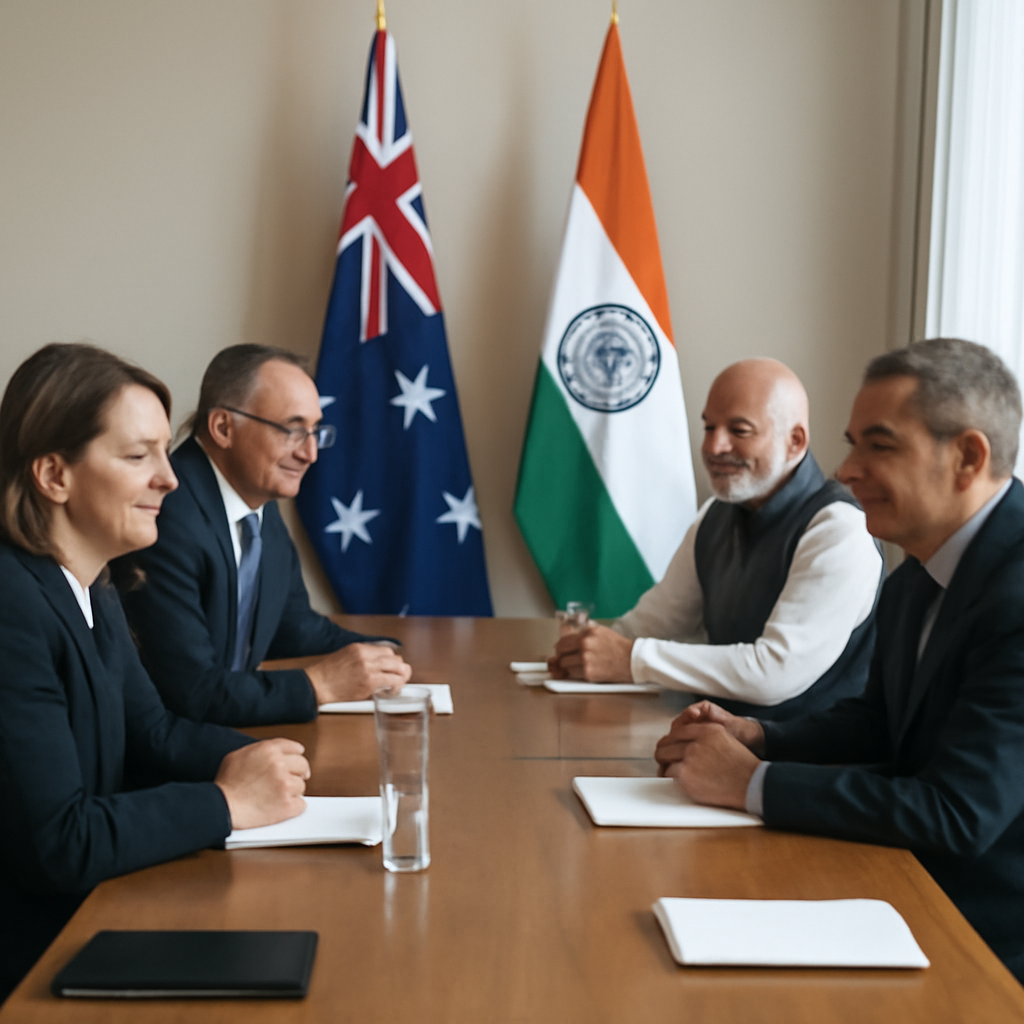
By virtue of its 2026 uranium supply agreement with India, Australia’s credibility in New Delhi is "at a high point." India is described as an active IAEA member, and its support could be influential in persuading other countries to adopt the Additional Protocol. The two countries co‑signed a July 2026 Joint Declaration on Defence and Security Cooperation that elevated their Comprehensive Strategic Partnership and acknowledged an acceleration of strategic convergence. That declaration, the paper notes, established a bilateral calendar of foreign, defence and economic security cabinet‑level discussions — a platform Canberra could use to pursue the bilateral nuclear diplomacy agenda.

Audit-ready is a season. It shouldn't be.
Evidence in spreadsheets, controls drifting between audits, frameworks multiplying on flat headcount. Nubivance runs continuous compliance on Rapid7 Cyber GRC - SOC 2, HIPAA, ISO 27001, PCI, CMMC.
End the scrambleTarget audience for new guardrails: the P‑5, China, and one other nuclear power
Australia and close partners are urged to focus on new guardrails for the nuclear weapons states, ideally involving the Permanent Five members of the UN Security Council (the P‑5) and at least one other nuclear‑armed country. The paper identifies India, Pakistan, North Korea and Israel as the other nuclear‑armed states, noting practical constraints: North Korea and Israel would be "near‑impossible to get to the starting blocks" and Pakistan is "highly unlikely to participate with India at the table." Against that landscape, India is singled out as the promising contender to bring into talks alongside the P‑5. The proposed measures should remain effective as AI and other critical technologies evolve.
IAEA protocols and the norm against attacking nuclear facilities
The author urges Canberra to highlight the India–Pakistan bilateral pact as a positive model and to lobby all IAEA member countries to support the agency’s efforts to secure a new protocol disavowing attacks on nuclear plants during wars. The paper contrasts that bilateral pact with Russia’s 2022 military attack on Ukraine’s Zaporizhzhia Nuclear Power Plant, described as the world’s first full‑scale military attack on an operational nuclear power facility. Alongside the disavowal protocol push, Australia is advised to double down on promoting the IAEA Additional Protocol — stressing that India, and UEA and other partners in India’s network, could help persuade others to adopt it. The piece also notes the strategic context created by a US‑Saudi bilateral nuclear sharing agreement and the United States’ apparent readiness to pursue similar arrangements, arguing these developments heighten the need to refocus attention on the Additional Protocol.
What this means for the IAEA, India, and the United States
- IAEA: The agency stands at the center of two linked campaigns the paper urges — a new protocol disavowing attacks on nuclear plants and wider adoption of the Additional Protocol — and will be the natural forum for multilateralizing any bilateral advances.
- India: With a 2026 uranium supply agreement with Australia, active IAEA membership and recent security declarations with Australia, India is cast as a persuasive bridge partner that could help rally other states to protocol adoption and norm building.
- United States: The paper frames U.S. engagement as essential for new transparency and risk‑reduction measures alongside China, and as contextually important given U.S. bilateral nuclear sharing activity with Saudi Arabia and the prospect of further such arrangements.
The argument is neither to abandon multilateral treaties nor to pursue bilateral ties as a substitute. Instead, the proposal urges Canberra to use its leverage with New Delhi and its standing in arms‑control circles to press for practical, phased steps — from guardrails for the P‑5 to hardening norms against attacks on nuclear plants and widening adoption of verification protocols. That combination, the paper concludes, is the clearest route Australia and India have to reshape nuclear diplomacy in an era the author describes as marked by expanded arsenals, declining transparency and weakening habits of negotiated restraint.