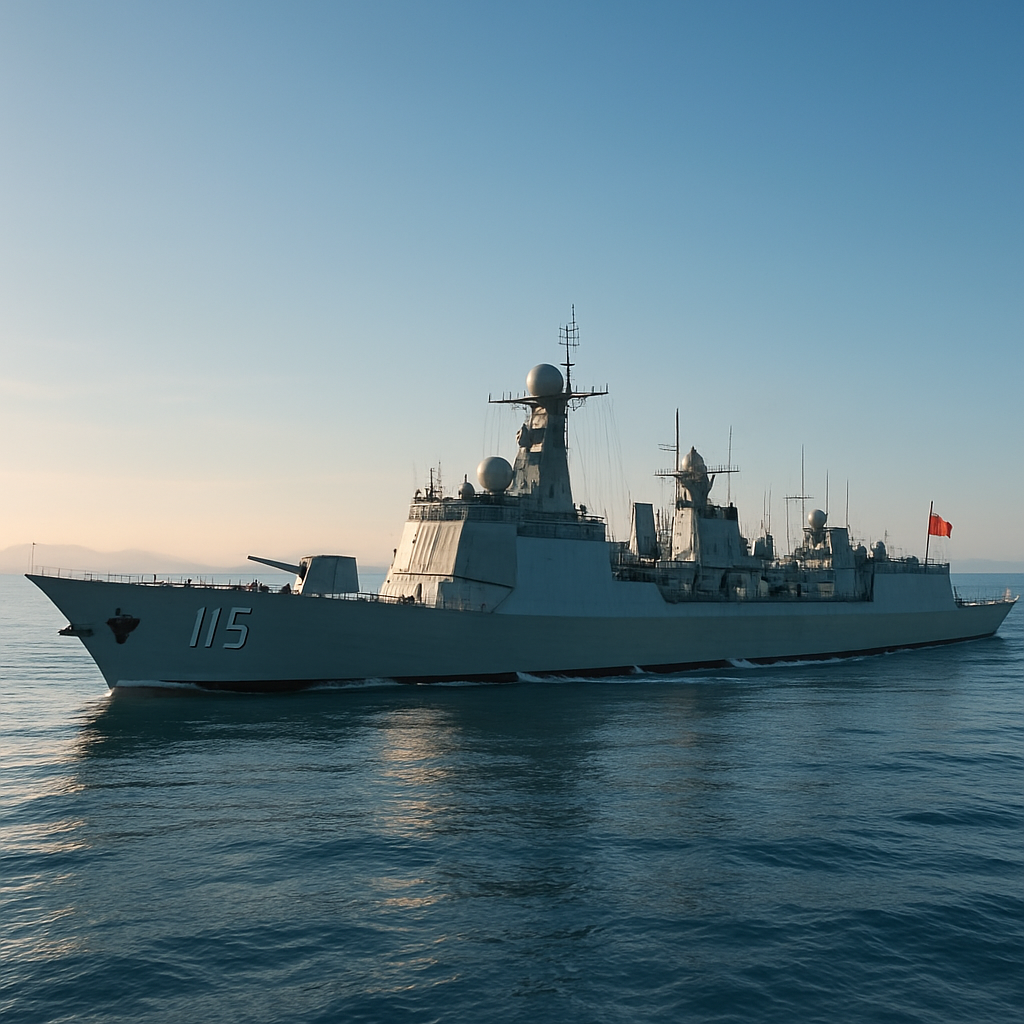
China’s 2025 live‑fire drills in the Tasman Sea — and the expectation they will be repeated elsewhere — mark a shift in how Beijing deploys force beyond its shores.
ASPI war game and the 2036 projection
Australian Strategic Policy Institute (ASPI) war gaming conducted in March — cited in the source material — underpins the forecast that China’s defence and security agencies could extend their influence through to 2036. That exercise informed the central claim: China’s appearances in seas and ports far from its coast are rising in frequency and are approaching a point where they will be seen as routine rather than episodic. The war game frames this development as a strategic trajectory, not an isolated series of events.
From episodic visits to a two‑ocean strategy
The source describes a deliberate transition from isolated appearances to a sustained footprint in the Indian and Pacific oceans. That transition is tied to a wider “two‑ocean strategy,” under which Chinese fleets operate in both the western Pacific and the Indian Oceans. The strategy gained “renewed relevance and momentum” after the Belt and Road Initiative began in 2013, and execution of the approach is now said to be more intensive. Part of the stated aim is to dilute United States influence across those oceans.

The cyber insurance questionnaire just landed. Now what?
SOC 2, HIPAA, insurance renewals - someone has to own security strategy. Nubivance provides fractional CISO leadership without the full-time salary.
Get a security leadNaval rest‑and‑rec‑and the Heping Fangzhou (Peace Ark)
The reporting highlights that what begin as rest and recreation (R&R) port visits could evolve into regular rotational presences: ships arriving for resupply and, in some cases, conducting surveillance and intelligence missions. Medical diplomacy missions — notably by the hospital ship Heping Fangzhou (Peace Ark) — are singled out as vehicles that could “lead to greater strategic benefits,” deepening Chinese presence particularly among smaller and weaker states in the Indian and Pacific oceans.
Dongdiao‑class “research” ships and persistent surveillance
The source warns that vessels described by Beijing as research ships may in fact be surveillance and intelligence platforms. Dongdiao‑class ships are specifically named and characterised as being “equipped with advanced radar and intelligence collection equipment.” Such ships have already been used to monitor Indian rocket and missile launches and have probably been mapping ocean topography to support submarine operations. The material also warns these vessels are likely to increasingly monitor foreign military activities and multinational exercises such as Talisman Sabre, the multinational drill led by Australia and the United States.
Dual‑use ports, the China Coast Guard, and legal expansion
The source projects several complementary trends that would expand China’s reach. Commercial ports and dual‑use logistics facilities could be upgraded from purely civilian functions to support naval and intelligence activities, with many more such facilities expected to appear over the next ten years. In parallel, the China Coast Guard is forecast to play a larger role in Beijing’s maritime strategy, potentially conducting extraterritorial law enforcement patrols across the Indian and Pacific oceans. The source also notes that China’s 2021 Coast Guard Law is “already contrary to international law,” presenting that law as an indicator of how the service might act further afield and suggesting Beijing could devise new legal justifications for interventions in other states’ territorial waters.
What this means for Australia, India, and smaller and weaker Indo‑Pacific states
- Australia: The source implies Australia should anticipate more frequent Chinese naval activity in its approaches and in nearby waters, and to plan diplomatic and security responses before such activity becomes routine.
- India: The source records China’s pattern of monitoring Indian rocket and missile launches and warns that surveillance activity and naval presence in the Indian Ocean will likely expand, suggesting India will need to factor persistent Chinese collection into its defence planning.
- Smaller and weaker states in the Indian and Pacific oceans: The source highlights that medical diplomacy and port visits can deepen Chinese presence in these states, implying they may face increased pressure and opportunities that carry strategic trade‑offs.
The source’s central admonition is unambiguous: these manoeuvres should be called out now, before they become normalised. It argues that greater regional security diplomacy can both highlight the emerging danger and provide cooperative means to counter or deter excessive coercion. If diplomacy fails, the reporting suggests, those diplomatic networks could become the foundation for stronger regional defence efforts. The choice, as framed here, is whether normalisation is allowed to proceed quietly — or whether Australia and its partners will put the pattern of increasing presence and dual‑use expansion squarely on the agenda.
https://www.aspistrategist.org.au/warning-signs-how-china-normalises-its-presence/