[SPONSOREDNUBIVANCE]
Know a small business winging it on security?
No IT department, no security budget, real exposure. Nubivance builds right-sized security foundations for small companies. Send them this.
Send it alongCybersecurity intelligence, threat analysis, and national security reporting.

The Air Force is seeking extra funds to repair or replace aircraft lost in recent conflicts, including dozens damaged or destroyed since Operation Epic Fury began in late February. This supplemental funding will help boost the number of fighter jets, bombers, and tankers in its fleet.

Defense Secretary Pete Hegseth told the Senate Armed Services Committee that the floodgates are about to open, promising a surge in defense contracts as a massive $152 billion in funding is set to be unleashed, with only $26 billion allocated so far. The pending contracts are expected to prioritize key initiatives, including munitions, nuclear modernization, and new ships.

The FCC is cracking down on telecom companies that aren't doing enough to stop robocalling and cyber threats, with Chair Brendan Carr slamming those who do the bare minimum to verify callers as complicit in illegal schemes. New rules aim to tighten verification and supply-chain security to protect US phone networks.

The US Air Force is set to retire its E-11A communications jets by 2028, ending the service life of a fleet that has played a vital role in relaying communications between aerial platforms and ground forces, particularly in challenging terrain. The E-11A's robust communications gateway has enabled seamless data exchange across multiple waveforms, supporting operations in the Persian Gulf, Central and South America, and beyond.

When China's foreign minister declared Taiwan an inalienable part of China's territory, his words went viral - spreading like wildfire across state media, diplomatic dispatches, and online campaigns. Since Japan's Prime Minister Sanae Takaichi took a firmer stance on Taiwan, Beijing has stepped up its disinformation game, distorting her words and making bold claims about Okinawa.

The 60-day mark for US military operations in Iran has been reached, sparking a heated debate over whether the administration will seek congressional approval to continue its actions. Lawmakers, including Sen. Tim Kaine, are pressing for clarity on the matter, citing the War Powers Resolution as the basis for their concerns.

As the Iran conflict escalates, costing a staggering $25 billion and counting, Ayatollah Mojtaba Khamenei unleashed a chilling warning: Americans don't belong in the Persian Gulf, except at the bottom of its waters. With the War Powers deadline looming, Trump faces a critical 60-day mark that could force him to withdraw troops or seek Congressional approval.

Beware of AI browser extensions that promise to boost productivity but secretly steal your data. Researchers uncovered 18 malicious extensions that masquerade as helpful tools but deliver spyware, Trojans, and other threats that can hijack your online activity.
No IT department, no security budget, real exposure. Nubivance builds right-sized security foundations for small companies. Send them this.
Send it along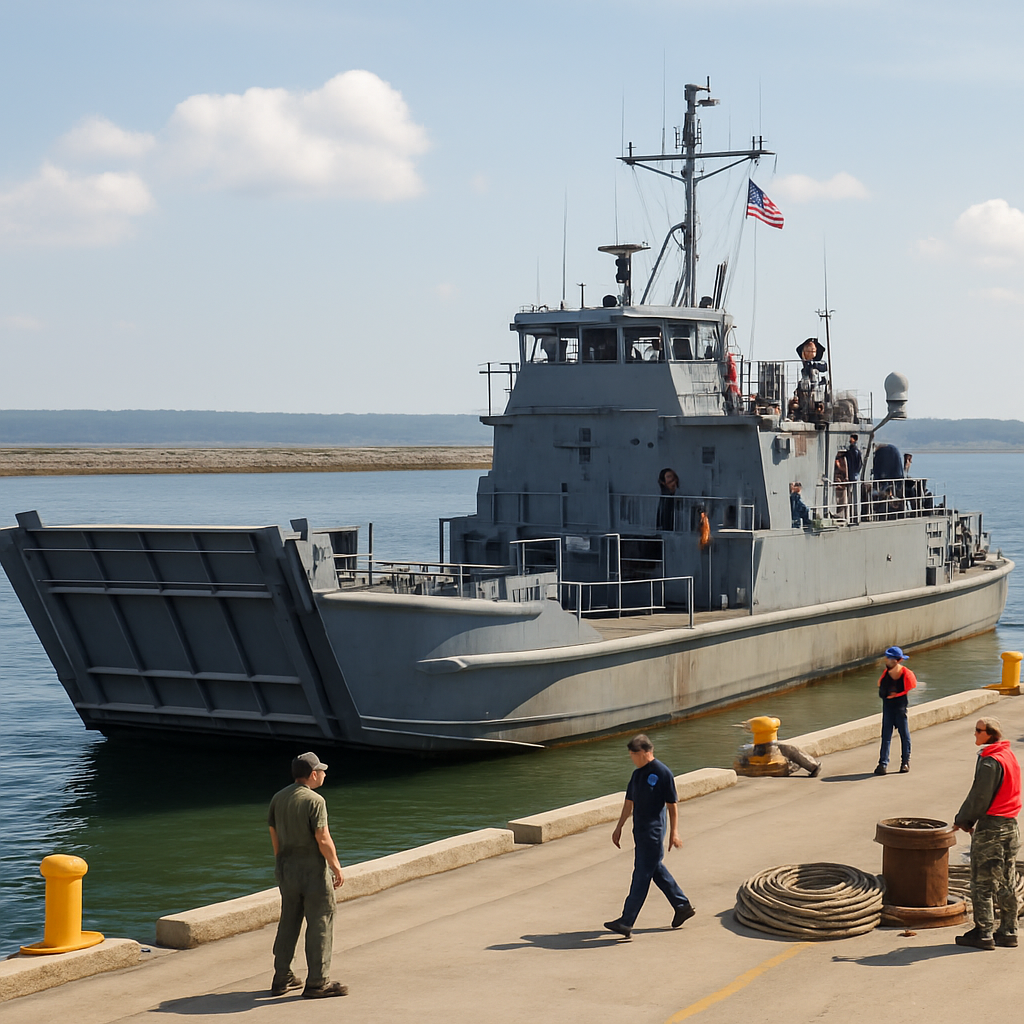
The US Navy and Marine Corps are shaking up their amphibious vessel deployment strategy to boost efficiency, with Adm. Daryl Caudle aiming to overhaul the current 36-month cycle to get more bang for their buck. By streamlining their approach, they may be able to fit in two deployments within a longer 50-month cycle.

Two former cybersecurity pros, Ryan Clifford Goldberg and Kevin Tyler Martin, have been sentenced to four years in prison for using their specialized knowledge to orchestrate a string of devastating ransomware attacks, extorting victims instead of protecting them. The pair, who once worked in incident response, now face the consequences of their crimes.

The US Marine Corps is facing a pressing challenge: a significant shortage of amphibious ships to meet the demands of combatant commanders. Every commander, from Central to Africa and Southern Commands, is requesting an amphibious ready group with a Marine Expeditionary Unit - a number that far exceeds the Corps' current capacity of three.

As China's influence grows in the Indo-Pacific, regional states face a daunting dilemma: balancing economic opportunities with sovereignty and security concerns, making it increasingly likely they'll hedge their bets rather than fully commit to either side. This strategic tightrope walk will be especially challenging for Pacific island countries under strain from China's more aggressive pursuit of port access and maritime influence.

Malicious actors struck SAP's JavaScript and cloud application development ecosystem on April 29, releasing poisoned versions of four widely-used npm packages that receive a staggering 572,000 weekly downloads. The compromised packages, which included mbt, @cap-js/db-service, @cap-js/postgres, and @cap-js/sqlite, were published in a brief window of just two hours.

With the record 75-day shutdown finally over, the Cybersecurity and Infrastructure Security Agency can breathe a sigh of relief as a new funding deal brings its operations back to normal, bolstering the nation's cyber defenses. The bipartisan measure provides a much-needed $64.4 billion in discretionary funding for the Department of Homeland Security.

State CISOs are losing faith in their ability to protect sensitive data, with confidence plummeting to just 22% - a drastic drop from 48% in 2022 - as AI-driven threats intensify. This sharp decline in confidence extends beyond state governments, with 63% of CISOs also doubting the ability of local governments and public higher education institutions to safeguard public data.

Get ready for a déjà vu: US Cyber Command warns that foreign interference is likely to disrupt the midterm elections, just like we've seen in the past. Army Gen. Joshua Rudd's warning to the Senate Armed Services Committee is a stark reminder that countries like Russia, China, and Iran are actively trying to undermine our democracy.
Full-platform Rapid7 rollouts - InsightVM, InsightIDR, event sources, agents, tuning - by a Registered Partner who has done it at state-agency scale, including OT/SCADA.
Talk deployment
The modern workforce has a new equation: humans and AI agents working together, facing the same dynamic threats and risks. This emerging reality demands a fresh approach to security, one that recalibrates risk and rethinks trust in a blended workforce.

Socket is supercharging its supply-chain visibility with the acquisition of Secure Annex, a cutting-edge extension security startup, to give developers unprecedented control across the entire software development life cycle. This strategic move combines Socket's expertise in application dependencies with Secure Annex's innovative approach to browser and IDE extensions.

Hospitals are under attack - literally. Last year, a staggering 460 ransomware attacks hit American hospitals and healthcare systems, causing 47 patient deaths, diverted ambulances, and canceled surgeries.

Phishing campaigns are getting smarter by the minute, with a whopping 86% of recent attempts leveraging AI to sneak past detection. This marks a significant jump from just two years ago, when AI was used in 80% of phishing ops.

In a major breakthrough, the US has extradited a 34-year-old Chinese hacker, Xu Zewei, who allegedly carried out cyber intrusions under the direction of China's Ministry of State Security, showing that distance and state protection no longer guarantee immunity from consequences. This move sends a strong message that cybercrime will be pursued globally, no matter where the perpetrators are hiding.

The FBI has struck a major blow against China's notorious hacker-for-hire ecosystem, disrupting a vast network of private tech companies and contractors secretly working for the Chinese government. This bold move exposes a brazen operation that prioritized profit by exploiting vulnerable computers and selling sensitive information to the highest bidder.

Meet Bluekit, a cutting-edge phishing kit that's revolutionizing the game with an AI Assistant panel, pairing traditional templates with advanced AI models to help cybercriminals quickly draft campaign materials. This innovative tool is streamlining attacks, making it easier for malicious actors to launch sophisticated phishing campaigns.

North Korea's hackers have pulled off a staggering 76% of all cryptocurrency losses in the first four months of the year, with just two massive attacks on Drift Protocol and KelpDAO accounting for the bulk of the damage. This marks a sharp escalation in Pyongyang's crypto crime spree, which has grown from under 10% of losses in 2020 to a dominant force in the market.