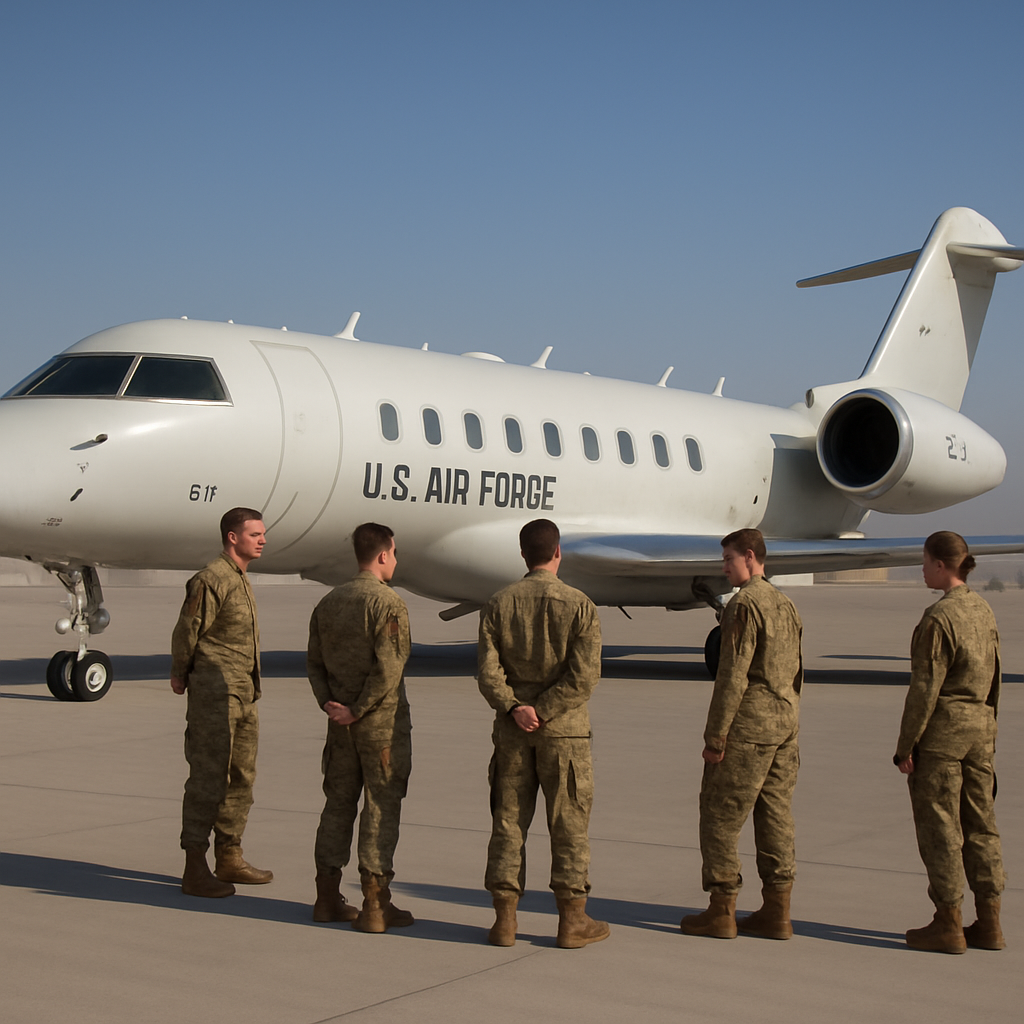
The U.S. Air Force plans to fully retire its fleet of E-11A Battlefield Airborne Communications Node (BACN) aircraft in Fiscal Year 2028, according to the service’s Fiscal Year 2027 Posture Statement.
E-11A BACN: capability and operational history
The BACN payload is described as “an extremely robust communications gateway” that can rapidly send and receive data across multiple waveforms and act as a translator between disparate radios and data-sharing systems. The E-11A has been used to relay communications between aerial platforms and forces on land and at sea, and has been especially valuable in Afghanistan’s mountainous terrain where line-of-sight limits conventional links. The fleet has supported operations across the Persian Gulf region, Central and South America, and was reported as active in combat operations as recently as Operation Epic Fury against Iran and the operation known as Absolute Resolve.
The fleet has been based on business-jet platforms: the three oldest E-11As use Bombardier BD-700/Global 6000 airframes, while newer examples use the Global 6500. The BACN mission has been concentrated in units such as the 430th Expeditionary Electronic Combat Squadron, which hosted additional E-11As in the Middle East and has accumulated high mission counts over the years.
Official decision: Posture Statement and the divestment
The Air Force’s Posture Statement for Fiscal Year 2027, signed by the Secretary of the Air Force Troy Meink, Air Force Chief of Staff Gen. Kenneth S. Wilsbach, and Space Force Chief of Space Operations Gen. B. Chance Saltzman, states the E-11A “will be fully divested” in FY2028. The announcement was distributed publicly and highlighted in a slide shared during the House Appropriations opening statement and amplified on social media by defense reporters.

This site is the portfolio.
OSINTSights runs on Cloudflare Workers, D1, R2, and Vectorize, with an AI pipeline on Hetzner ARM. Nubivance designed, built, and operates it. We do the same for clients.
See what we buildReasons cited: survivability, cost, and a shift to space
The posture statement frames the divestment as part of “a generational shift away from legacy systems” toward next‑generation capabilities in air and space and continued investment in the DAF Battle Network. Practical drivers cited in reporting include the E-11A’s lack of low-observability, which forces it to operate from standoff distances when facing peer or near-peer threats, and the vulnerability of high-value airborne nodes to very long-range anti-air missiles. The Air Force also points to the high logistics, maintenance, training, and cost burden associated with a high-demand, low-density platform.
That shift mirrors other moves in the force: the service previously retired the E-8C Joint STARS without a direct airborne replacement and is transferring ground moving-target indicator (GMTI) responsibilities to a distributed network of space-based sensors.
Bridging BACN’s functions: Hybrid SATCOM, DAF Battle Network, and podded options
In the short term, the service says BACN capabilities will be bridged by the Hybrid SATCOM Terminal program. A 2024 Northrop Grumman demonstration used commercial space Internet providers to establish a resilient multi-orbit, multi-constellation network. The Posture Statement also emphasizes the DAF Battle Network as “a key capability to fuse sensor data and remain resilient against all adversaries,” and describes it as an integrated system-of-systems connecting sensors, effectors and logistics.
Another possible avenue is aircraft-mounted, podded BACN-like solutions. The Smart Node Pod from Northrop Grumman is cited as an example and was described as already in production. The posture statement and reporting note uncertainty around the pace and completeness of the transition—specifically whether required terminals are already installed on aircraft, ships, and ground units and whether successor systems will be able to translate Link 16 and other waveforms.
What this means for the 430th Expeditionary Electronic Combat Squadron, ground forces, and Northrop Grumman
- 430th Expeditionary Electronic Combat Squadron: The squadron, which has flown E-11As from bases such as Prince Sultan Air Base and supported high-tempo forward deployments, will see a mission and force-structure change as its BACN airframes are divested by FY2028.
- Ground forces operating in terrain-limited communications environments: Units that benefited from BACN’s line-of-sight bridging, particularly in mountainous regions, will need replacements for localized connectivity given that BACN’s effectiveness declines with greater standoff distance from the battlespace.
- Northrop Grumman and industry partners: Vendors already demonstrating Hybrid SATCOM solutions and producing podded systems such as the Smart Node Pod are positioned to supply bridge technologies; the company’s 2024 demonstration using commercial space Internet providers is cited as an interim model.
The Air Force is explicit in its intent: retire a niche, high-cost airborne gateway and attempt to migrate its functions into space and distributed networks. But the record in the posture statement and reporting underscores an abbreviated timeline and technical uncertainties—terminals, waveform translation, and the operational reach of space-based replacements remain open questions as FY2028 approaches.
Source: The War Zone — Air Force Wants To Axe Its E-11A BACN Communications Jets