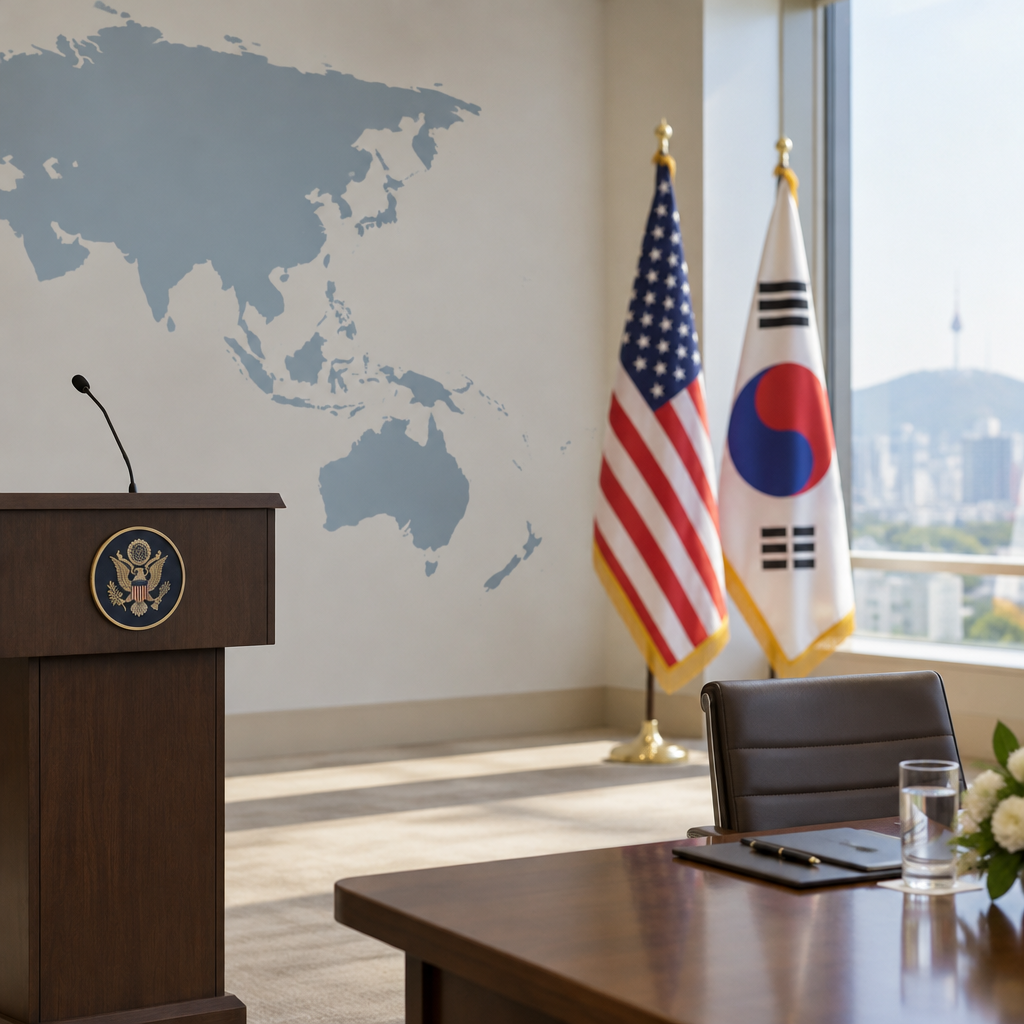
"'freezing', not dismantling, its nuclear weapons program," said both President Donald Trump and South Korean President Lee Jae‑myung, a phrase that signals a substantive shift in how the major actors are framing Pyongyang's arsenal.
What President Donald Trump is reportedly seeking
The prospect of a meeting between President Donald Trump and North Korean leader Kim Jong‑un — possibly timed around the Asia‑Pacific Economic Cooperation summit in China on 19 November — has reopened debate about U.S. strategy toward Pyongyang. The source material frames the central policy shift away from verifiable denuclearisation toward managing the nuclear threat that North Korea represents.
Politically constrained by an incoming Democratic‑controlled Congress and with no verifiable denuclearisation achievement in Iran or new arms‑limitation talks with Russia since New START, Trump has limited tools and a narrow window to pursue his long‑held aim to address nuclear risks. The source cautions that any move toward easing sanctions must be conditioned on concrete assurances and verification from North Korea.
A staged agenda for threat management at a summit
The recommended sequence for any summit purposefully pivots from grand bargains to stepped, verifiable risk reduction. The source places nuclear transparency first: North Korea should confirm the status of its arsenal and accept transparency measures, including site visits by a U.S. expert or a trusted foreign intermediary — even if the IAEA is not immediately involved.
Only after initial transparency would negotiators move to risk‑reduction measures such as hotlines and other confidence‑building steps involving the U.S.–South Korea joint command. Next would come assurances about the stability and security of nuclear weapons sites, with the possibility of later IAEA verification. Finally, the United States could seek a formal North Korean pledge not to undertake further nuclear testing — noting that North Korea last tested in 2017 and that the United States has not tested for more than 30 years.

This site is the portfolio.
OSINTSights runs on Cloudflare Workers, D1, R2, and Vectorize, with an AI pipeline on Hetzner ARM. Nubivance designed, built, and operates it. We do the same for clients.
See what we buildVerification, sanctions relief, and the danger of a trophy photo
The source stresses a nonnegotiable sequencing: sanctions relief should not be discussed or offered until Pyongyang provides a set of assurances and allows verification. It warns that a hasty summit focused on optics — "a trophy photo" — without meaningful, verifiable outcomes would likely undermine future progress and reward North Korea with enhanced recognition by a major power.
Past precedent is invoked: the three 2018–19 Trump–Kim summits produced photo opportunities but no substantive outcomes, and the aborted 2019 Hanoi summit collapsed over precisely the quid pro quo of denuclearisation versus sanctions relief. The source argues that repeating that pattern would embolden Pyongyang and harm global non‑proliferation efforts.
Regional context: South Korea, China and Russia
South Korea and China, the source says, are shifting public language. Both President Donald Trump and South Korean President Lee Jae‑myung have publicly referenced North Korea’s substantial nuclear holdings and used the term "freezing" rather than dismantling. China’s standing policy of denuclearisation of the Korean Peninsula, the source reports, has been "watered down" in publicly available documents. By contrast, Russia is described as "actively aiding and abetting" Kim’s nuclear weapons program.
Those dynamics matter because they reshape incentives for Pyongyang and the leverage the United States can bring to bear if it seeks verification and risk‑reduction measures that require regional cooperation.
What this means for the United States, South Korea, and North Korea
- The United States: Must insist that sanctions relief is off the table until Pyongyang accepts transparency, allows site visits, and agrees to verifiable risk‑reduction measures; otherwise, a photograph risks legitimising North Korea without constraining its arsenal.
- South Korea: Having publicly shifted toward the idea of "freezing," Seoul will be a key participant in any joint command‑linked confidence building and should expect to be involved in operational risk‑reduction measures such as hotlines.
- North Korea: If Kim responds to U.S. demands for transparency and verification, the path opens incrementally — from site access to eventual IAEA verification and a pledge not to test. If Pyongyang does not provide such signals, the source suggests stalemate will persist and the strategic status quo will remain unchanged.
The source leaves a stark final point: whether President Trump and Kim meet, or Washington tacitly recognises North Korea’s nuclear status, the central task has shifted to managing Pyongyang’s nuclear threats rather than pursuing an immediate, all‑or‑nothing denuclearisation. The essential question it leaves for leaders in Washington, Seoul and Beijing is concrete: will any summit be structured to demand transparency and verification first, or will it repeat a pattern of recognition without constraint?
https://www.aspistrategist.org.au/how-a-trump-kim-summit-should-address-the-nuclear-issue/