"Protecting both individual warfighters and the force as a whole requires protecting both the information drawn from the human body and human authority over how it is used," writes Dr. Elise G. Annett, framing a debate the Pentagon can no longer ignore.
How biodata reshapes command decisions
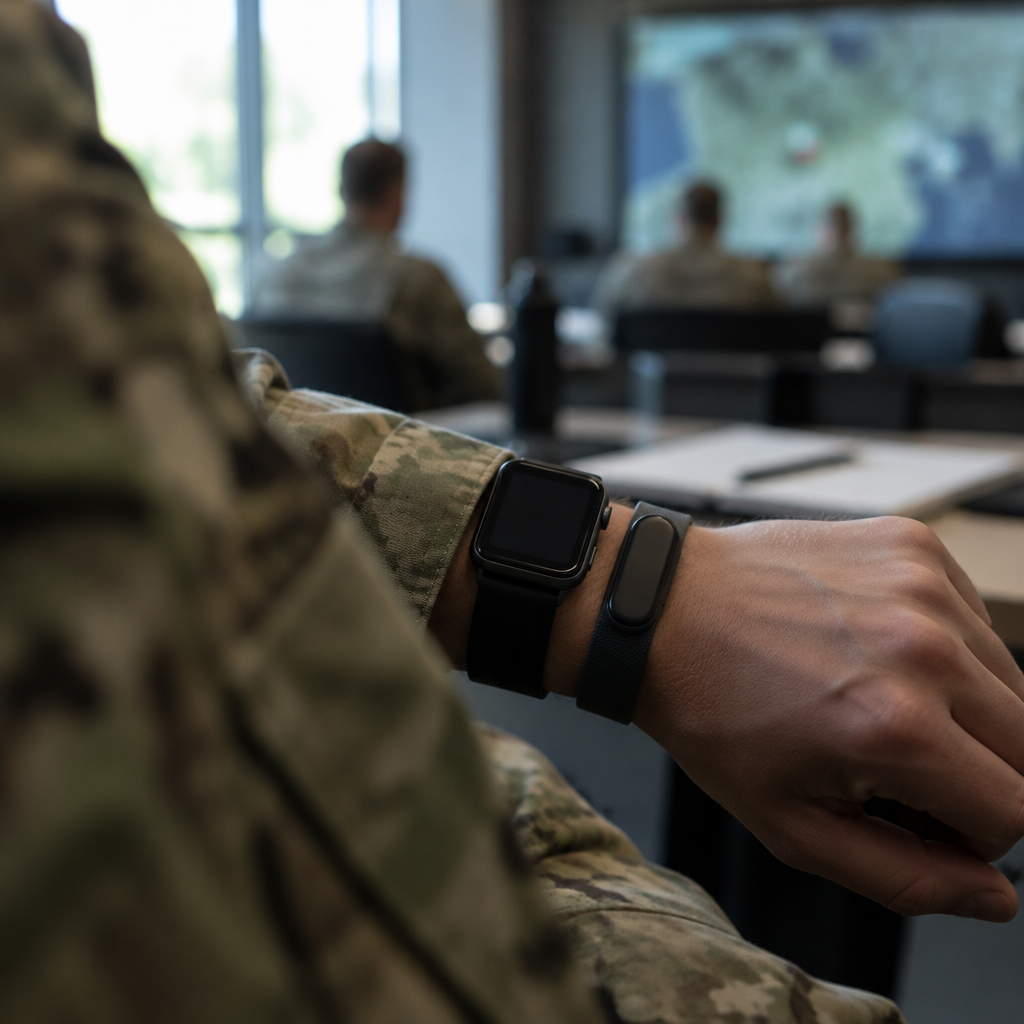
Emerging sensors and AI can produce continuous measures—heart rate and variability, sleep and recovery metrics, body temperature, blood chemistry, biomarkers of injury or infection, and movement and activity patterns—that turn personal physiology into operational signals. Dr. Annett argues that when inferences drawn from those data begin to influence where, when and how people or formations are employed, medical information becomes command information. That shift raises a core distinction the author presses repeatedly: a sensor measures, an AI interprets, and a commander decides. Each function carries a different standard of reliability and responsibility.
Security risks: theft, manipulation, and emissions control
The essay warns that biodata is not merely sensitive on an individual level. Over time, aggregated physiological and behavioral records can map who trains together, recovery cycles, time spent at facilities and when readiness fades—information an adversary could exploit. The piece cites a concrete precedent: in 2018 the Department of Defense restricted geolocation capabilities in designated operational areas after recognizing that fitness trackers could reveal location, routines and force concentrations. Beyond theft, an adversary might manipulate biodata to make a capable formation appear unfit or to portray exhausted forces as ready, risks that could "gaslight commanders" into harmful choices.

Audit-ready is a season. It shouldn't be.
Evidence in spreadsheets, controls drifting between audits, frameworks multiplying on flat headcount. Nubivance runs continuous compliance on Rapid7 Cyber GRC - SOC 2, HIPAA, ISO 27001, PCI, CMMC.
End the scrambleSeparating clinical access from command use
Annett calls for designed distinctions, not ad hoc fixes, between who can see identifiable clinical records and who can receive operationally bounded summaries. Medical personnel may need personally identifiable data for diagnosis; commanders should receive only mission-relevant assessments—such as confined indicators of fatigue or illness—without full medical histories. The author stresses that dashboards and scores must indicate whether an assessment reflects a direct measurement, a deviation from an individual baseline, a population-based inference, or an AI-generated prediction, and whether the underlying model has been validated for the mission.
Recommendations for a secure biodata architecture
The essay lays out six concrete requirements for systems that incorporate biodata into military practice. First, collection and emissions control must be explicit command decisions with mission-specific rules and documented risk assessments. Second, safeguards must protect both individual privacy and operational security across the entire data life cycle. Third, clinical access must be separated from command use through role-based access levels. Fourth, outputs must distinguish baselines from population norms, direct observations from predictions, and validated results from uncertain inferences, with procedures for challenging and overriding scores. Fifth, accountability must be assigned before adoption so responsibility remains traceable to identifiable humans. Sixth, the force must train for denial, deception and manipulation of biodata in wargames and exercises.
What this means for commanders, medical personnel, and adversaries
- Commanders: must make explicit, mission-specific decisions about whether devices operate in an environment, who may authorize exceptions, and how to interpret bounded readiness summaries versus full clinical data.
- Medical personnel: should retain authority over clinical determinations and be able to access identifiable records for diagnosis, while supporting anonymized, operationally relevant reporting for commanders.
- Adversaries: could gain operational advantage by stealing, correlating, or manipulating biodata; the military must therefore secure data end-to-end and simulate deceptive scenarios to build judgment.
Dr. Elise G. Annett, the author of the essay, is identified as a Research Fellow in the Program for Disruptive Technology and Future Warfare at the Institute for National Strategic Studies, National Defense University, and a Senior Digital Domain Fellow at the Center for the Application of Grand Strategy. She cautions that AI can illuminate patterns but cannot settle questions of cohesion or necessity; humans must be held accountable for decisions, and policy should prevent "automation bias" and "metric fixation."
The practical prescription is straightforward and exacting: design permissions into devices; secure sensors, pathways and storage; separate clinical and command authorities; label model outputs with their provenance and uncertainty; assign named human accountability; and rehearse denial and deception. If those pieces are not in place, biodata's operational utility will carry acute operational risk. As Annett notes, governance may ultimately rest with the Pentagon—and "in the last resort, Congress"—to ensure that sensitive physiological information strengthens, rather than undermines, force protection and leadership.
https://breakingdefense.com/2026/11/biodata-ai-and-the-future-of-command-getting-it-right/