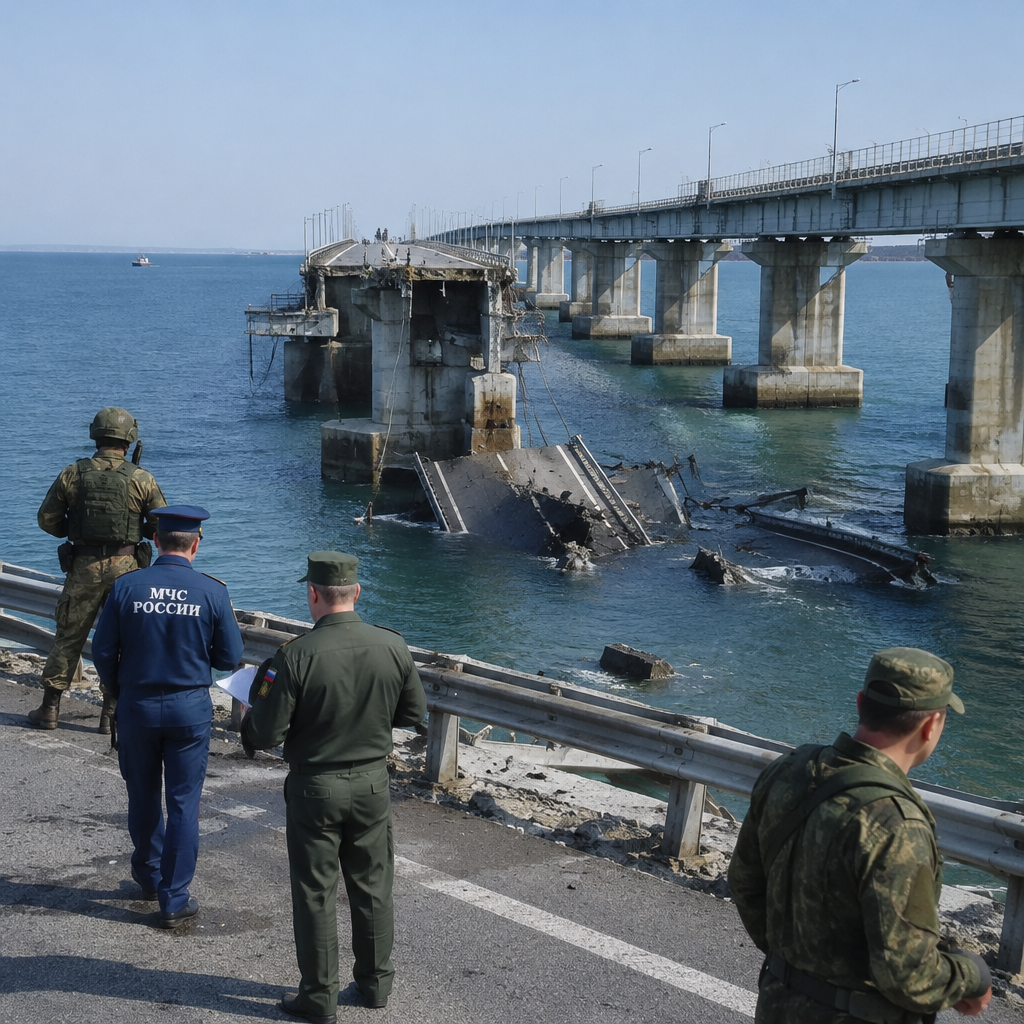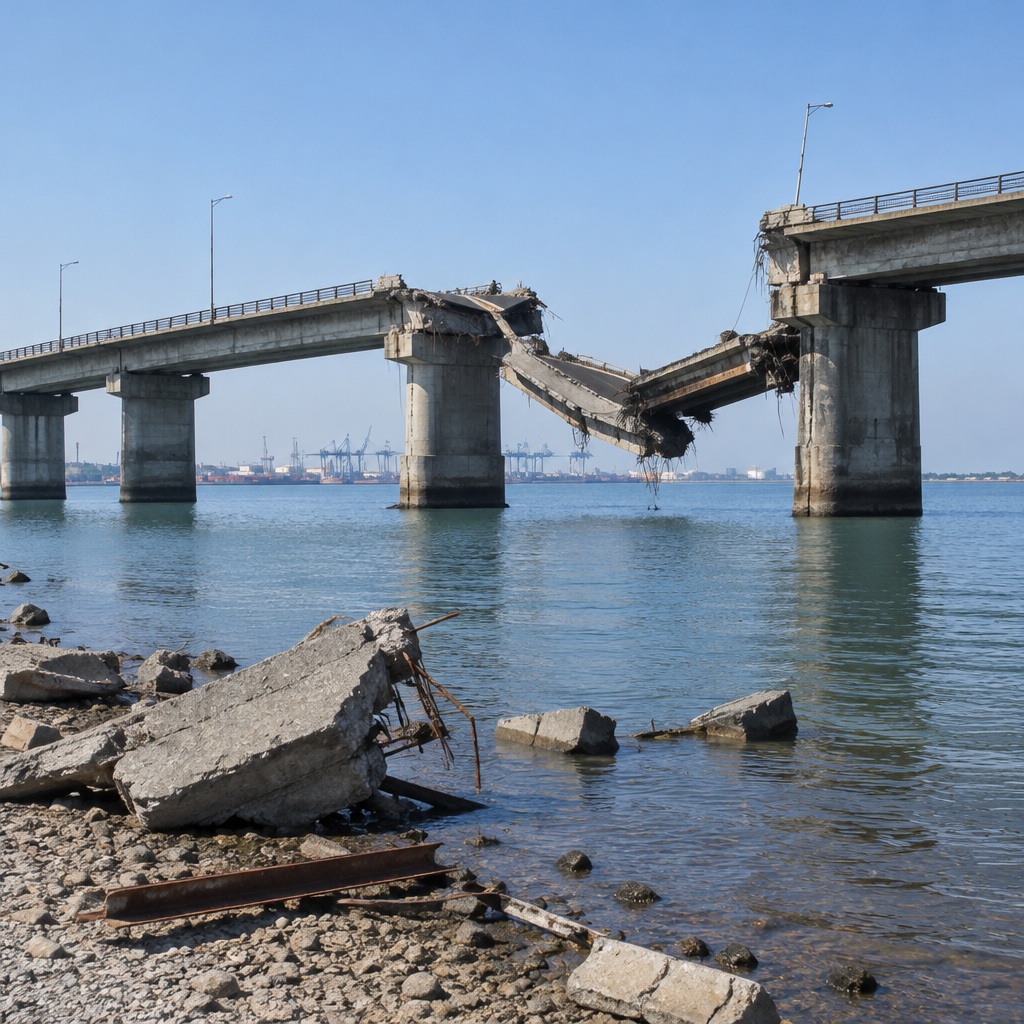
"Last night’s strikes damaged the bridge’s upper load-bearing structure. Today, seven Ruta missiles hit the bridge, causing one span to collapse," wrote Destinus on LinkedIn after the November strikes.
President Volodymyr Zelensky, the SBU, and a seven-stage operation
Ukraine’s government described the Kerch Bridge attack as a coordinated, multi-week effort planned by the Security Service (SBU) and the General Staff and announced by President Volodymyr Zelensky. Zelensky said the operation unfolded over seven stages and systematically targeted Russian air defenses, radars, electronic warfare systems and other installations before the final assault on the bridge itself. The final phase took place overnight on November 16–17, 2026, and involved a mix of long‑range strike drones, cruise missiles, and shorter‑range drones.
Ruta, FP‑5 Flamingo, and R‑360 Neptune: missile strikes on the rail and road spans
The operation combined multiple cruise‑type weapons against different structural elements of the bridge. Destinus — the European company that manufactures Ruta — said Ruta missiles struck the railway section over two consecutive days, and explicitly stated that seven Ruta missiles hit the bridge on the second day, causing a span to collapse. Ruta Block 1, the baseline version described by its maker, is intended for precision strikes at ranges up to 186 miles and carries up to a 331‑pound payload; Destinus also identifies Block 2 and Block 3 variants for extended and deep‑strike missions.
Fire Point’s FP‑5 Flamingo was credited by Ukrainian sources with a precision strike on the bridge’s road section. Fire Point and Zelensky said Flamingos hit the superstructure; Fire Point posted a visualization showing two Flamingos striking the bridge, and Zelensky said one Flamingo struck the road‑span arch. Fire Point’s marketed performance figures include a maximum range of roughly 1,864 miles and warhead weights the company has described as reaching into the thousands of pounds; Zelensky also noted that the missile’s communications link remained operational until the final seconds, a point supported by purported onboard video from the weapon’s final run‑in.
Zelensky named the R‑360 Neptune among the weapons used against the railway section as well. The Neptune is Ukraine’s domestically developed cruise missile originally designed for anti‑ship roles; public specifications cited in reporting put the baseline Neptune at an approximate 186‑mile range and a warhead near 331 pounds.

This site is the portfolio.
OSINTSights runs on Cloudflare Workers, D1, R2, and Vectorize, with an AI pipeline on Hetzner ARM. Nubivance designed, built, and operates it. We do the same for clients.
See what we buildJet‑powered and long‑range drones: Palianytsia, Da Vinci, Sichen, MICH‑2000, FP‑1
Long‑range unmanned systems played several roles. Zelensky credited the turbojet‑powered Palianytsia with striking the bridge’s road section during the final phase; Ukrainian authorities first publicly acknowledged the system in August 2024 and have said its detailed specifications are classified. Destinus’ Da Vinci — a propeller‑driven one‑way attack drone related to the company’s Lord design — was reportedly used to suppress Russian air defenses; Lord variants have been described as capable of more than 621 miles and carrying warheads in the 88–220‑pound range.
Other long‑range strike UAVs Zelensky named include Sichen and MICH‑2000. Sichen is a Ukrainian design visually akin to the Iranian Shahed‑136, public reporting has placed its range at up to roughly 870 miles with warhead mass cited as much as 88 pounds. MICH‑2000 is another Shahed‑lookalike reported to be derived from modified commercial Chinese airframes and has been linked in reporting to ranges quoted as high as approximately 1,240 miles or, in other accounts, up to 2,000 km; public performance data remain limited. Fire Point’s FP‑1 — a long‑range one‑way attack drone from the same company that makes the FP‑5 — was also named among the systems employed.
Dovbush, Vendetta, and An‑197: smaller attack drones and drone carriers
A number of shorter‑range and specialised unmanned systems were listed among the assets used in the broader operation. The Dovbush family encompasses multifunction Ukrainian UAVs, including variants for reconnaissance and strike and larger “drone mothership” platforms able to carry smaller attack drones for forward deployment. Vendetta is described in Ukrainian reporting as an FPV loitering munition with thermal imaging, a nighttime strike capability and a reported range between about 12 and 43 miles; such systems are often used to press or neutralise point defenses and electronic warfare nodes.
An‑197 appears on Zelensky’s list as a lesser‑described long‑range strike UAV linked in reporting to Ukraine’s deep‑strike unmanned family, but published technical detail is sparse and its exact role in the Kerch strikes was not specified.
What this means for Destinus, Fire Point, and Russian air defenses
- Destinus: The company publicly tied its Ruta missiles to the railway hits and depicted multi‑day strikes; its statement drew attention to the use of multi‑sensor navigation and Block variants optimized for salvo attacks and electronic‑warfare robustness.
- Fire Point: Fire Point’s FP‑5 Flamingo and FP‑1 drones factored centrally in Ukrainian accounts; visualizations and purported onboard footage circulated widely and the firm’s advertised range and warhead figures underline its aim to field heavy, long‑range domestic strike options.
- Russian air defenses and electronic warfare units: Ukrainian statements and the reported sequence of operations indicate an explicit campaign to degrade radar, air‑defense and EW systems before and during the strike — a complex suppression effort that, according to Ukrainian messaging, permitted heavier weapons to reach the bridge.
The Kerch Bridge attack, as described by Ukrainian officials and the weapons’ manufacturers, underscores a layered approach: preparatory strikes on sensors and defenses, then a synchronized use of long‑range missiles, turbojet drones and shorter‑range precision munitions. Which specific variants struck which discrete targets in every stage has not been itemised by name, but the mix of domestic cruise missiles, jet‑powered drones and assorted one‑way UAVs reveals an increasingly diverse Ukrainian deep‑strike toolkit — and leaves a clear follow‑up question: what tactical or technological change in coordination, platform employment, or navigation resilience enabled these systems to pierce such a defended target at this scale?
Source: These Are The Weapons Ukraine Used To Drop The Kerch Bridge — TWZ