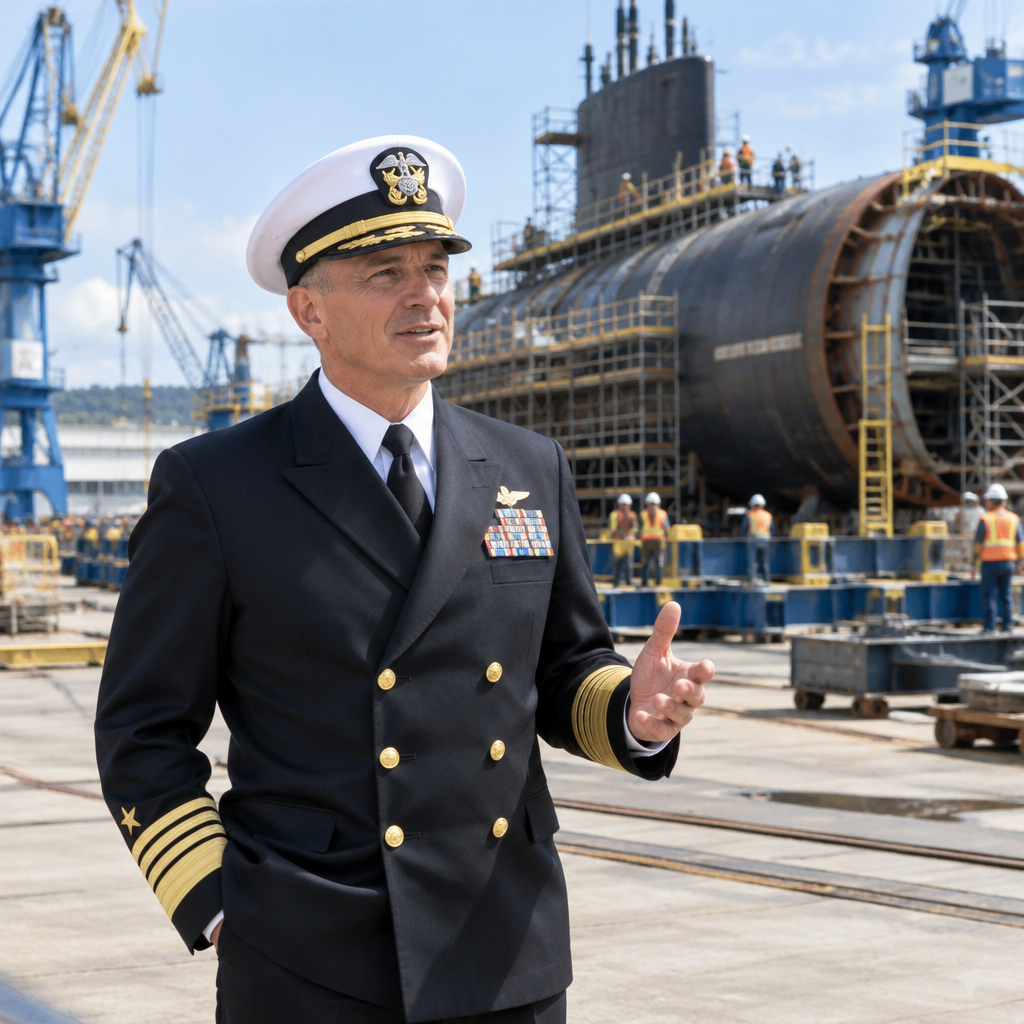
"To be clear, delivering District of Columbia in 2028 is still not easy, so it does remain a heavy lift, and we have plenty of work to do," Vice Adm. Rob Gaucher said, and then added: "But it is absolutely achievable."
Vice Adm. Rob Gaucher’s updated assessment
At the Submarine League Annual Symposium, Vice Adm. Rob Gaucher, the Pentagon’s Direct Reporting Portfolio Manager (DPRM) for Submarines, delivered a noticeably more optimistic read on the Columbia-class lead boat than he had in April. Then, Gaucher warned that meeting the 2028 delivery goal would be a "wicked heavy lift" and said the program still needed to work through "hiccups" because the submarine had never been operated before. He also cautioned at the time that a 2028 delivery should not be pursued if it would produce long-term harm to the program.
On Nov. 13, Gaucher credited recent increases in operations, improved "deck plate performance," better alignment on goals, tightened production planning, and work on "day-to-day production bottlenecks" for increasing his confidence in the timeline. He kept the caveat that delivery remains "not easy" and requires continued effort.
2028 target in the context of earlier schedule shifts
The Columbia-class lead submarine, the District of Columbia, was originally slated for delivery in 2027. Navy leaders said in 2025 that that delivery date could shift to 2029 amid supplier issues, and in 2024 the Navy reported several shipbuilding programs were suffering from delays due to shipyard workforce and supply chain challenges. That 2024 notice included a projection that the District of Columbia was expected to face a 12- to 16-month delivery delay.
Despite that earlier turbulence, Navy leaders have consistently stated this year that their objective is to deliver the District of Columbia in 2028 — a target Gaucher now calls "absolutely achievable" provided ongoing work continues to close production gaps.

This site is the portfolio.
OSINTSights runs on Cloudflare Workers, D1, R2, and Vectorize, with an AI pipeline on Hetzner ARM. Nubivance designed, built, and operates it. We do the same for clients.
See what we buildAcceleration plan and the roles of General Dynamics Electric Boat and HII’s Newport News Shipbuilding
To push the program forward, the Navy and its shipbuilding partners established an acceleration plan in 2025. That plan aimed to deliver all modules for the Columbia-class submarine to the final assembly yard at General Dynamic Electric Boat in Groton, Conn., by the end of 2025. The program’s prime shipbuilders named in reporting are General Dynamics Electric Boat and HII’s Newport News Shipbuilding.
The acceleration measure was explicitly linked to creating a construction "ramp-up" for the Columbia-class, a ramp-up the Navy has said is necessary before the program moves to full-rate construction.
Construction progress: District of Columbia and the future Wisconsin
Rear Adm. Todd Weeks, speaking at the WEST 2026 conference in February when he was the program executive officer for strategic submarines, said the acceleration plan had produced a construction "ramp-up." Weeks — now the portfolio acquisition executive for industrial operations — reported that the District of Columbia was approximately 65 percent complete and that the second Columbia-class submarine, the future Wisconsin, was roughly 35 percent complete.
Weeks also said full-rate construction of the vessel class was slated for the early 2030s, framing the 2028 delivery of the lead boat as a near-term milestone within a much longer production timeline.
What this means for the Navy, General Dynamics Electric Boat, and HII’s Newport News Shipbuilding
- The Navy: will continue to monitor deck plate performance, production planning, and day-to-day bottlenecks — the exact improvements Gaucher cited as the basis for his increased confidence in 2028 delivery.
- General Dynamics Electric Boat and HII’s Newport News Shipbuilding: remain central to executing the 2025 acceleration plan, delivering modules to the Groton final assembly yard and sustaining the reported construction "ramp-up."
- Suppliers and shipyard workforces: retain a critical role given earlier 2024 findings that workforce and supply chain issues drove projected delays of 12 to 16 months for the District of Columbia.
The program’s status now reads as a working tension between a sober appraisal of industrial realities and renewed operational momentum: Gaucher calls the 2028 delivery an "absolutely achievable" objective while acknowledging it is still a "heavy lift." The next concrete markers will be continued deck-plate performance reviews, adherence to the acceleration plan’s module delivery schedule, and whether the construction ramp-up sustains the progress Rear Adm. Todd Weeks described.