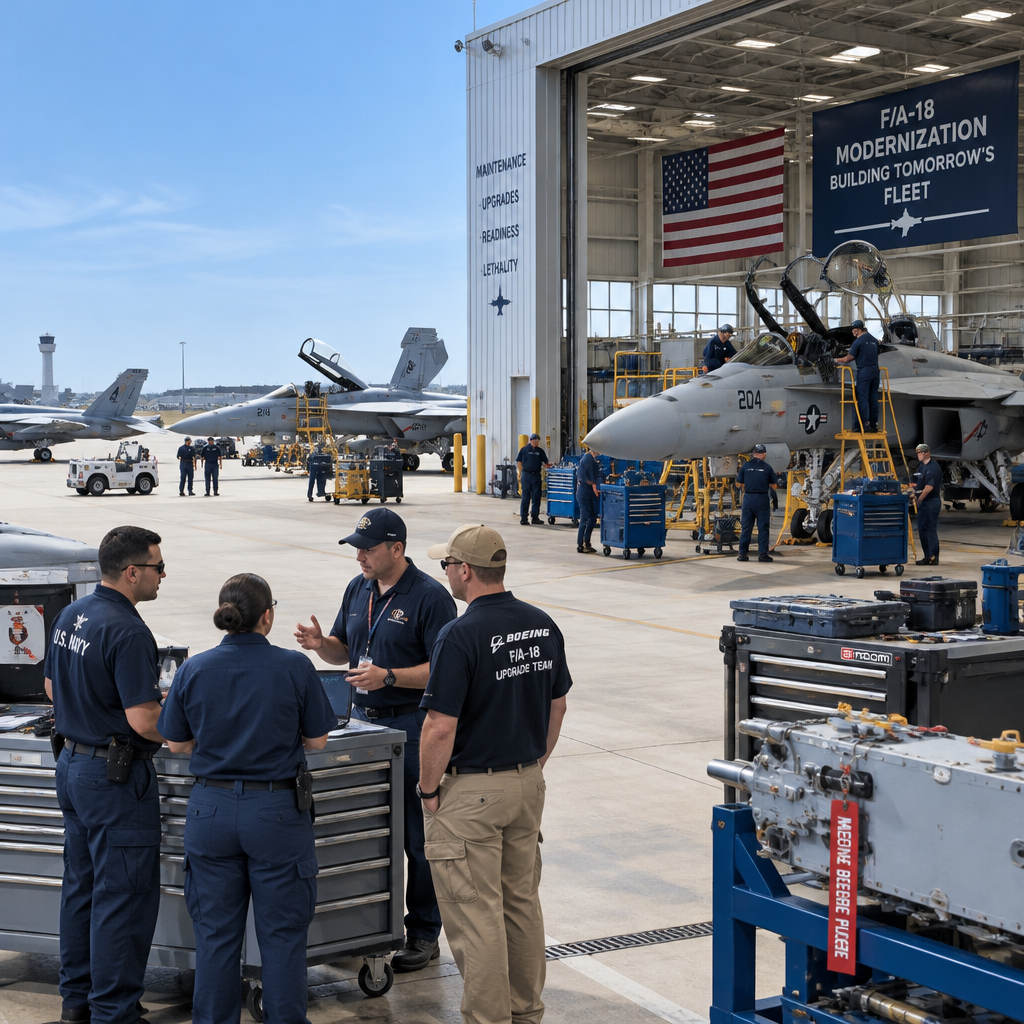
“PMA-265 anticipates a maximum SLM induction profile of up to 47 aircraft per year across the industrial base,” the recent NAVAIR contracting notice states — a specific target that has prompted the Navy to ask the market where extra modification capacity might come from.
NAVAIR market research and the 47-aircraft-per-year target
Naval Air Systems Command (NAVAIR) is conducting market research “to determine the industrial base’s existing capability and facility capacity to provide supplemental or secondary Service Life Modification (SLM) turnkey capacity for F/A-18E/F Super Hornet and EA-18G Growler aircraft starting in FY29 [Fiscal Year 2029],” according to the contracting notice. The notice frames the inquiry around long-term strike fighter inventory requirements and explicitly says the Government is evaluating “the availability of additional commercial or second-source depot modification repair overhaul (MRO) capacity.”
Boeing relocations, production end dates, and competing work
Boeing currently performs SLM work at facilities in St. Louis, Missouri, and San Antonio, Texas, and conducts additional modification work at other sites including Jacksonville, Florida. In September 2025 Boeing announced its intention to shut down the St. Louis SLM line in 2027 and “transition at least some of that workload elsewhere, possibly to San Antonio and/or Jacksonville.” The company also plans to end production of new Super Hornets in 2027; the EA-18G Growler is already out of production.
Boeing executives framed the moves around expanding production for other programs. Dan Gillian, Vice President and General Manager of Air Dominance at Boeing, said the company’s “expansion plans across the St. Louis site triggered the execution of a multi-year strategic plan, requiring the relocation of some work.” Steve Parker, President and CEO of Boeing Defense, Space & Security, said after the F/A-XX award that “Delivering two advanced fighters in parallel was always our plan, and we invested accordingly.” The company is also ramping deliveries of F-15EX, T-7A, MQ-25, and working on the F-47 and F/A-XX programs.

The cyber insurance questionnaire just landed. Now what?
SOC 2, HIPAA, insurance renewals - someone has to own security strategy. Nubivance provides fractional CISO leadership without the full-time salary.
Get a security leadService Life Modification, Block upgrades, and fleet timeline
The Navy still plans to put most, if not all, of its F/A-18E/F fleet — “a total fleet of approximately 550 aircraft at present” — through the SLM process. SLM extends Super Hornet service life from 6,000 to 10,000 flight hours and is coupled with Block III upgrades that add wide-area touchscreen multifunction displays, boosts in networking and processing power, and an improved avionics suite. Work is also underway on a Block II upgrade package for the Navy’s roughly 160 EA-18Gs that the contracting notice says will include major improvements to the Growler’s electronic warfare suite.
The Navy expects SLM work to continue into the mid-2030s even as F/A-XX is developed; the F/A-XX is expected to replace the F/A-18E/F and EA-18G fleets but the first of the next-generation fighters are “not expected to begin entering service until some time in the 2030s.”
Industrial base implications and potential new contractors
The notice makes clear the Navy is interested in adding capacity beyond the current Boeing-led pipeline. Boeing conducts SLM in cooperation with the Navy at Fleet Readiness Center Southwest (FRCSW) in San Diego, and Boeing has said it can deliver SLM work “from multiple locations” for the life of the fleet. The contracting notice explicitly opens the door to “additional commercial or second-source” capacity — an invitation that could involve established primes or newer entrants. The article notes Northrop Grumman, which lost the F/A-XX competition, has been involved in Super Hornet production in the past as a subcontractor.
The Navy faces potential trade-offs: the contracting notice says actual aircraft allocation “may vary based on Fleet requirements, aircraft availability, demonstrated performance, schedule, and available capacity.” It is not immediately clear whether the 47-aircraft target marks a substantive increase over earlier throughput goals; in 2020 the Navy had aimed to induct 40 Super Hornets into the SLM pipeline annually within three years.
What this means for the Navy, Boeing, and Northrop Grumman
- The Navy: will seek to avoid major disruptions to SLM and upgrades for Super Hornet and Growler fleets to preserve carrier air wing readiness through the 2030s, and is actively identifying supplemental industrial capacity beginning in FY29.
- Boeing: is relocating and reorganizing SLM work as it expands other production lines and plans to shift St. Louis workload by 2027, while maintaining that it can “continue to meet our customers commitments.”
- Northrop Grumman and other potential second sources: could be candidates for additional modification or MRO work, building on past subcontractor roles and any interest from the Navy in tapping non-traditional or expanding firms.
Super Hornets and Growlers remain central to recent operations, including “the ongoing war with Iran, as well as other recent conflicts in the Middle East,” and their munitions suite is growing — the article cites long-range air-to-air missiles and hypersonic Blackbeard air-to-surface missiles, and shows an F/A-18E carrying four AIM-424 Malice missiles during a test flight. Given the Navy’s stated induction profile and Boeing’s infrastructure shifts, NAVAIR’s market research will determine whether the service leans on Boeing’s dispersed sites, taps additional depots like FRCSW, or brings new commercial partners into the SLM pipeline ahead of FY29.
Source: https://www.twz.com/air/new-facilities-to-pump-out-upgraded-f-a-18e-f-super-hornets-eyed-by-navy