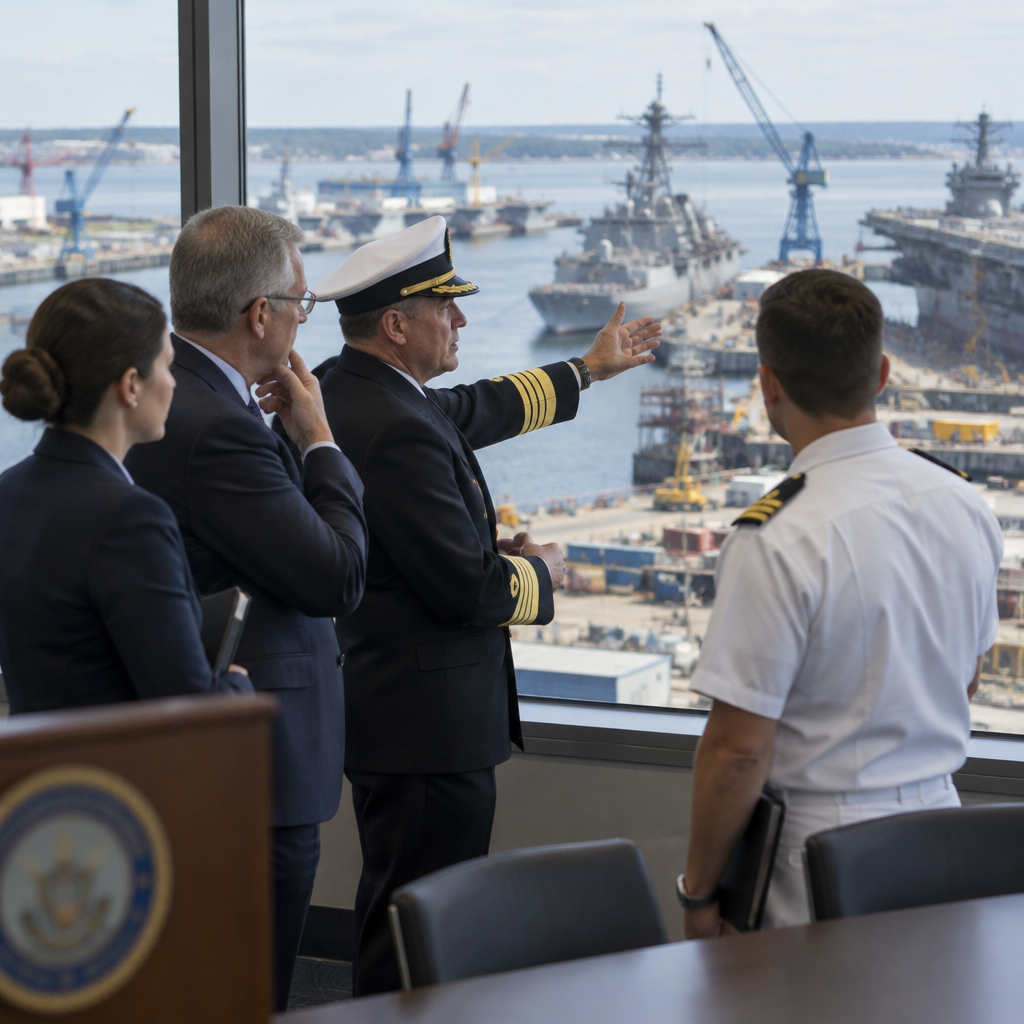
"We have to explore all avenues of building frigates," Acting Navy Secretary Hung Cao told senators, laying bare a tension: Congress wants more ships built faster, but it is reluctant to let those ships be built or sourced overseas.
Senate Appropriations Committee: limits on foreign shipyard work
The Senate Appropriations Committee's explanatory statement for the 2027 defense spending bill directs the Navy to develop "a full strategy and implementation plan" for "effective use of foreign partner capabilities," while simultaneously forbidding the use of appropriated funds for "work in foreign shipyards or procurement of shipbuilding items from foreign sources." The language, if finalized, would require the plan to include "concrete steps, resources, responsibilities, and timelines sufficient" to realize shipbuilding in different locations as part of a "distributed shipbuilding model along with foreign partner capabilities to transform domestic shipbuilding capability nationwide."
Acting Navy Secretary Hung Cao and nominee William Toti: look to foreign entrants
Facing pressure to accelerate production, senior Navy figures urged openness to nontraditional builders. Hung Cao pointed to South Korean production rates, telling senators the Chungnam takes 15 months "from the moment they lay a keel until they launch that vessel." Cao named Hanwha as an example of a potential entrant—Hanwha purchased Philly Shipyard in 2024 and has submitted a bid to acquire Austal USA.
In a separate confirmation hearing, Navy undersecretary nominee William Toti called a "new, tech-forward, foreign-owned shipyard in the U.S." the "quickest way" to build frigates. Those endorsements from senior Navy officials sit uneasily alongside the appropriators' language that supports only a "limited use of allied shipyards to address significant shortfalls in certain auxiliary vessels" and remains "unconvinced that foreign shipyards are an appropriate solution for combatant vessels."

Audit-ready is a season. It shouldn't be.
Evidence in spreadsheets, controls drifting between audits, frameworks multiplying on flat headcount. Nubivance runs continuous compliance on Rapid7 Cyber GRC - SOC 2, HIPAA, ISO 27001, PCI, CMMC.
End the scrambleCongressional Budget Office: FREMM adaptation and FFG-62 cost growth
The Congressional Budget Office highlighted past challenges in adapting foreign designs. In a footnote to a shipbuilding-plan report, the CBO wrote: "[The] FFG-62 program was based on a foreign design, the Italian FREMM (Fregata Europea Multi-Missione). Adapting that design to U.S. Navy standards for construction and incorporating U.S. Navy combat systems and weapons played a significant part in the cost growth and delays that led to the cancelation of the FFG-62 program." The CBO also noted it "did not analyze whether 'foreign design would replace, complement, or augment the FF(X) Flight II program.'"
Senate appropriators: unmanned maritime systems and counterdrone shortfalls
Beyond hulls and yards, Senate appropriators rebuked the Navy for lagging on unmanned and counterdrone capabilities. Lawmakers said the Navy has "insufficiently incorporated those capabilities into fleet and warfighting doctrine," a shortfall they argued has "caused lags in private sector investment in manufacturing." The draft spending bill would require the Navy to submit a report on its "investment priorities for unmanned, uncrewed, and autonomous surface and undersea maritime platforms, assessment of existing manufacturing capacity for such systems, and strategy for scaling production capacity."
Vantor, Michael Bergen, and the rise of non‑Earth imaging as a "neighborhood watch"
Parallel to maritime debates, commercial space companies are pitching new surveillance techniques. Michael Bergen, Vantor's vice president of air & space, described the firm's work at a Washington Times space event on Nov. 17: by pointing satellites "across horizontally and out—take pictures of other objects in space," companies can perform "non-earth imaging." Vantor recently captured photos of a Russian satellite nearly colliding with an American satellite, and Bergen said this kind of observation—what he called a "neighborhood watch on space"—changes behavior because "when adversaries or people are watched, they act differently."
The market for non‑Earth imaging is active: Australian startup HEO unveiled a three‑dimensional visualization tool and has partnered with Satellogic and BlackSky, while Vantor recently won a contract with the National Geospatial‑Intelligence Agency.
What this means for policymakers, Navy procurement leaders, and commercial space firms
- Policymakers and appropriators will need to reconcile competing priorities: a congressional mandate for a strategy that leverages foreign partner capabilities and a statutory restriction barring the use of appropriated funds for foreign shipyard work.
- Navy procurement leaders face a dual challenge—speeding frigate production while avoiding the cost and schedule risks the CBO identified when adapting foreign designs—and must deliver the required distributed‑shipbuilding plan with "concrete steps, resources, responsibilities, and timelines."
- Commercial space firms and government buyers will watch how "non‑earth imaging" contracts, such as Vantor's NGA award and HEO partnerships, influence norms and the operational behavior of other nations' satellites.
The draft spending bill captures a practical contradiction: a push to harness allied capacity and commercial innovation, and a strict bar on spending for foreign yards or parts. The final version of the annual defense policy bill remains in the works, and the Navy must produce the detailed plan Congress is demanding—one that, according to appropriators, must show how foreign partner capabilities could be used without invoking prohibited appropriations. How the service responds to that requirement, and whether it can avoid repeating the adaptation pitfalls the CBO flagged, will determine whether the current push for distributed, faster shipbuilding produces more hulls or more hearings.