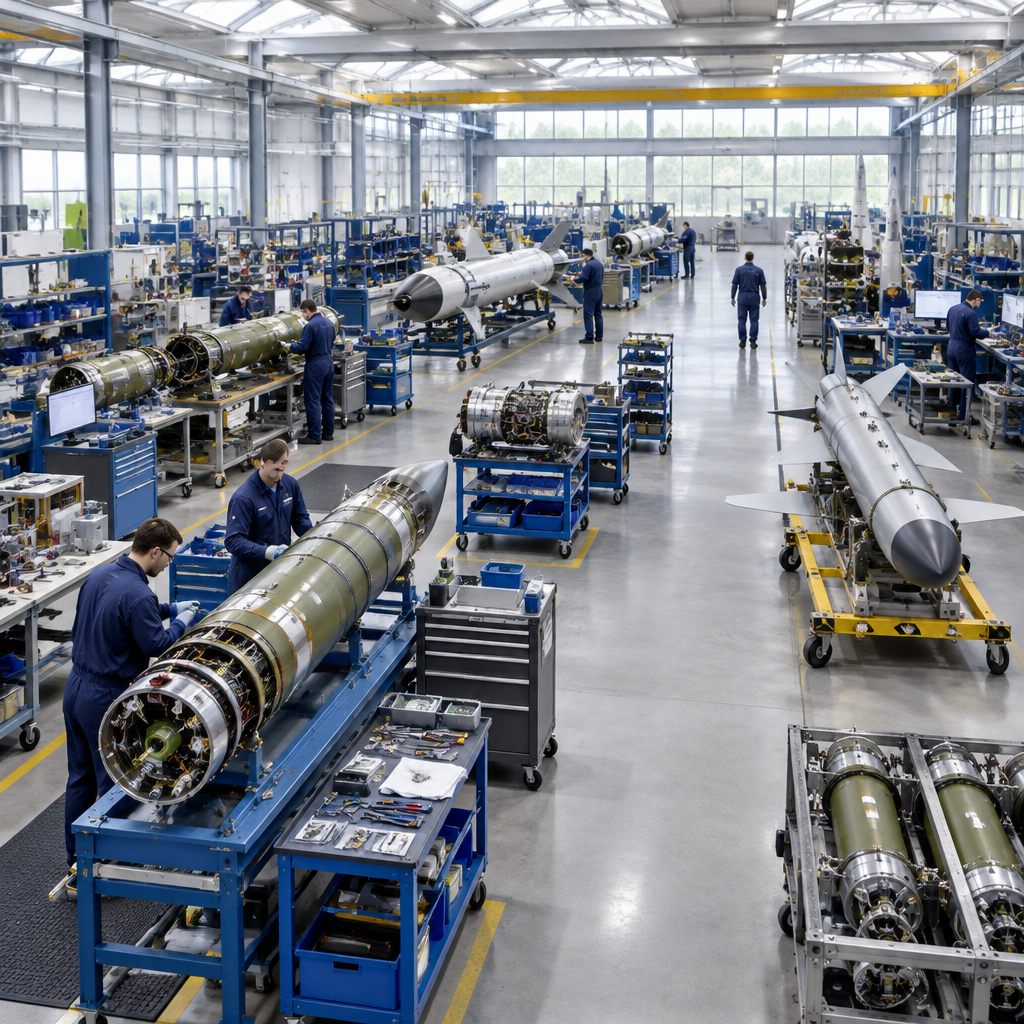
At stake is whether the United States can meet the Pentagon’s own missile and missile‑defense requirements — and whether allied militaries that rely on American systems will get the supplies they need — even as global demand for missiles and missile defenses surges.
The scale of the problem: demand outpacing supply
The short account provided here is stark in its economy: global demand for missiles and missile defenses is rising, and the United States “finds itself struggling to produce enough equipment to meet the Pentagon’s requirement — let alone that of foreign partners who rely on American systems.” That sentence frames the central constraint: production capacity is the bottleneck, not necessarily doctrine, tactics, or specification. The summary emphasizes both domestic requirements and international obligations as simultaneous pressures on the same U.S. industrial base.
What experts are saying: a focused conversation
Becca Wasser of Bloomberg Economics and Mark Cancian of the Center for International and Strategic Studies joined Breaking Defense Editor-in-Chief Aaron Mehta to examine the problem. Their conversation — described in the latest installment of Breaking Defense’s series on missiles and missile defenses — centers on persistent production challenges and the “scary potential outcomes” if the United States and its partners cannot resolve them. The summary makes clear that the discussion addressed both industry capability and strategic consequences.

Audit-ready is a season. It shouldn't be.
Evidence in spreadsheets, controls drifting between audits, frameworks multiplying on flat headcount. Nubivance runs continuous compliance on Rapid7 Cyber GRC - SOC 2, HIPAA, ISO 27001, PCI, CMMC.
End the scrambleGovernment and industry responses: efforts underway, uncertainty remains
The reporting notes there are “efforts underway to increase production,” but it also underlines that those efforts may not be moving fast enough. That two‑part proposition — escalation of activity on the supply side coupled with doubt about sufficiency — is the dominant theme. The summary does not detail which programs or contracts are being expanded, who in industry is scaling, or by how much production could rise; it does, however, place emphasis on the urgent tension between proclaimed intent (expanding output) and practical capacity (current shortfall and lingering questions about adequacy).
How the Pentagon, foreign partners, and industry are positioned
- The Pentagon: Faces a concrete production shortfall relative to its stated requirements. The immediate problem is supply — meeting internal demand while balancing commitments to allies who depend on U.S. systems.
- Foreign partners who rely on American systems: Are vulnerable to a U.S. production squeeze because their procurement of missile and missile‑defense systems depends on U.S. industrial throughput. Shortfalls in U.S. output therefore translate directly into capability and readiness risks for those partners.
- Industry: Is the locus of the remedy — there are efforts underway to boost production — but the summary expressly raises the question whether industry can move “as fast as needed,” implying constraints in workforce, supply chains, facilities, or capital that the piece does not enumerate.
Risks and open questions the conversation highlighted
The reporting frames the failure to fix production as more than an administrative headache. It points to “scary potential outcomes” should efforts fall short, without spelling out specific scenarios in the short summary. What is clear from the account is that the stakes are dual: capability gaps could affect U.S. force readiness, and they could also weaken the operational posture of allies who depend on U.S. systems. The simultaneous domestic and allied demand creates a multiplier effect: every shortfall matters twice.
Conclusion — a race in public view
The United States is, in the language of the summary, “racing” to address a production challenge. There are visible attempts to accelerate output, and there are named analysts publicly debating the consequences. What remains unresolved in the public record summarized here is whether the efforts underway will be sufficient and timely. That uncertainty — the gap between activity and adequacy — is the central takeaway: policymakers, procurement officers, and allied planners will be watching production metrics and the outcomes of these industry efforts closely in the months ahead. Keep an eye on future episodes of Breaking Defense’s series for more reporting and analysis.