"The President has directed the Navy to aggressively increase domestic shipbuilding capacity, including leveraging the proven shipbuilding skills and industrial expertise of our allies," Navy Capt. Ron Flanders said on Tuesday, according to USNI News.
What is being studied and why it matters to the Navy
The U.S. Navy is conducting a study that includes three foreign frigate designs — Japan’s Mogami class, South Korea’s Chungnam class, and Turkey’s Istanbul class — as possible candidates for rapid procurement, USNI News reported, citing anonymous sources. The review responds directly to a provision in a memo from President Trump titled “Rebuilding the United States Navy and America’s Shipbuilding Industrial Base,” which directed the Secretary of the Navy (currently Acting Secretary Hung Cao) to submit a plan outlining timelines and resourcing requirements for a new competitive acquisition approach for surface combatants with anti‑submarine, surface‑warfare and convoy‑escort capabilities.
The Mogami class (Japan): stealth, modular VLS, and export momentum
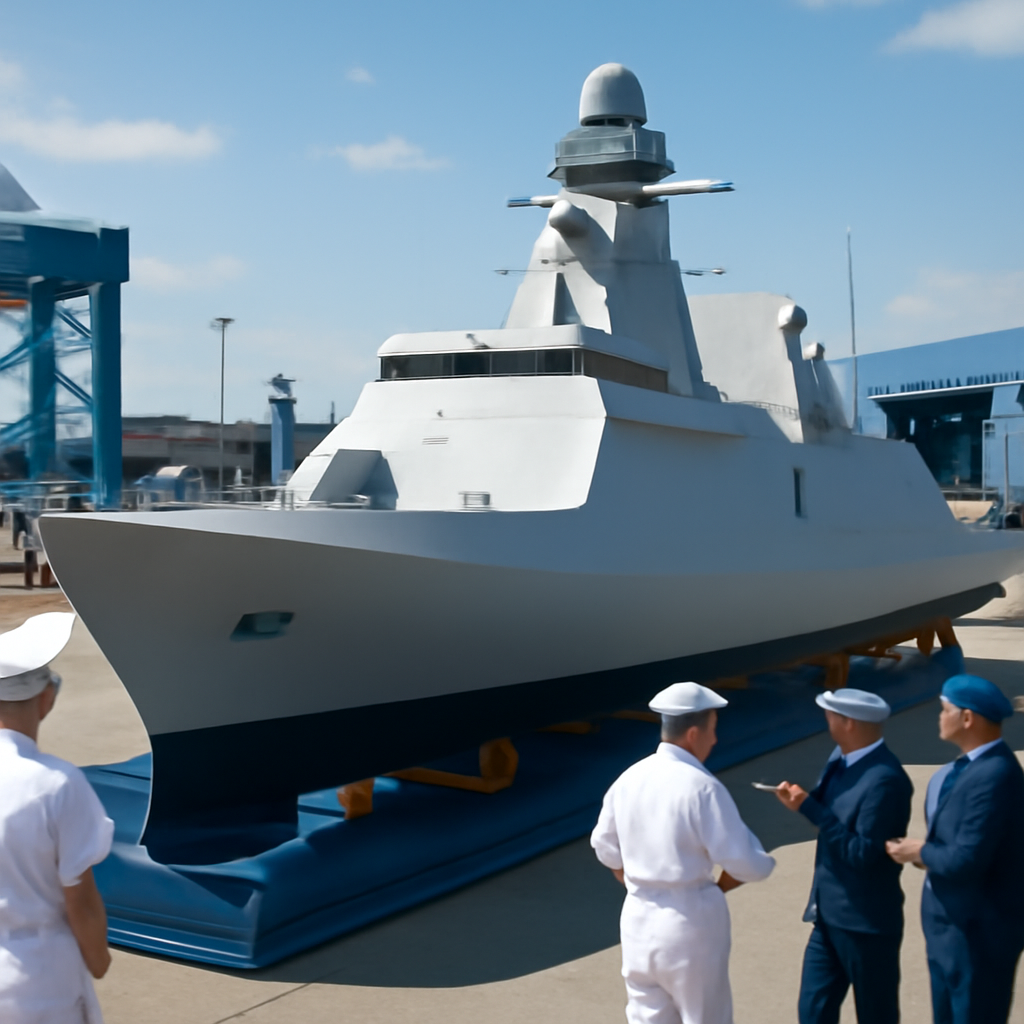
The Mogami class is a modern, multi‑mission frigate with stealthy shaping and a combined diesel and gas (CODAG) propulsion system. Baseline ships displace about 5,500 metric tons, are roughly 436 feet long, and carry a mixed sensor suite including an AESA main radar and MHI’s distinctive UNICORN mast. Armament on baseline ships includes Type 17 anti‑ship missiles in two four‑round launchers, a SeaRAM with RIM‑116 missiles, and a five‑inch main gun; early hulls were delivered without Mk 41 cells but the seventh ship, JS Niyodo, commissioned in May, was the first fitted with a Mk 41 array. MHI has also developed an enlarged derivative (about 6,200 metric tons) with a 32‑cell VLS array; Australia announced last year it will acquire a fleet of these enlarged Mogami derivatives under SEA 3000.

Audit-ready is a season. It shouldn't be.
Evidence in spreadsheets, controls drifting between audits, frameworks multiplying on flat headcount. Nubivance runs continuous compliance on Rapid7 Cyber GRC - SOC 2, HIPAA, ISO 27001, PCI, CMMC.
End the scrambleThe Chungnam class (South Korea): CODLOG power and a 16‑cell K‑VLS
The Chungnam class (FFX‑III) is a South Korean frigate in service since 2024. The design is about 423 feet long, displaces roughly 4,300 tons fully loaded, and uses combined diesel–electric or gas (CODLOG) propulsion. Each ship carries a 16‑cell K‑VLS able to accommodate K‑SAAM surface‑to‑air missiles, Haeseong I anti‑ship cruise missiles, and K745A1 Hong Sang Eo anti‑submarine rockets, plus a five‑inch main gun, triple torpedo tubes and a CIWS II with a 30mm Gatling cannon. Two Chungnam ships are in service with plans for four more; construction has involved HD Hyundai Heavy Industries, SK Oceanplant, and Hanwha Ocean — the latter already active in U.S. industry through acquisitions such as Philly Shipyard in 2024.
The Istanbul class (Turkey): compact CODAG frigate with growing VLS capability
Turkey’s Istanbul class (also called Istif or I class) is a smaller multi‑role frigate — roughly 371.5 feet long and about 3,000 tons fully loaded — that entered Turkish service in 2024 with the lead ship TCG Istanbul. The class uses CODAG propulsion, a rotating AESA radar on an integrated mast, and a MiDLAS 16‑cell VLS. Initial reports indicated MiDLAS was configured for Hisar SAMs; recent reporting in August showed the second ship, TCG Izmir, with a visibly longer 16‑cell MiDLAS allowing larger vertically‑launched munitions such as Siper, Atmaca, or Gezgin. The class also carries deck‑mounted Atmaca launchers, a 76mm bow gun, Gokdeniz CIWS, and helicopter facilities; Turkey plans to acquire eight of the class and TAIS Shipyards has a contract to build at least two for Indonesia.
Congress, law, and the Finland Model
Any U.S. acquisition of foreign‑built warships would encounter legal and political headwinds. Current law would require a national security waiver to procure foreign‑made naval vessels; a draft of the 2027 National Defense Authorization Act in the Senate would eliminate the ability to issue such a waiver. In June, members of the House Armed Services Committee moved to block spending on foreign‑built warships in a separate draft NDAA. The Trump administration’s proposed mitigation is the so‑called “Finland Model”: build an initial tranche overseas while requiring major investments, technology transfer, and U.S. workforce hires as production transitions to domestic yards. The White House Office of Management and Budget wrote in July that the Administration “strongly opposes section 1025, which would prohibit the use of funds for procurement of initial battle force ships to be built in a foreign shipyard,” arguing that prohibition would not address shipyard backlogs in U.S. prime yards.
What this means for the Navy, Congress, and U.S. shipyards
- The Navy: faces competing priorities — a desire to expand frigate numbers quickly while avoiding the design‑change pitfalls that undermined the Constellation program and the mixed results of the Littoral Combat Ship. The service is pursuing an FF(X) derived from the Coast Guard’s Legend class National Security Cutter, but early FF(X) ships will lack a VLS, raising operational questions.
- Congress: remains skeptical of foreign procurement; pending NDAA actions would either curtail or prohibit waiver authority and, thus, the Finland Model’s initial overseas builds.
- U.S. shipyards and builders: would be asked to absorb transferred production and workforce expansion as part of any Finland Model deal, even if an initial one or two hulls were constructed abroad — a sequence the Administration argues is needed to address backlogs across six major programs.
The study is scheduled to wrap up in November. If it produces options that survive legal and political scrutiny, the Navy could open a formal international competition that might include short runs built overseas and follow‑on construction in U.S. yards — but Congress’s pending NDAA moves and the requirement for waivers make whether that path is viable an open, closely watched question.
Source: TWZ — The Three Foreign Frigates Being Studied For Possible U.S. Navy Service