“This is a historic event, at least for our unit for sure,” said “Napalm,” a squad commander and programmer with the 92nd Assault Brigade’s uncrewed ground vehicle (UGV) company.
The claim and the video
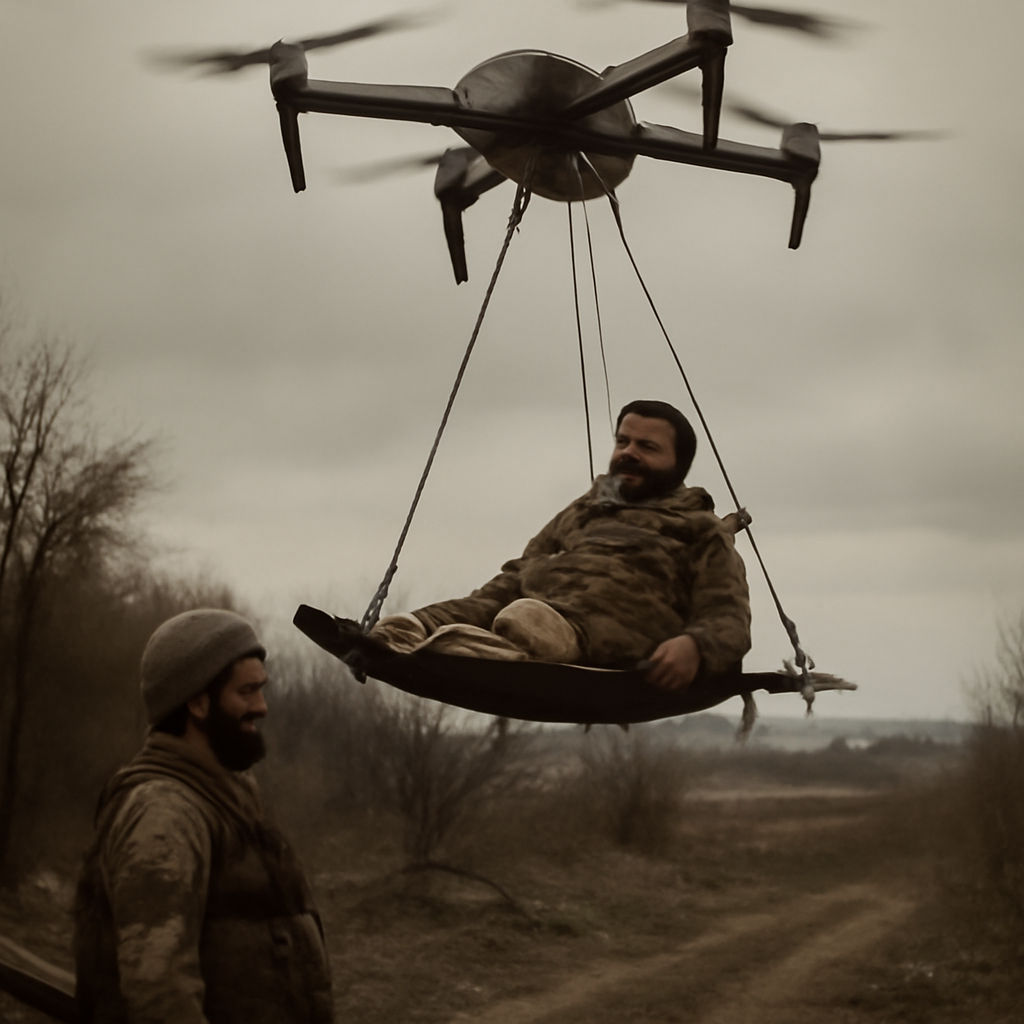
The Ukrainian Armed Forces say they have carried out what they describe as the world’s first frontline evacuation of a wounded soldier by aerial drone. The casualty, identified only as an infantryman from the 30th Mechanized Brigade, is said to have been recovered successfully and is now undergoing treatment and rehabilitation. The 92nd Assault Brigade published a video of the event; the footage has not been independently verified and the operation’s precise date and location were not disclosed. The source cautions the clip could depict a staged demonstration rather than an actual combat evacuation.
How the extraction was shown to work
The published footage shows the soldier clipping himself to the underside of a heavy hexacopter via a harness, then being flown away while dangling under the drone’s rigid landing legs. The soldier is pictured hunched under the hexacopter before attaching the harness and remained in contact with the UAV operator throughout the recovery. The 92nd’s account says mines and intense Russian drone activity prevented a conventional ground evacuation, prompting the specialists to attempt an aerial extraction.

Audit-ready is a season. It shouldn't be.
Evidence in spreadsheets, controls drifting between audits, frameworks multiplying on flat headcount. Nubivance runs continuous compliance on Rapid7 Cyber GRC - SOC 2, HIPAA, ISO 27001, PCI, CMMC.
End the scrambleEquipment: Gurzuf Defense, the Audag-6 report, and SkyFall’s StarGate
The aircraft used in the 92nd’s operation was a heavy hexacopter manufactured by Ukrainian company Gurzuf Defense; the company provided it free of charge. The UAV was piloted by a UAV operator from the 30th Mechanized Brigade. The 92nd has not disclosed the evacuation distance or flight duration. If, as reported, the drone used was an Audag-6 model, that platform is stated to be capable of carrying a 200-pound payload over a distance of up to 15 miles.
Separately, Ukraine is testing a purpose-built aerial medical-evacuation drone called the StarGate, developed by SkyFall. StarGate is described as a heavy hexacopter with a covered, medical-grade stretcher slung below the airframe, a reported payload capacity of around 330 pounds, AI-assisted navigation, and the ability to deploy nets against hostile drones attempting to intercept it. By contrast, the 92nd’s operation relied on a heavy-lift hexacopter adapted ad hoc for casualty transport, which required the wounded soldier to be sufficiently capable and trained to strap in.
UGVs, battlefield constraints, and why aerial options are emerging
Ukraine increasingly uses uncrewed ground vehicles for logistics and casualty evacuation. According to Euromaidan Press, Ukrainian UGVs conducted approximately 112,000 logistics and evacuation missions between January and August 2026. But ground robots remain challenged by mines, mud, cratered terrain and vulnerability to enemy drones and artillery — factors that limit UGV operations in the battlefield’s “kill zone,” which the source says can extend six to nine miles or more from the front line.
Aerial platforms can reach casualties in terrain where ground vehicles cannot safely travel and can arrive faster without adhering to fixed routes. That benefit helps explain the rapid development and fielding of aerial medevac concepts in Ukraine. The report ties this evolution to wider international experimentation: examples cited include the 2016 Lockheed Martin K-Max casualty-evacuation demonstration, U.S. Army work on unmanned platforms such as the DPI DP-14 Hawk, and more recent tests of heavy-lift designs like the Flowcopter FC-100, which the U.S. Army tested in a medevac role during Exercise Saber Strike and is described as carrying a 220-pound payload with a range of more than 60 miles.
What this means for technologists, policymakers, and frontline medics
- Technologists and security teams: Rapid fielding of ad hoc aerial extractions highlights the importance of payload, range, and counter-drone measures—parameters already noted in reported specs for the Audag-6 and StarGate. AI-assisted navigation and active defenses such as net deployment will be areas to watch.
- Policymakers and procurement leaders: The gap between adapted heavy-lift hexacopters and purpose-built designs like StarGate suggests procurement choices will balance speed of fielding, medical capability (covered stretcher vs. suspended harness), and survivability in contested airspace.
- Frontline medics and soldiers: An ad hoc aerial extraction requires the wounded to be able to clip in or to be assisted; that operational constraint changes training, triage decisions, and the conditions under which aerial evacuation is feasible.
The 92nd’s published video and the broader push toward aerial medevac mark a clear operational experiment: drones adapted to recover personnel where ground robots and crewed medevac cannot safely go. Critical facts — the mission’s distance, duration, and independent verification of the footage — remain undisclosed. For now, the event stands as a snapshot of rapid adaptation on the battlefield and a prompt for further technical, logistical, and ethical questions about uncrewed personnel recovery.
Source: TWZ — Aerial Drones Appear To Be Picking Up Wounded Off The Battlefield In Ukraine