“I look at it through three lenses,” said Doug Jones, chief technology officer for defense at Leidos — and those three lenses map directly onto why the Army cannot simply duplicate the Europe-style network in the Pacific.
Doug Jones: contested, multi-domain threat
Jones framed the Pacific challenge as a mixture of high-end weapons and mass, fought across space, cyber, air, sea and land. “It’s a contested across all domains – space, cyber, air, sea, land,” he said, arguing that the adversary force was “expressly created to counter how we project power.” Those conditions force the Army to protect “critical nodes in the Pacific” to preserve its ability to project power via carriers, air forces, land forces, and cyber and information capabilities.
Eric Moore: deployable, reconstitutable assets and disconnected operations
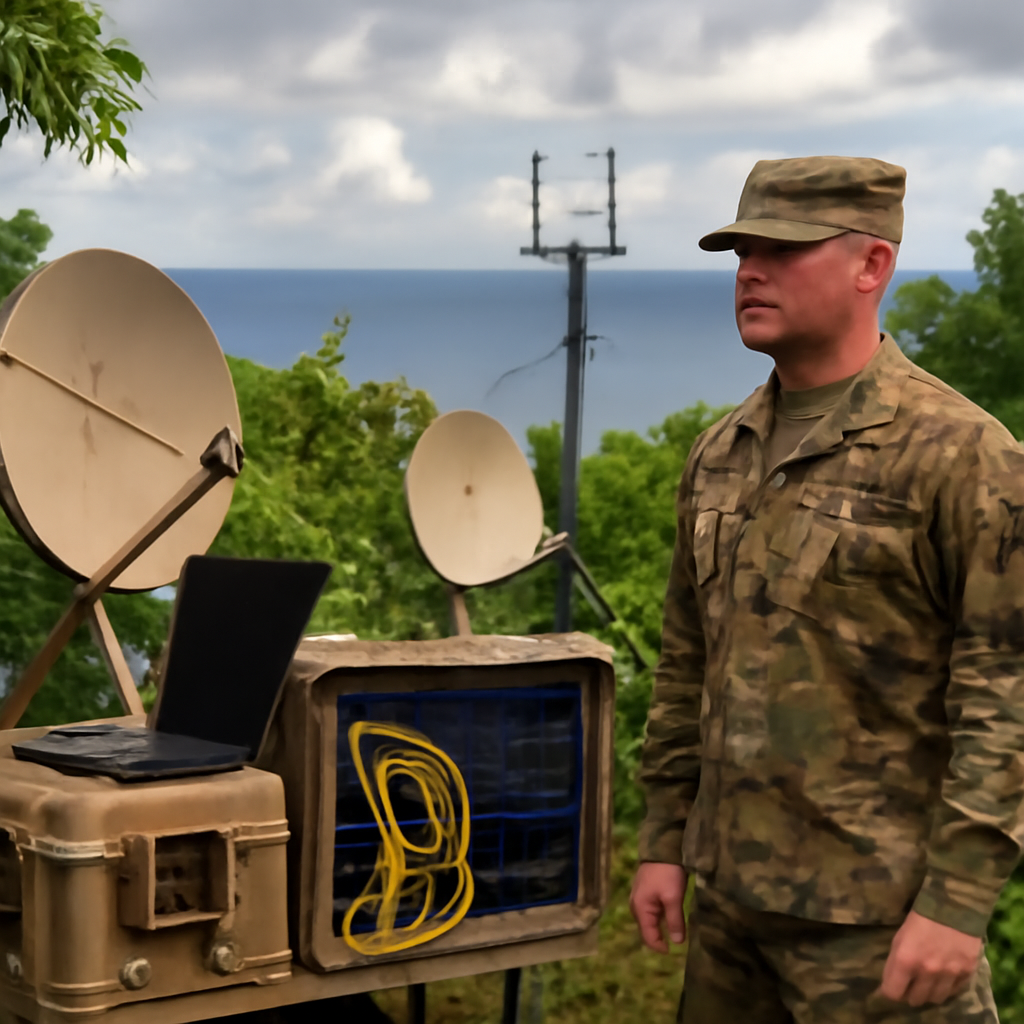
Leidos’s Eric Moore described the Pacific as an environment where fixed fiber, data centers and commercial connectivity — the multi-path backbone common in Europe — cannot be assumed. “In this theater we have to think more about deployable and reconstitutable assets,” Moore said. He argued the Army must be prepared to operate with limited or no connectivity for extended periods: “Connectivity cannot be a prerequisite for mission success.”
That blunt prescription changes design priorities. Instead of building around persistent infrastructure, planners must focus on mobile network elements that can be carried to land masses and reassembled, and on software and architectures that tolerate long stretches of degraded communications.

This site is the portfolio.
OSINTSights runs on Cloudflare Workers, D1, R2, and Vectorize, with an AI pipeline on Hetzner ARM. Nubivance designed, built, and operates it. We do the same for clients.
See what we buildAGUN and a transport-agnostic network fabric
To reach that posture the Army is pursuing a transport-agnostic, data‑centric transport layer. Moore described software‑defined networking work under the Army’s Global Unified Network (AGUN) modernization contract as the path to a standardized, multipath, inherently resilient fabric that can extend the enterprise out into a “reconstitutable and deployable edge” required in the Pacific theater.
Moore and Jones both stressed that resiliency is not a single product: it is “diversity of solution, diversity of transport, diversity of storage, diversity of underlying capabilities.” That diversity, they said, is what can mitigate jamming, kinetic attack and weather-driven outages that are common across island chains.
Allied cooperation: no Pacific NATO, ad hoc sharing and data architecture
The Pacific lacks a formal, NATO‑like alliance architecture, the source notes, so partnerships are built on bilateral and regional relationships rather than a single treaty framework. Jones highlighted the practical consequences: cooperation depends on data‑sharing arrangements that protect sensitive techniques and sources while giving partners usable operational pictures.
He used signal processing for air tracks as an example. The raw techniques to identify tracks may be classified, but aggregated data — fusing commercial radars on islands with military radars, at both classified and unclassified levels — can be shared in a way that helps partners defend themselves without revealing methods. That requires an information architecture that can manage multiple classification levels and provide selective sharing.
Defense and logistics: land masses, mobility and survivability
Although water dominates the region, both leaders emphasized land mass control. Jones noted that the Army “has to control and protect all the land assets in the theater” because land bases are essential for logistics, integrated air‑missile defense and supporting maritime and air operations. He invoked the historical precedent of creating bases to support island‑hopping operations, and then added the modern wrinkle: forces now depend on real‑time information and must ensure connectivity that can survive jamming and kinetic attack.
Mobility is a recurrent lesson from recent conflicts. Stationary sensors such as TPY-2 radars can become high-value targets for drone swarms or mass‑missile attacks, so portable network and sensor capabilities — and the ability to move them rapidly — are core defensive measures.
What this means for technologists, policymakers, and logistics leaders
- Technologists and security teams: prioritize transport‑agnostic, software‑defined fabrics and a diverse set of mobile network elements that can operate when disconnected, degraded or contested — exactly the “reconstitutable and deployable edge” Moore describes.
- Policymakers and regional planners: invest in relationships and data‑sharing architectures that let partners exchange fused, operationally useful information at mixed classification levels without exposing sources and methods.
- Procurement and logistics leaders: buy for mobility and multiplicity — not just a single resilient system, but a portfolio of transports, storage and services able to survive weather, jamming and direct attack across island chains.
The bottom line is stark and specific: building a Pacific network like Europe’s is not merely an engineering problem, it is a geography‑and threat‑driven design imperative. The fix, as Leidos leaders put it, is not one silver bullet but layers of mobile, diverse, software‑defined capability combined with strong regional partnerships. Whether that combination can be fielded at the speed and scale the theater demands remains the central operational question.