“This is certainly [a] more tangible form of support than verbal statements expressi[ng] solidarity with Manila,” Collin Koh, a scholar at the S. Rajaratnam School of International Studies in Singapore, wrote on X.
The November 10 joint statement
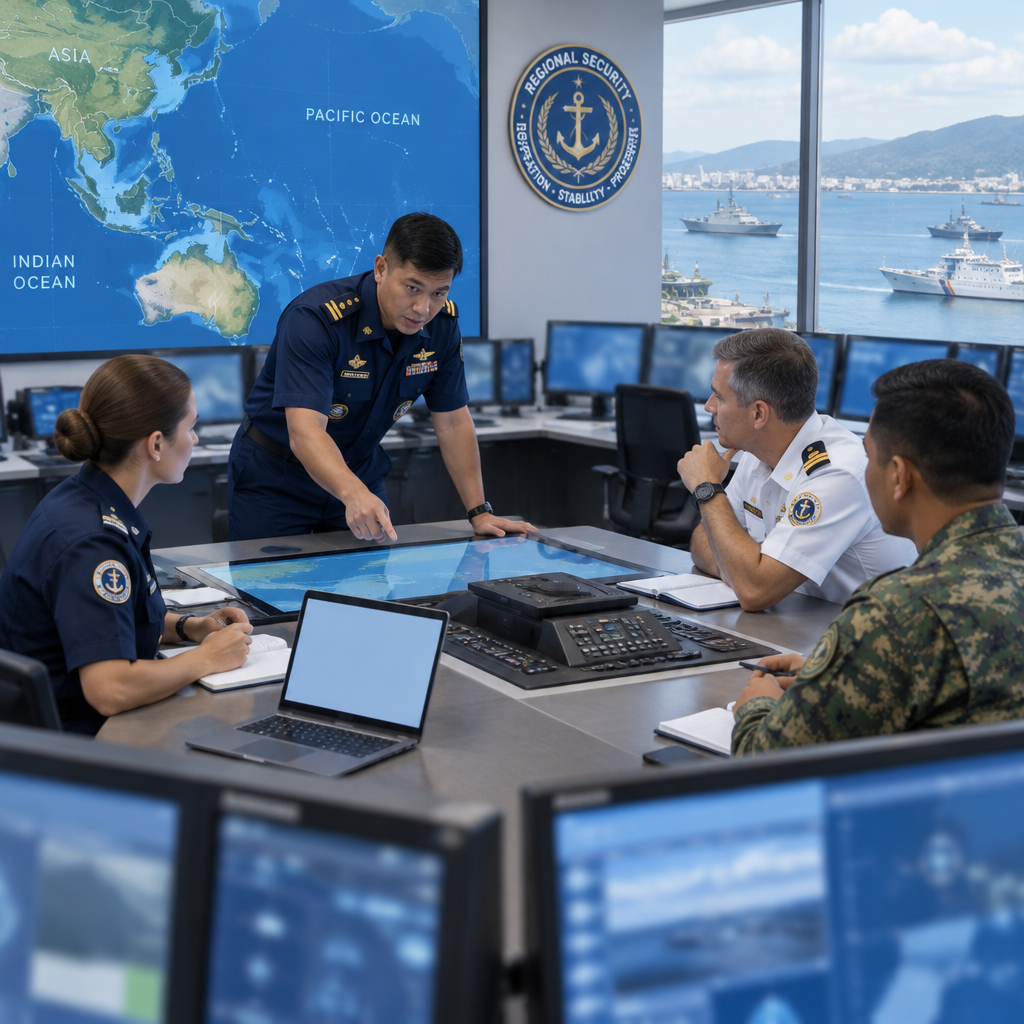
On November 10, defense chiefs from the United States, Japan, Australia, and the Philippines issued a joint statement committing to a series of “forward-looking initiatives” aimed at strengthening the Philippines’ defenses. The informal security grouping — often referred to as the “Squad” — announced plans to establish a Combined Coordination Center in the Philippines and to synchronize defense investments “to support the Philippines in defending its archipelago,” the statement said. The communiqué also called for strengthened ministerial and senior policy-level consultations and for expanding “the scope, complexity, and frequency of their combined exercises and cooperative activities.”
Combined Coordination Center and the Defense Cooperation Council (DCC)
The proposed Combined Coordination Center will build on the Defense Cooperation Council, a multilateral framework established by the four Squad nations. The joint statement did not specify the center’s location, its timeline for establishment, or its precise functions. Terms of reference for the DCC were signed by military leaders from the four countries in Singapore on May 29.
U.S. Pacific Command described the DCC framework as providing “information sharing, regular multilateral maritime activities, coordinated strategic communications, and improved interoperability in operational planning, logistics, and military sustainment.” The new center is presented in the statement as a means to institutionalize and synchronize those activities in the Philippine archipelago.

Audit-ready is a season. It shouldn't be.
Evidence in spreadsheets, controls drifting between audits, frameworks multiplying on flat headcount. Nubivance runs continuous compliance on Rapid7 Cyber GRC - SOC 2, HIPAA, ISO 27001, PCI, CMMC.
End the scrambleRecent operational activity and material transfers
The move toward a coordination hub follows repeated cooperation at sea and a series of exercises. The Philippines, the United States, and Canada conducted the 20th round of Maritime Cooperative Activities in the Sulu Sea in mid‑September, the joint statement noted. Manila has also expanded maritime and coast guard patrols and exercises with all three Squad members and with other partners, including Canada.
On November 9, Japan announced it would provide a radar system and unmanned aircraft to the Philippine military under its Official Security Cooperation framework — equipment the Foreign ministry described as worth 4.3 billion yen ($27 million), according to Kyodo News. Japan’s statement framed the transfer as helping to “enhanc[e] security of important sea lanes for Japan, and contribut[ing] to maintaining and strengthening regional peace and stability.”
Why the four nations acted: China’s maritime assertiveness
The joint statement linked the steps directly to concerns over China’s growing maritime power and assertiveness. It said the defense chiefs “reiterated their serious concerns about the situations in the East China Sea and the South China Sea” and “reaffirmed their strong opposition to any unilateral actions, including by force or coercion, which escalate tensions and undermine regional peace and stability.”
For the Philippines specifically, the statement and related reporting highlighted a four‑year trend: Beijing has increased both the frequency and intensity of its incursions into Manila’s exclusive economic zone, producing a series of dangerous confrontations and pushing bilateral relations to their lowest point in years. The Squad’s initiatives are presented in the statement as a direct response to that trend.
Responses from analysts and Chinese state media
Analysts framed the coordination hub as a tangible step beyond rhetorical support. Collin Koh said the center would “augment” the partners’ Maritime Cooperative Activities in the South China Sea and represented more concrete backing for Manila than prior statements of solidarity.
The Chinese response, as reported, came predictably from state-run media. In a post on X, the Global Times called the Philippines “the most convenient tool for the U.S., Japan, and Australia to stir up trouble for China over the South China Sea issue,” and warned Manila to “ponder how to stop being a pawn.”
What this means for the Philippines, the United States, and Japan
- The Philippines: The announced center and synchronized investments aim to reinforce Manila’s ability “to defend its archipelago,” building on expanded patrols, exercises, and new equipment transfers highlighted in the statement.
- The United States: The DCC framework and the proposed coordination center formalize mechanisms — information sharing, multilateral maritime activity, coordinated communications, and interoperability in planning, logistics, and sustainment — that the U.S. Pacific Command has already described as central to multilateral cooperation.
- Japan: Beyond participation in the DCC and exercises, Japan has moved to provide tangible hardware — a radar system and unmanned aircraft worth 4.3 billion yen ($27 million) — framing this assistance as important to protecting sea lanes and regional stability.
The new Combined Coordination Center remains, in the statement’s words, an outline rather than an operational blueprint: no location, timeline, or detailed functions were published. What is clear is intent — to institutionalize multilateral defense coordination in support of the Philippines — and the immediate political consequence: Beijing has been publicly critical. The next concrete steps to watch are the timing and site of the center’s establishment, and the operational linkages between the center and the DCC’s information‑sharing and sustainment mechanisms.