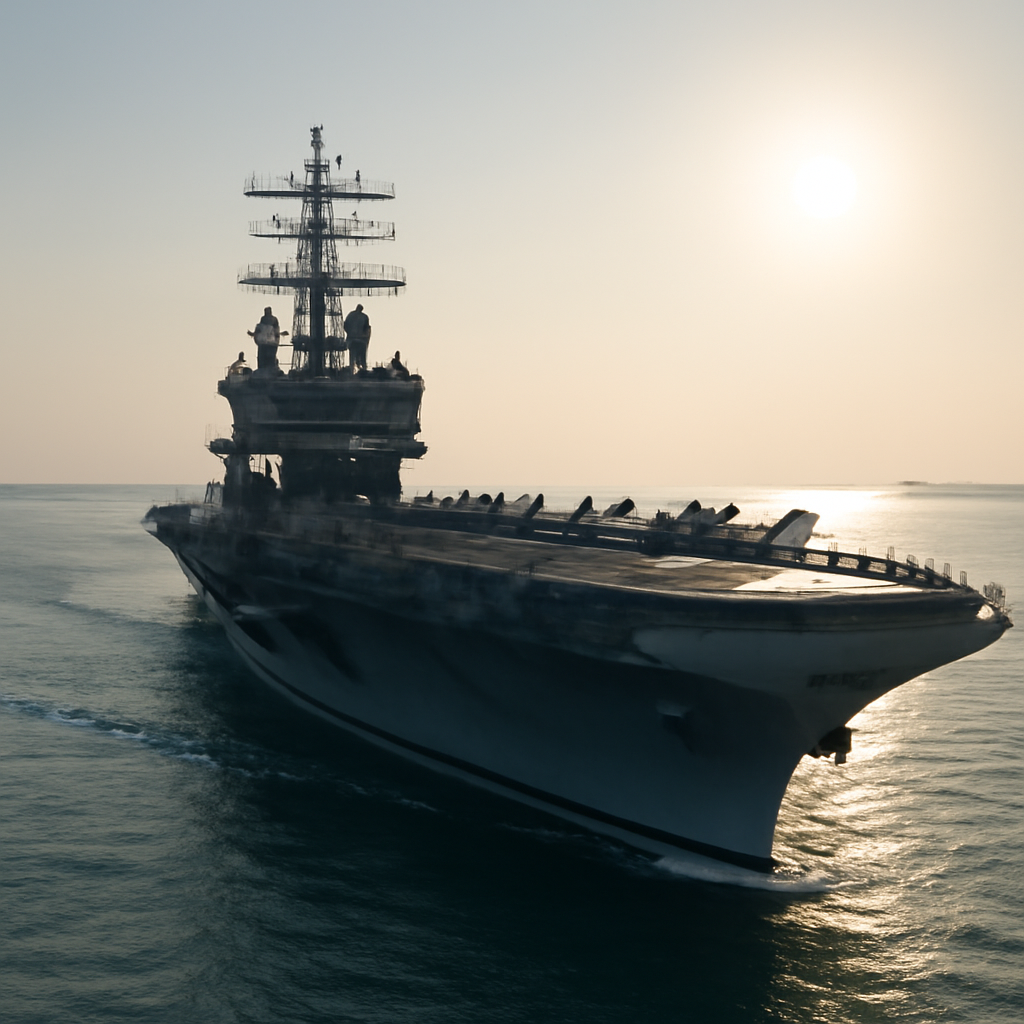
"The USS Abraham Lincoln crushed their deployment and will return home soon as part of a planned rotation," acting Secretary of the Navy Hung Cao said Friday.
USS Abraham Lincoln and USS George Washington: a planned rotation
Those words frame a movement that reshuffled the forward-deployed carrier picture this week. The Nimitz‑class USS George Washington transited the Singapore Strait as the sun was rising on August 13 and steamed west through the Malacca Strait, the Andaman Sea, and into the Indian Ocean. The transit, not publicly disclosed before the strait passage, was reported as en route to the U.S. Central Command (CENTCOM) area of responsibility to replace the USS Abraham Lincoln, which will cross the nine‑month deployed mark this week.
Lincoln has sustained a high sortie tempo in the CENTCOM theatre: the ship has flown more than 10,000 sorties and delivered over 1.5 million pounds of ordnance, according to the reporting. Lincoln was also photographed alongside fast combat support ship USNS Arctic and dry cargo ship USNS Alan Shepard in what appears to be a resupply alongside operations in the Arabian Sea.
No U.S. carrier in the Indo‑Pacific: a temporary coverage gap for PACOM
George Washington’s repositioning leaves Adm. Samuel Paparo, the commander of U.S. Pacific Command (PACOM), without any carrier strike group in the theater, the report notes. The move “means the U.S. currently has no carrier presence in Asia to deter the People’s Republic of China (PRC) and Democratic People’s Republic of Korea (DPRK),” the tracker said.
Paparo has previously warned of constraints on munitions, saying that operations in other regions “inherently, it imposes costs on the readiness of America to respond in the Indo‑Pacific region… it is now eating into [our] stocks, and to say otherwise would be dishonest.” With George Washington headed west, the closest deployed U.S. carrier group will be operating in a different part of the world should a contingency arise unexpectedly in Asia.

The cyber insurance questionnaire just landed. Now what?
SOC 2, HIPAA, insurance renewals - someone has to own security strategy. Nubivance provides fractional CISO leadership without the full-time salary.
Get a security leadCENTCOM blockade, the expired negotiation window, and continuing operations
As of publication, Abraham Lincoln and USS George H.W. Bush remain in the CENTCOM area of operations enforcing a maritime blockade described in the report as a “steel wall.” The 60‑day window originally set by a memorandum of understanding to negotiate an agreement to end hostilities expired on August 17; the source reports that neither side indicated interest in extending the window and that both sides appear farther apart than when the agreement began.
Iranian Foreign Minister Abbas Araghchi posted on Telegram over the weekend, “We have not yet made a decision to restart negotiations with the United States.” U.S. President Trump told Fox News, “I have no time schedule. I’m not in a hurry,” and posted on Truth Social about keeping Iran from acquiring a nuclear weapon, without addressing the expired deadline directly.
CENTCOM public affairs reported operational results: forces have turned 64 commercial vessels around, disabled three using kinetic effects, and boarded two additional vessels to ensure compliance (latest update published August 17).
Fleet posture, ship movements, and the near‑complete JFK
Other movements and readiness details underpin the carrier landscape. USS Carl Vinson was spotted leaving San Diego on August 10; her current mission set is not publicly available, but she has been working up for a future deployment. USS Theodore Roosevelt remains pierside in San Diego based on satellite imagery; her deployment date is classified. The report notes that with no carriers in PACOM and the CENTCOM blockade ongoing, Roosevelt’s deployment could occur sooner rather than later and that she could operate in Asia, the Middle East, or both.
Industrial and program milestones were also recorded: Pre‑Commissioning Unit John F. Kennedy returned to Newport News after completing acceptance sea trials on August 15. The second Ford‑class carrier is described as 98 percent complete and expected to be delivered in spring 2027, according to a press release from the Portfolio Acquisition Executive (PAE) for Maritime. Capt. Mark Johnson, Program Manager for Aircraft Carrier New Construction at PAE, was quoted praising the crew’s performance during trials.
The tracker summary: three U.S. carriers are deployed; three are working up or at homeport in various states of readiness; four are in maintenance; and one is being used for training. Positions are described as general approximations.
What this means for Sailors and Marines aboard USS Abraham Lincoln, Adm. Samuel Paparo, and carrier crews preparing to deploy
- Sailors and Marines aboard USS Abraham Lincoln: the ship has endured continuous operations and no liberty port calls since November; the reported rotation and resupply activity indicate relief and a planned return home after nearly nine months deployed.
- Adm. Samuel Paparo and PACOM leadership: with no carrier presence in Asia following George Washington’s redeployment, PACOM faces a temporary loss of carrier coverage for deterrence against the PRC and DPRK; the timing of a replacement depends on carrier transit speed and routing.
- Carrier crews preparing to deploy (Carl Vinson, Theodore Roosevelt and others): planners must balance readiness timelines, classified deployment dates, and the operational demands in CENTCOM that have stretched sortie and munition usage across the fleet.
The immediate factual hinge is simple: George Washington steamed toward CENTCOM on August 13 to replace a long‑deployed Abraham Lincoln, creating a brief lapse in U.S. carrier presence in the Indo‑Pacific as the blockade and negotiations in the Middle East remain unresolved. The next concrete signals to watch are the George Washington’s arrival date in CENTCOM, formal confirmation of Lincoln’s return date, and whether Carl Vinson or Theodore Roosevelt will shift deployment timelines to fill the Pacific gap.
Original TWZ report: Where Are The Aircraft Carriers?: August 17, 2026