“Arming the Navy with nuclear weapons ‘brooks no further delay,’” North Korean leader Kim Jong Un declared at the Hero Kim Kun Ok’s unveiling — a line that now frames Pyongyang’s latest claim of at-sea missile tests.
KCNA imagery and North Korean claims
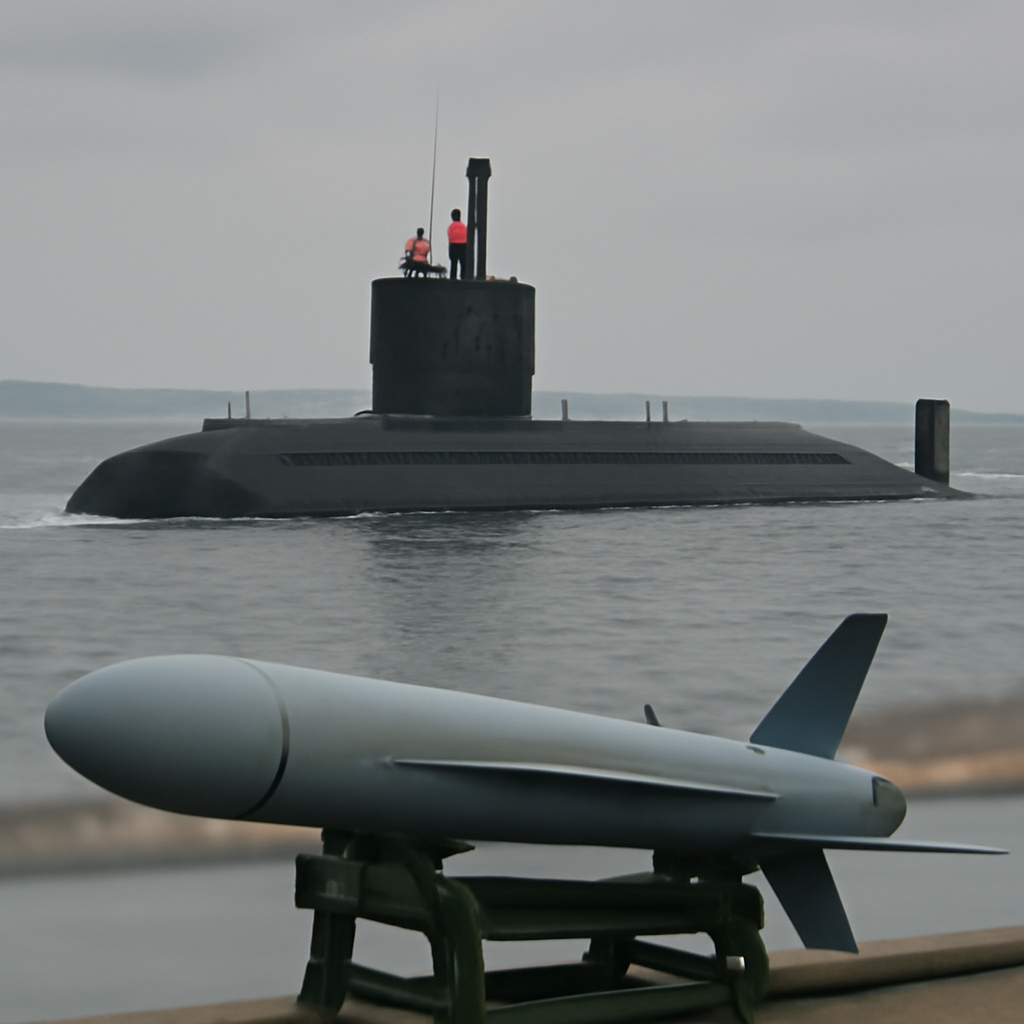
State media Korean Central News Agency (KCNA) reported on October 14 that North Korea test-fired two types of submarine-launched strategic cruise missiles off its east coast. KCNA released imagery showing cruise missiles in flight, a submerged launch, and one photo of the diesel-electric submarine Hero Kim Kun Ok underway. North Korea said the tests aimed to “assess the readiness of its underwater combat systems,” improve the Navy’s ability to execute strategic missions, and “demonstrate the reliability of its deterrent.” KCNA did not disclose ranges, flight paths, or detailed performance data for the missiles, and did not explicitly identify the vessel that launched them beyond the imagery it released.
South Korea’s Joint Chiefs of Staff: detection and launch method details
South Korea’s Joint Chiefs of Staff (JCS) reported that it had detected and tracked the launches from before firing through the cruise and terminal phases. A JCS spokesperson said one missile type was launched from a vertical launch system (VLS) and another from a torpedo tube. The JCS assessed that the launches came from a submarine but did not initially identify the vessel publicly. The JCS tracking lends “additional credence” to the possibility that the Hero Kim Kun Ok was the platform, even as analysts acknowledge alternative explanations.

Audit-ready is a season. It shouldn't be.
Evidence in spreadsheets, controls drifting between audits, frameworks multiplying on flat headcount. Nubivance runs continuous compliance on Rapid7 Cyber GRC - SOC 2, HIPAA, ISO 27001, PCI, CMMC.
End the scrambleTechnical portrait: the Hero Kim Kun Ok and its weapons architecture
Unveiled in September 2023, the Hero Kim Kun Ok is described by North Korea as a 3,000-ton-class diesel-electric submarine with hull number 841 and has been promoted as a “tactical nuclear attack submarine” and a core offensive platform. Open-source imagery previously showed a prominent ‘turtle back’ aft of the sail concealing what appeared to be 10 missile launch tubes and additional torpedo tubes. The boat is widely characterized in the reporting as a heavily modified derivative of the Cold War-era Romeo class rather than a purpose-built guided-missile submarine. The submarine’s reported mix of forward and rear tubes — with the forward four larger than the rear six — would support multiple missile types and launch methods, matching the JCS description that one missile came from VLS and another from a torpedo tube.
Related missile and submarine activity
The October 14 tests were reported as North Korea’s first publicly reported underwater missile-testing event since January 2024. North Korea has used other submarines in prior tests: March 2023 saw a submarine-launched cruise missile test from the older 8.24 Yongung, and in January 2024 Pyongyang said it fired Pulhwasal-3-31 strategic cruise missiles from that vessel, which is a roughly 2,000-ton-class boat with one or two vertical launch tubes. Analysts cited in the reporting suggested North Korea may now be validating combat systems ahead of deployment and could test a submarine-launched ballistic missile (SLBM) before the Hero Kim Kun Ok enters service. The reporting also notes Pyongyang’s separate nuclear-powered submarine project unveiled as under construction in March 2025 and references previous parade displays of SLBMs identified as the Pukguksong-5 in January 2021.
What this means for South Korea, the United States, and Japan
- South Korea: The JCS’s detection and tracking of the launches underscores Seoul’s monitoring capabilities; reporting also notes South Korea’s “sophisticated” anti-submarine capacities that make an antiquated Romeo-class derivative easier to track from port than a more modern or nuclear-propelled boat.
- The United States: The tests form part of a broader sequence of weapons demonstrations that Washington would factor into military planning. The reporting notes Pyongyang’s rejection of an apparent diplomatic opening from U.S. President Donald Trump after Washington sought adjustments to a U.S.-South Korean exercise.
- Japan: Along with South Korea and the United States, Tokyo is specifically named as a party whose military planning is complicated by North Korea’s diversification of delivery systems, including ground, surface, and now subsurface-launched cruise missiles.
If the Hero Kim Kun Ok was the launch platform, the reported events mark the first publicly noted at-sea weapons tests tied to that vessel and a step toward validating submarine-launched missile systems aboard it. Yet the reporting is careful to note alternatives: North Korea has previously paired underwater launches from other platforms with imagery of submarines for propaganda, and KCNA did not provide conclusive technical data. The concrete near-term questions the record leaves are whether Pyongyang will pursue an SLBM test from this hull and how reliably the boat can deploy and operate under realistic conditions; those outcomes will determine whether the vessel is an incremental addition to Pyongyang’s deterrent or a substantial change in regional naval risk calculations.