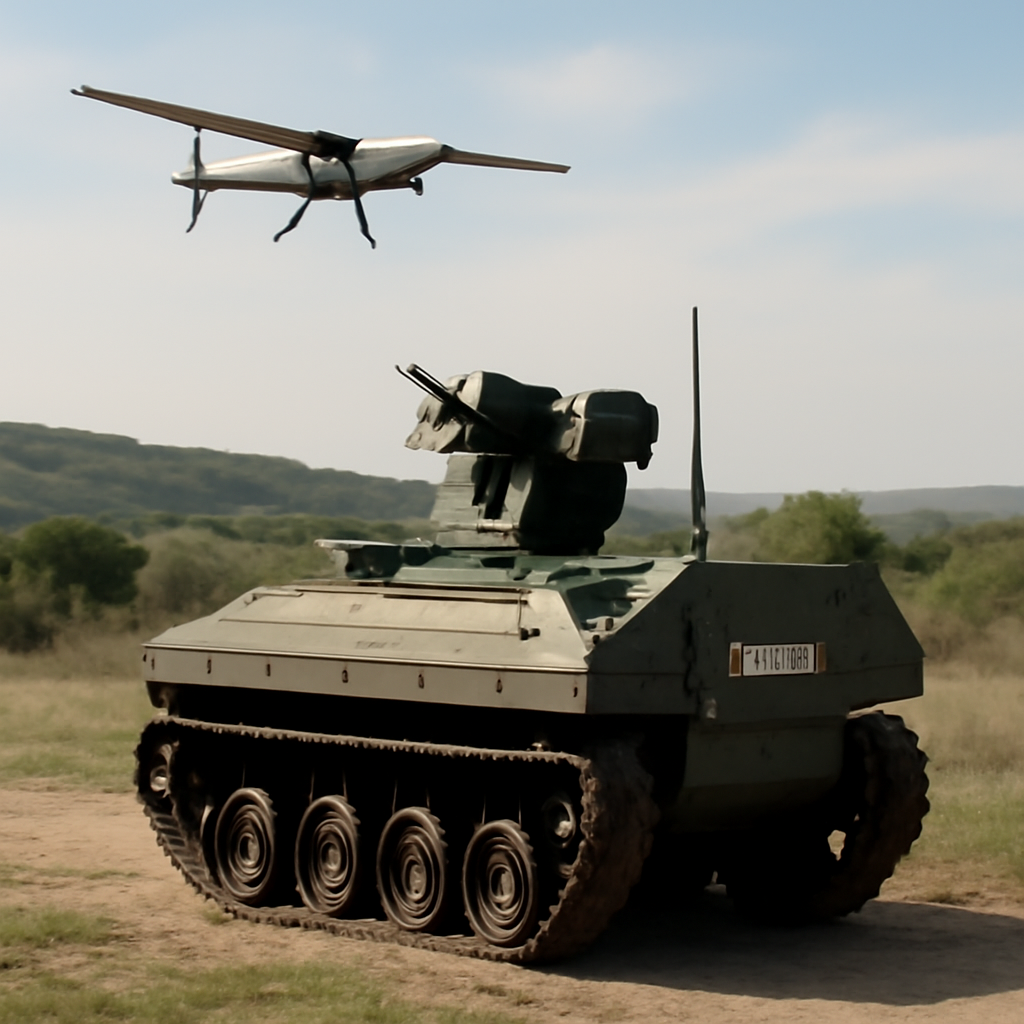
"BARKAN offers units direct fire support and can remain in continuous operation for up to eight hours over difficult terrain," HAVELSAN said, summarising the unmanned ground vehicle's intended operational reach at Ateş Serbest-2026.
BULUT UAV: runway-independent reconnaissance and target marking
HAVELSAN's BULUT appeared in live demonstrations at the General Nahit Şenoğul firing and training area in Polatlı, Ankara, performing reconnaissance, target‑marking and surveillance missions. The company describes BULUT as a fixed‑wing, sub‑cloud autonomous UAV produced for modern military units and security forces, and the platform draws on a runway‑independent vertical take‑off and landing capability to operate where prepared runways are unavailable.
BARKAN UGV: armed, modular and multipurpose
On the ground, HAVELSAN showcased BARKAN engaging designated targets with an integrated 12.7 mm remote‑controlled weapon station (RCWS). The exercise tested UGVs in reconnaissance and surveillance, logistics‑line protection and three‑dimensional mapping as well as fire support. HAVELSAN says BARKAN can be configured for a wide range of roles — bomb disposal using a robotic arm, chemical, biological, radiological and nuclear (CBRN) threat detection, cargo carriage, day‑and‑night reconnaissance, mapping and rescue missions — and that the platform was designed to meet Turkish Land Forces and law‑enforcement requirements.
BARKAN made its public debut at the end of February 2021; HAVELSAN later expanded the family with BARKAN II as part of Türkiye's broader effort to develop autonomous and robotic land systems.

This site is the portfolio.
OSINTSights runs on Cloudflare Workers, D1, R2, and Vectorize, with an AI pipeline on Hetzner ARM. Nubivance designed, built, and operates it. We do the same for clients.
See what we buildAteş Serbest‑2026: multi‑service live firing and static displays
Ateş Serbest‑2026 began on 1 September and brought together elements from the Land Forces, Naval Forces, Air Force and General Staff Special Forces Command. The exercise is intended to showcase firepower in the Turkish Armed Forces' inventory, demonstrate effects on target, and improve coordination of fire support between services. Live firing and static displays covered different mission areas and included demonstrations from multiple national producers.
The exercise schedule included a Distinguished Observer Day on 15 October and a planned conclusion on 22 October.
Other systems on display at Polatlı
Polatlı also hosted a range of other unmanned and crewed systems. The modular PALEM UGV appeared equipped with ASELSAN's SARP DUAL RCWS and ROKETSAN's KARAOK turret; one scenario showed PALEM moving a casualty to safety after a tank reached the casualty and laid a smokescreen. ROKETSAN presented KARAOK as its third‑generation, fire‑and‑forget, short‑range guided anti‑tank weapon.
Artillery demonstrations included ASFAT's 155 mm PANTER howitzer, whose five‑person crew engaged targets at ranges of up to 40 km. MKE participated with the TOLGA short‑range air defence system and the 155 mm FIRTINA and 105 mm BORAN howitzers.
HAVELSAN's wider recent displays were also noted: at ADEX 2026 in Baku the company exhibited BAHA, a separate VTOL UAV, from 30 September to 2 October; at NUSRET 2026 on 7 October HAVELSAN displayed a self‑funded underwater remotely operated vehicle (ROV) capable of operating at depths of up to 300 m; and its ADEX 2026 display included the SANCAR armed unmanned surface vehicle, which the company said has completed acceptance and live‑fire trials.
What this means for the Turkish Land Forces, law enforcement, and defence industry
- Turkish Land Forces: The combined demonstrations of BULUT, BARKAN and crewed artillery systems underscore a focus on integrating unmanned aerial and ground platforms into reconnaissance, target marking and direct fire support — tasks highlighted repeatedly during the Polatlı scenarios.
- Law enforcement: BARKAN's design intent to meet law‑enforcement requirements and its configurable roles for bomb disposal, CBRN detection and casualty evacuation indicate a push to adapt military UGV technology for domestic security missions.
- Defence industry and procurement leaders: Executives from ASELSAN, Baykar, HAVELSAN, ROKETSAN and TÜBİTAK SAGE attended the exercise on site, reflecting both industry collaboration in field trials and an on‑display pipeline of systems — from RCWS and turrets to guided weapons and artillery — available for integration and procurement.
The Polatlı demonstrations stitched together unmanned systems, traditional artillery and new effectors under a single operational narrative: testing how sensors, weapons and protective functions perform together in combined arms scenarios. With Distinguished Observer Day on 15 October and the exercise scheduled to conclude on 22 October, the immediate next step is further evaluation of those interactions in live‑firing conditions and in scenarios that stress logistics, casualty movement and CBRN response — precisely the mission areas the featured systems were shown to address.
Original reporting: Quwa — HAVELSAN Fields BULUT UAV and BARKAN UGV at Ateş Serbest‑2026