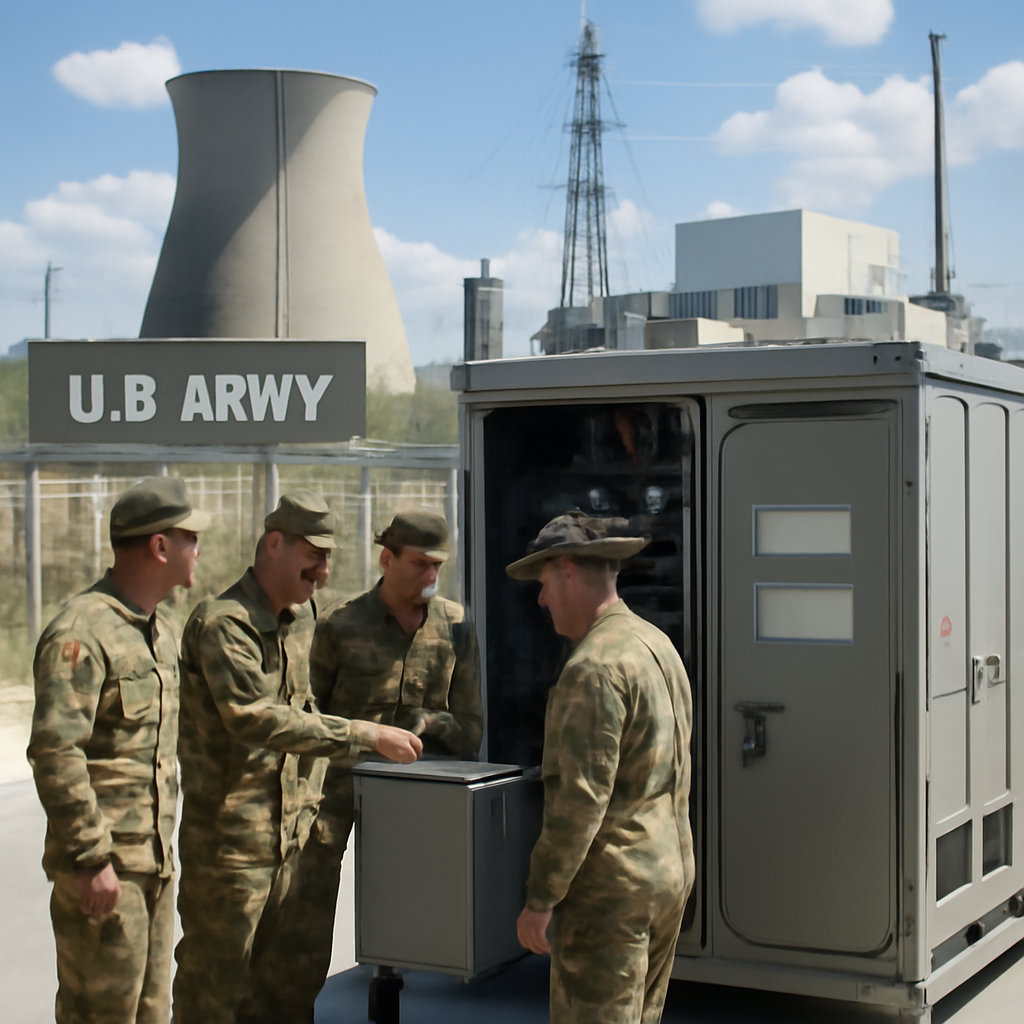
"Unlike in prior conflicts, we now know that our domestic electric grid is potentially at risk in a conflict," Jeff Waksman told reporters, explaining why the Army is moving ahead with the Janus microreactor effort.
Jeff Waksman and the Janus program
The Army has committed roughly $2.2 billion across five companies to the Janus program, with the stated goal of producing 20 prototype microreactors that will be contractor owned and operated at five bases. The first prototype is scheduled to be operational by the fall of 2028. Waksman, the principal deputy assistant secretary of the Army for installations, energy and environment, framed the program as a response to two perceived risks: vulnerabilities in the domestic electric grid during conflict and limits on moving fossil fuels to where they’re needed.
Nuclear waste handling and the Department of Energy
Operational core life for the microreactors varies by design and could be “as short as a handful of years, up towards a couple of decades,” and some designs will sit above ground while others require excavation. That raises an immediate question: what happens to spent fuel and any contaminated soil?
The program contract requires that “all radiological material has to be removed from the site within two years of [the end of] operation,” Waksman said, and he emphasized the Army’s intent of “no long-term nuclear waste” at installations hosting these reactors. The Army is discussing arrangements with the Department of Energy (DOE) under which DOE would take title to the waste and the waste would go to a DOE site, with money transacted as part of that handoff. “We are not going to stand up an Army-licensed nuclear waste facility. That would not be beneficial or practical,” Waksman said.

This site is the portfolio.
OSINTSights runs on Cloudflare Workers, D1, R2, and Vectorize, with an AI pipeline on Hetzner ARM. Nubivance designed, built, and operates it. We do the same for clients.
See what we buildHALEU fuel supply and DOE/NNSA coordination
All companies selected for Janus plan to use High-Assay Low-Enriched Uranium (HALEU) feedstock — uranium enriched to between 5 percent and below 20 percent — and to produce Tristructural Isotropic (TRISO) fuel particles for reactor cores. But the U.S. supply of HALEU is limited, and “as of right now, there simply is not enough fuel supply available to feed the 20 microreactors planned for this program,” the Army acknowledged.
Waksman said the Army expects prioritization to supply the “fastest moving reactors” and that the nation’s ability to provide HALEU for more than 20 reactors “is probably going to push beyond what our supplies are as a nation.” He noted coordination with DOE and the National Nuclear Security Administration (NNSA) to stand up new enrichment capability, including downblending Highly Enriched Uranium (HEU). The article cites DOE’s January announcement to spend $2.7 billion over 10 years to boost domestic enrichment services for both LEU and HALEU.
Costs, the contractor-owned model, and affordability
The $2.2 billion in Janus funding is positioned as prototype development money; full installation on bases and any expansion will increase the bill. Waksman acknowledged uncertainty over whether the contractor-owned-and-operated model will deliver the price points companies advertise. He said Janus is intended to “flesh out how we can get those prices down,” while noting microreactors are unlikely to be as cheap per kilowatt-hour as large commercial reactors for “engineering and physics reasons.”
Waksman provided a point of comparison: in austere locations the department “is regularly paying” about $0.40 per kilowatt-hour for natural gas. He warned that if microreactors cost $1.00 per kilowatt-hour, “that’s not going to work.” The Army relied on companies’ proposals in selecting awardees and said part of the selection process was confidence that vendors could reduce costs into a useful range for the service.
Safety, security, and the regulatory path
The Army will license the Janus reactors on its installations rather than the Nuclear Regulatory Commission (NRC). At the same time, Waksman said the service is working with the NRC to “make the additional licensing process as smooth as possible” so that companies can transition design work toward commercial NRC licensing afterward. He made clear that DOE-, Army-, and NRC-licensed reactors are distinct: “It does not mean that a DOE-licensed reactor is automatically Army licensed, or that an Army licensed reactor is automatically NRC licensed.”
On security, Waksman pointed out that HEU (above 20 percent enrichment) will not be used for Janus, which changes the risk profile. He also said the Army will “be leveraging the Army security that already exists” and that “additional security requirements for important infrastructure on Army installations” are part of the program. Details were not released, but the report notes the military already uses air defense and counter-drone systems to protect critical infrastructure and that the administration is “laying the groundwork to stand up Golden Dome, a sprawling, multilayered homeland air defense system.” Environmental laws still apply; Waksman noted NEPA reforms may speed reviews but that “all the environmental rules that would apply to nuclear reactors in the commercial sphere would also apply here.”
The Janus program sets a concrete timetable and budget for prototypes but leaves critical operational decisions open: definitive DOE waste-handling agreements, a reliable HALEU supply for later units, demonstrable cost reductions, specific security measures beyond base protections, and the pathway for NRC commercial licensing. The Army’s immediate next landmark is clear — get the first contractor-owned microreactor operating on a U.S. base by fall 2028 — even as the program’s long-term scale and footprint remain contingent on answers the service is still negotiating.