"To achieve strategic overmatch in prolonged combat operations, the Department of the Army requires a paradigm shift toward ‘Affordable Mass’," the solicitation reads — and the Army has just put that doctrine to the test.
What the manufacturing rodeo demands from vendors
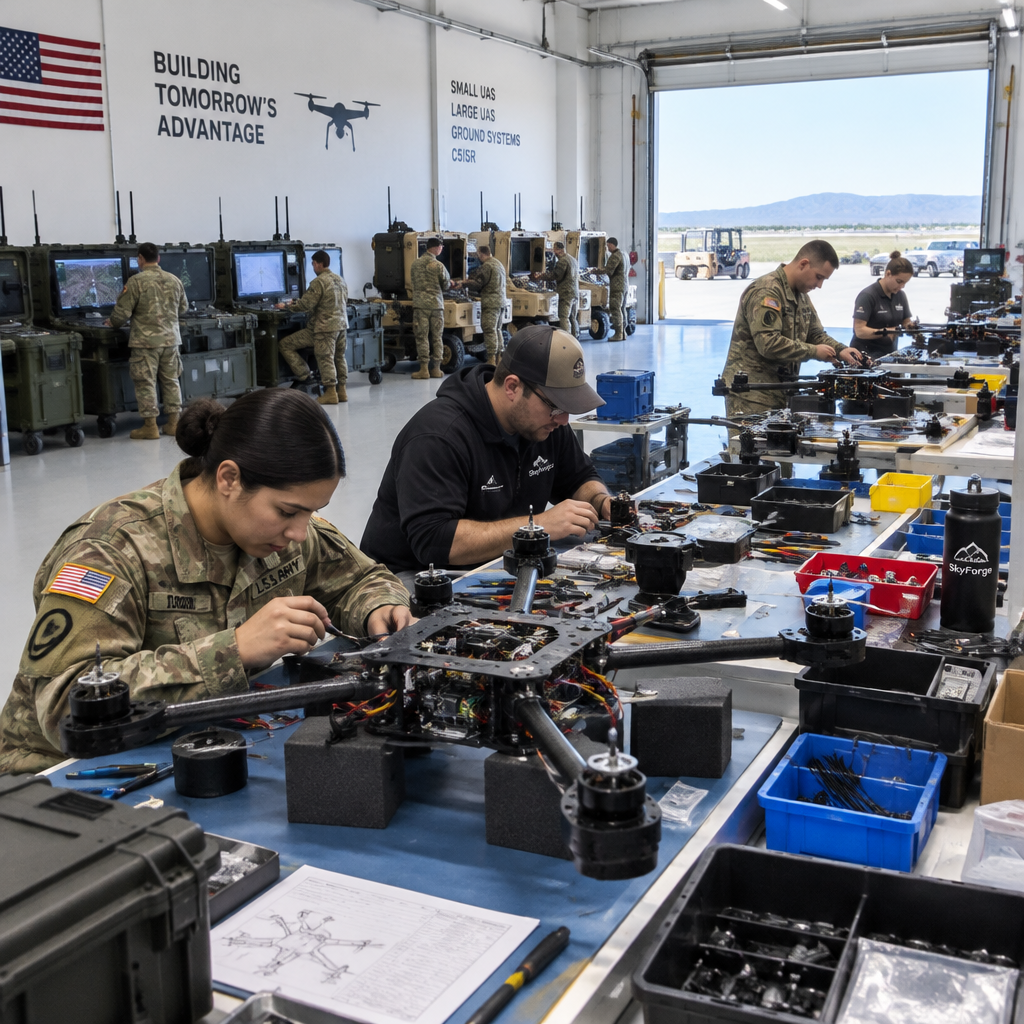
The Army’s first "manufacturing rodeo" centers on a blunt, measurable objective: vendors must demonstrate the ability to rapidly build and scale one-way attack drones that cost no more than $3,000 apiece. The solicitation asks selected companies to deliver 400 Group 1 (20 pounds or less) one-way attack drones and 20 ground combat stations each by March 1. Group 1 is specified as weighing 20 pounds or less, and the service will provide government-furnished equipment — battery packs, brushless motors, MK118 lethality kits and frame kits — for vendors to assemble into finished systems.
Schedule and interim milestones are strict. Ten percent of the drones and ground stations must be delivered by Feb. 15 for "testing and operator training." Initial responses to the solicitation are due Wednesday.
How the Army will test systems at the Drone Dominance Gauntlet
The finished platforms will be put through a public proving ground: the Army’s third Drone Dominance Gauntlet event in March. There the systems will face "complex" obstacle courses, heavy electronic jamming and "live target arrays." The solicitation seeks a diverse set of Group 1 one-way attack drones — including systems capable of precision strike, operation in contested environments and the carriage of commercial kinetic and non-kinetic payloads — and it requires an open systems architecture for all entries.
Success at the Gauntlet carries large upside: systems "deemed successful will 'unlock priced contractual options for scaled production' for up to 10,000 drones," according to the solicitation. If teams clear that bar, the program plans to transition drone assembly into shared coproduction lines between the vendor and the government.

This site is the portfolio.
OSINTSights runs on Cloudflare Workers, D1, R2, and Vectorize, with an AI pipeline on Hetzner ARM. Nubivance designed, built, and operates it. We do the same for clients.
See what we buildSupply-chain verification, audits and industrial stress drills
The rodeo is not solely a test of airframes and software; it is explicitly a stress test for manufacturing and supply chains. The Army says the exercise is "an execution-oriented prototype and industrial stress drill designed to vet both platform performance and domestic supply chain robustness under compressed timelines." To that end, the Army and the Defense Contract Management Agency will carry out "rigorous" audits and "teardown" inspections at vendors’ manufacturing plants to verify that all parts are void of any components from outside the continental United States.
After initial deliveries and the Gauntlet, production lines will face a battery of further drills intended to simulate real-world disruptions: "simulated feeder disruptions," raw material blockades and other obstacles are listed as planned exercises. The solicitation frames these tests as a way to "definitively validate the United States' capacity to mass-produce lethal, affordable autonomous systems during sustained national security emergencies."
What this means for vendors, the Army, and the Defense Contract Management Agency
- Vendors: The solicitation forces a near-term emphasis on rapid scale-up and manufacturability. Companies must assemble 400 one-way attack drones and 20 ground combat stations by March 1, accept government-furnished kits, meet a $3,000 per-unit cost cap, and submit 10% of production by Feb. 15 for testing and operator training — all while subjecting their plants to teardown inspections and domestic-sourcing verification.
- The Army: The service is using the rodeo to "strain" and "stress test" supply chains and platform designs in an execution-oriented setting. By tying success at the March Gauntlet to priced options for up to 10,000 units and coproduction lines, the Army is attempting to move from prototype demonstrations into validated mass-producibility under compressed timelines.
- Defense Contract Management Agency: The agency will play a central role in auditing and tearing down systems at vendor facilities to confirm domestic origins of components and to assess manufacturing robustness under the industrial stress drills specified in the solicitation.
The rodeo is built as an industrial experiment: aggressive timeline, tight cost ceilings, and explicit domestic-sourcing verification. The immediate next step is procedural — initial responses are due Wednesday — but the program’s schedule moves quickly from contract awards into production milestones, teardown inspections and the March Gauntlet. The solicitation leaves no mystery about the Army’s ambition: to test whether low-cost, mass-produced autonomous attack systems and resilient domestic production can be achieved together. Whether the coproduction lines and simulated disruptions will "definitively validate" that capacity remains the central question the rodeo is designed to answer.
https://breakingdefense.com/2026/11/army-kicks-off-manufacturing-rodeo-with-focus-on-small-drones/