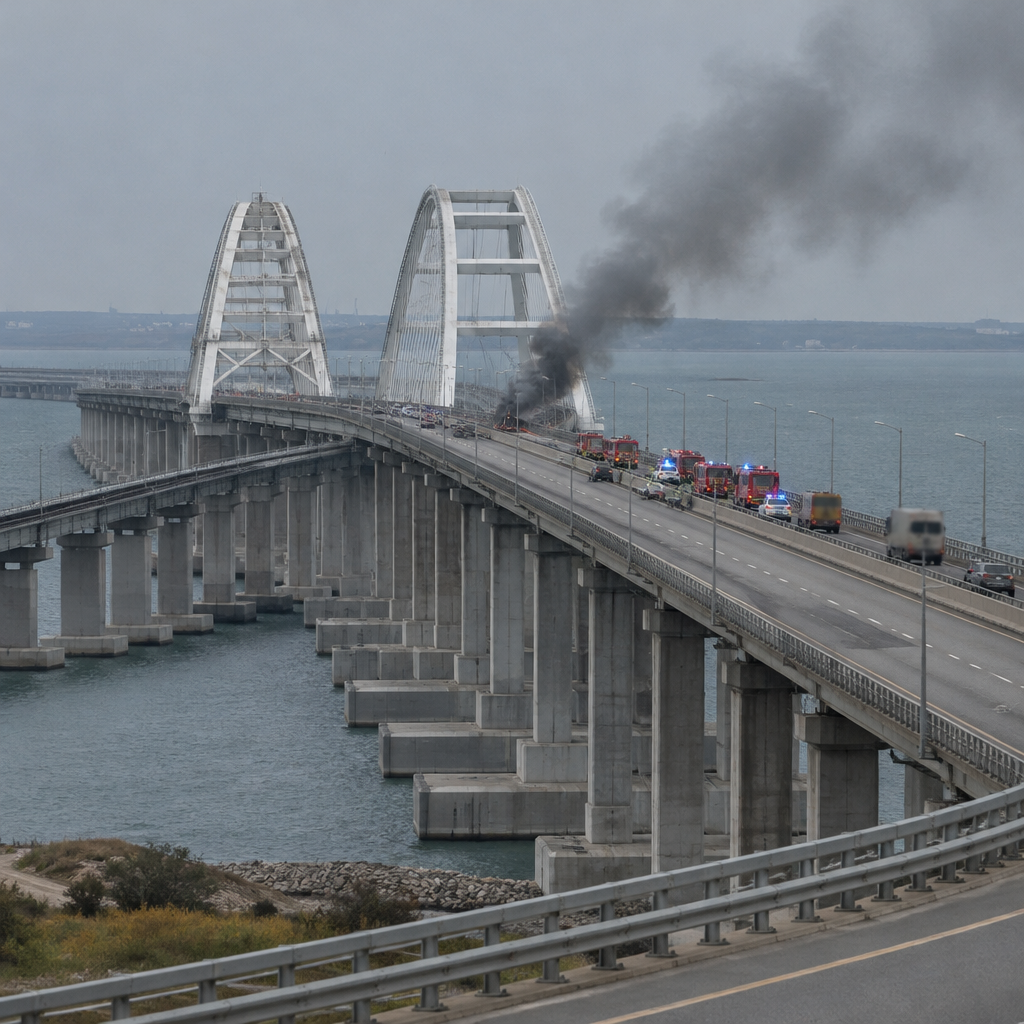
"The enemy attacked the Crimean Bridge again," Sergey Aksyonov wrote on Telegram at about 1:34 a.m. local time on Tuesday, and added that traffic on the span was suspended while authorities would "provide further updates on the situation."
Sergey Aksyonov and the immediate response in occupied Crimea
Russian-installed head of Crimea Sergey Aksyonov posted the attack confirmation on Telegram, telling residents and visitors to "refrain from traveling towards the bridge" and to "take into account any restrictions when planning their routes." He also urged people to "only trust official sources of information." Aksyonov’s statement came after what the reporting describes as a second strike on the Kerch (Crimean) Bridge in less than 24 hours.
Social-media and television footage: explosions, deformation, and uncertainty
Videos circulating on social media purport to show explosions and fire on the Kerch Bridge, including a clip that appears to show an explosion in the same part of the structure hit during the earlier strike and the bridge "losing its shape." TWZ cautioned that the "poor nature of imagery" makes authenticating those clips and assessing the outcome of the reported second strike difficult.
Russian television first broadcast footage showing significant damage to the crossing after the earlier attack, with visible deformation of the main road span on the Kerch side. Independent commentators on X (formerly Twitter) amplified those images: one post said local sources in Russian-occupied Crimea reported "at least 15 impacts," while others noted claims by Russian "Z-bloggers" that the arch was hit directly.

Audit-ready is a season. It shouldn't be.
Evidence in spreadsheets, controls drifting between audits, frameworks multiplying on flat headcount. Nubivance runs continuous compliance on Rapid7 Cyber GRC - SOC 2, HIPAA, ISO 27001, PCI, CMMC.
End the scrambleSatellite imagery and a measured tilt: physical signs after the first strike
TWZ obtained satellite imagery (©2026 Vantor) that showed damage to the arch and possible scorch marks on the roadway following the first attack. The imagery was described as consistent with the damage visible on Russian television. Analysts posting sketches from photographs estimated a 4.9-degree tilt in the damaged arch after that initial strike, a displacement that "could severely limit the loads the span can safely carry," according to the reporting.
TWZ also noted that the satellite imagery showed dark marks at the opposite end of the main road span; the report cautioned these marks "may not be related to the initial attack." The second strike, reported overnight, arrived against that background of visible structural stress and ongoing analysis.
Strategic role of the Kerch Bridge and the pattern of attacks
TWZ described the Kerch Bridge as both a "prized span" associated with Vladimir Putin and a "critical road and rail connection for moving military personnel, equipment, and supplies between mainland Russia and occupied Crimea." The overnight strike was the first time in more than a year that Ukraine struck the bridge after three prior attacks had already damaged it, the reporting said, and the bridge "has remained a top target for Ukrainian forces."
Despite repeated attacks and visible damage, the report underscored that the bridge continued to figure prominently in logistical calculations for movement across the peninsula, a fact that helps explain why it has been repeatedly targeted.
How military logisticians, civilian authorities in Crimea and Kyiv, and imagery analysts are responding
- Military logisticians and planners: The reported damage—including an assessed 4.9-degree tilt to the arch—directly affects what the span can safely carry. That constraint will shape routing decisions for personnel and materiel between mainland Russia and occupied Crimea until authorities can confirm structural stability and reopen the crossing.
- Civilian authorities in Crimea and Kyiv: In Crimea, Aksyonov’s suspension of traffic and requests that residents avoid the bridge are immediate measures to limit civilian movement into a potentially unstable area. In Kyiv, reporting via the Financial Times — cited by TWZ — quoted Kyiv Mayor Vitali Klitschko saying preliminary reports indicated Russian ballistic missiles hit the northern and southern bridges over the Dnipro; the FT coverage framed those strikes as part of an intensifying campaign targeting bridges in recent weeks.
- Imagery analysts and technologists: TWZ emphasized the continuing role of satellite imagery and open-source video in tracking damage, while noting the difficulties of authenticating low-quality clips. TWZ editor-in-chief Tyler Rogoway told X that "something new appears to have shifted technologically and/or tactically for Ukraine" in the ability to strike the Kerch Bridge, and the report also flagged recent disruptions in SpaceX Starshield satellite communications service affecting Ukraine.
No Ukrainian officials had come forward to claim credit for the second overnight strike as of the TWZ report, even though the outlet opened by saying Ukraine launched the second attack. TWZ framed the second strike as likely to follow the first, noting that "you would think Ukraine is going to do anything possible to retarget that exact point ASAP," a comment it attributed to social-media analysis.
The record, as presented in the reporting, is a mix of on-the-ground warnings, contested video, satellite confirmation of the earlier damage, and competing missile strikes reported in Kyiv. Authorities in Crimea have promised further updates; analysts and logisticians will be watching for official confirmations of structural integrity, any opening of the span to traffic, and whether additional strikes alter control of the corridor.
Contact the author: howard@twz.com