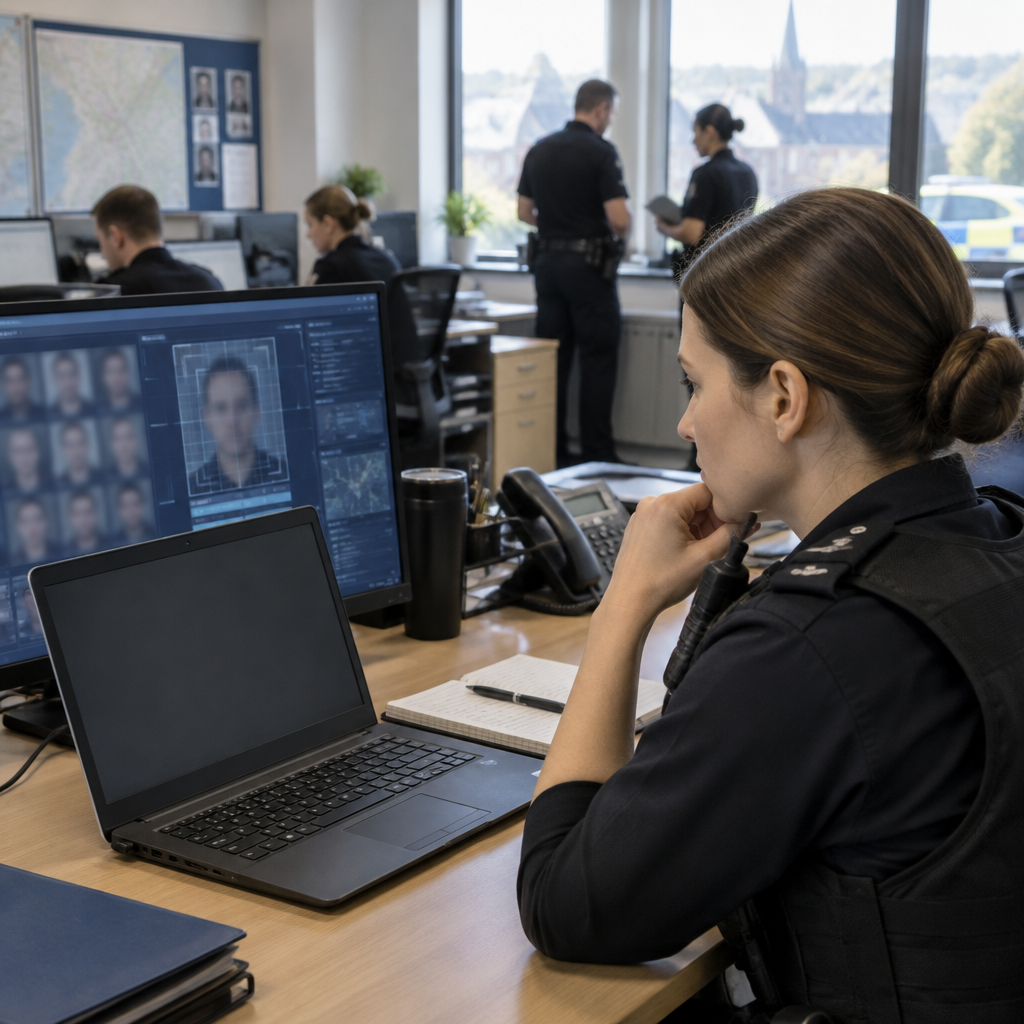
"Police forces must be able to show that appropriate safeguards are in place, risks relating to bias and data retention are effectively managed, and decisions are still subject to human judgment," Kathryn Stone, His Majesty's inspector at HMICFRS, said.
HMICFRS finds fragmented governance and legal gaps
His Majesty's Inspectorate of Constabulary and Fire & Rescue Services (HMICFRS) has concluded that the United Kingdom's use of retrospective facial recognition (RFR) by police forces and the National Crime Agency suffers from "fragmented and underdeveloped" frameworks for governance and legislation. The inspectorate said there is a large gap in understanding about how RFR should be used in responsible policing and identified a lack of bespoke legislation to provide a uniform approach. HMICFRS argued that existing laws "have not kept pace with the technology" and called for a statutory code to be included in the forthcoming Police Reform Bill to set nationwide standards.
Investigators treating RFR matches as evidence, not intelligence
The report highlights a widespread misunderstanding among investigators about the status of RFR outputs. Although National Police Chiefs' Council (NPCC) representatives routinely communicate that RFR results are intelligence, not evidence, HMICFRS found that individual investigators "often" thought RFR results constituted evidence. "We found that some investigators didn't always carry out enough corroborative enquiries before acting on potential matches," the inspectorate said. "In a small number of cases, officers relied too heavily on RFR results, which led to inappropriate investigative action."
HMICFRS described these findings as "deeply concerning." The inspectorate noted operational pressures as a common explanation — acute demands on response teams, and in at least one force, managers who encouraged officers to "progress investigations quickly" after getting a match. The report underlined that "just because an arrest is made, it does not necessarily mean it is wrongful," since investigators may need to rule subjects out; nevertheless, the onus for appropriate action remains with police forces themselves.

This site is the portfolio.
OSINTSights runs on Cloudflare Workers, D1, R2, and Vectorize, with an AI pipeline on Hetzner ARM. Nubivance designed, built, and operates it. We do the same for clients.
See what we buildTraining shortfalls, image-retention failures and the benefits of centralised teams
HMICFRS found that training on RFR use remains inconsistent across forces and that better training would support more lawful and effective use. The inspectorate also identified repeated failures to meet image retention obligations: some forces retained custody images on the Police National Database that should have been deleted under existing guidance. The report noted that the best-performing forces had centralised facial recognition teams, which tended to provide stronger governance and more consistent processes.
The Police Reform Bill includes a provision to group custody images with DNA and fingerprints, a step the inspectorate framed as bringing more robust measures to ensure images are retained or deleted in line with legal requirements. HMICFRS also recalled that a Home Office review in 2017 found introducing a statutory framework for automated deletion was "untenable," concluding police could not automate the deletion of images and that doing so manually would be too time-consuming.
Public and police sentiment, and civil-society alarm
HMICFRS contrasted operational failings with a generally favourable public view of facial recognition in policing. Surveys carried out in 2025 by the Ada Lovelace Institute, the Alan Turing Institute, and the King's College London Policy Institute showed support for police use of facial recognition "ranging from 91 percent and 53 percent respectively." Home Office figures released alongside the report indicated similar positivity among police officers, with only 4 percent reporting a negative experience.
But not all voices welcomed the inspectorate's findings as reassurance. Jasleen Chaggar, senior legal and policy officer at Big Brother Watch, warned that the practice of treating RFR outputs as evidence "significantly increases the risk that more innocent people will have officers knock on their door to arrest them for crimes committed in towns they've never visited, as we've seen before." She added: "Worse still, police aren't even logging their use of retrospective facial recognition, meaning people could wrongfully become suspects in criminal investigations without any record of why they've been accused." The Register's comments section was noted by HMICFRS as often painting a vastly different picture of public perception.
What this means for police forces, the public, and the government
- Police forces: Must tighten local governance, standardise training, centralise RFR capability where possible, and enforce image-deletion policies — HMICFRS says those that did so showed better, more consistent practice.
- The public: Faces a mix of broadly expressed support in surveys and real risk of wrongful investigative action where corroboration and logging are weak; trust hinges on demonstrable safeguards for bias management, retention, and human oversight.
- The government and lawmakers: Are being urged to include a statutory code in the Police Reform Bill to create national standards and clearer legal footing; HMICFRS said stronger national standards and oversight "are essential to maintaining public confidence."
The inspectorate's findings map a simple, stark choice: preserve public confidence in a technology many say speeds investigations, or let inconsistent practice and weak recordkeeping erode trust through avoidable wrongful investigative action. HMICFRS has placed a statutory code in the Police Reform Bill at the centre of its remedy; the next step is for legislators and police leaders to decide whether the legal and governance changes the inspectorate demands will be adopted and enforced.