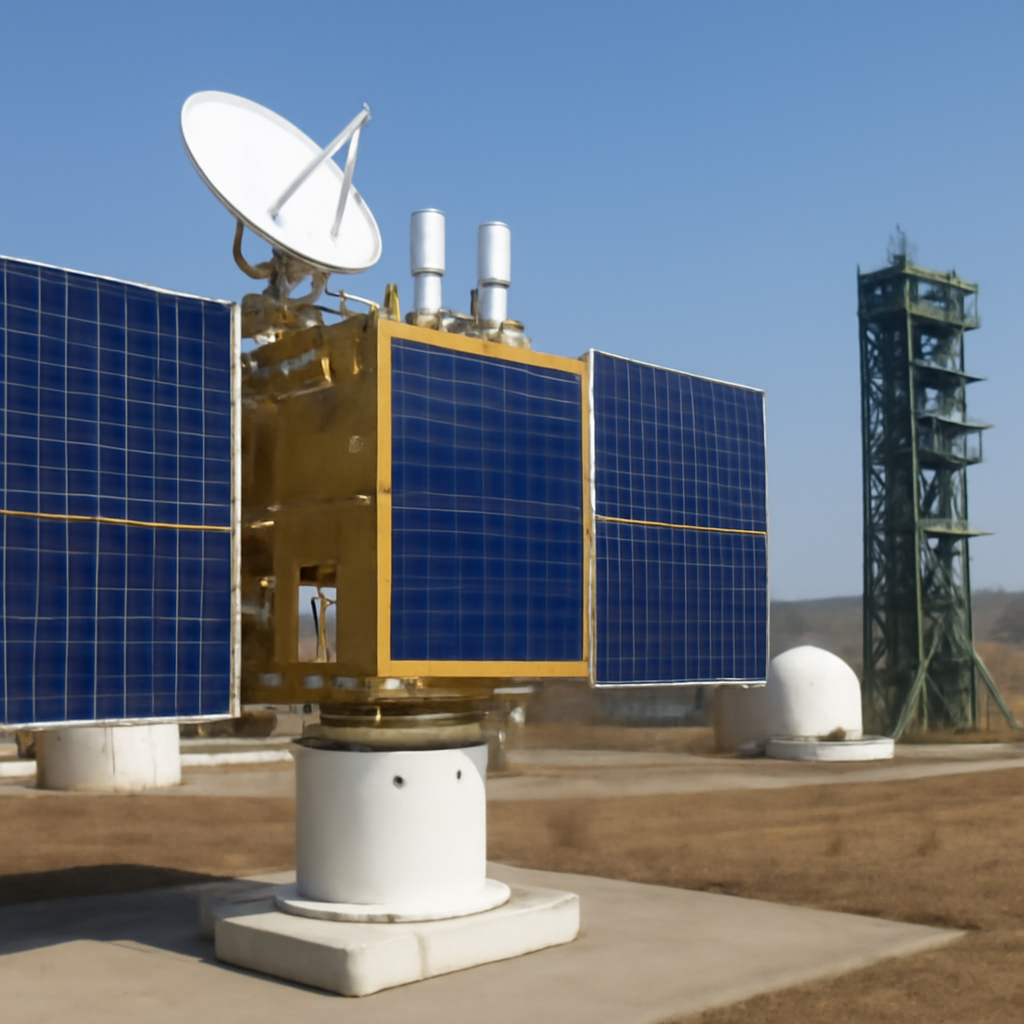
Malligyong-1 launched in November 2023 — a clear technological milestone for Pyongyang, but one satellite alone cannot provide continuous surveillance of the Korean Peninsula or the Western Pacific.
Malligyong-1 and North Korea’s satellite problem
North Korea has publicly announced plans to deploy multiple reconnaissance satellites capable of monitoring the Korean Peninsula and U.S. military hubs in the Western Pacific, including Guam and Okinawa. The source makes clear that placing a single satellite into orbit is far easier than fielding an operational military reconnaissance constellation. Effective constellations require multiple coordinated satellites, reliable launch capabilities, sophisticated ground infrastructure, and the ability to process and distribute imagery rapidly and securely.
Satellites in low Earth orbit pass over the same location only periodically, the source notes; a lone satellite leaves significant gaps between observations. That limitation is particularly problematic for time-sensitive military targets such as transporter-erector-launchers (TELs), mobile missile units, aircraft deployments, and naval movements. Closing that capability gap through indigenous development will likely take North Korea years.
Russia’s alternative: share intelligence, not satellites
Rather than transferring the highly sensitive technologies needed for advanced reconnaissance satellites — including high-resolution optical sensors, synthetic aperture radar (SAR), and secure satellite communications — the source argues that Moscow could provide processed intelligence products derived from its existing Earth observation network. Russia already operates an extensive network of military and civilian Earth observation satellites capable of monitoring Northeast Asia.
Sharing intelligence products would give Pyongyang many of the battlefield benefits of an advanced reconnaissance capability while allowing Moscow to retain control over the underlying space technologies. Satellite-derived intelligence can be calibrated, restricted, or suspended according to political or military objectives, enabling the Kremlin to control what intelligence is shared, when it is shared, and under what conditions.

This site is the portfolio.
OSINTSights runs on Cloudflare Workers, D1, R2, and Vectorize, with an AI pipeline on Hetzner ARM. Nubivance designed, built, and operates it. We do the same for clients.
See what we buildThe Belarus precedent: institutionalized access
Russia has already used a model centered on intelligence sharing with a close partner. In early 2024, Russia and Belarus announced plans to develop a joint Earth observation satellite constellation that integrates satellites, ground infrastructure, and image-processing capabilities into a single network. Belarusian officials argued integration would dramatically shorten revisit intervals and enable near-real-time Earth observation.
The Belarus arrangement shows Moscow can strengthen a partner’s reconnaissance capabilities without exporting sensitive space technologies. For North Korea — whose indigenous program remains at an early stage following Malligyong-1 — a similar approach would provide operational advantages without requiring a domestic satellite industry.
Institutional signs: treaties, reorganizations, and shared forums
Several concrete developments suggest the political and institutional foundations for Russia–North Korea intelligence cooperation are growing. The Comprehensive Strategic Partnership Treaty signed in June 2024 explicitly identified space cooperation as an area for bilateral collaboration. In 2026, Pyongyang reorganized its Ministry of State Security into a National Intelligence Bureau, and senior North Korean intelligence officials increased contacts with Russian security institutions.
North Korea also participated in the “International Cooperation in the Field of Information Security” roundtable in Moscow in May 2025, joining Russia, Belarus, Cuba, Iran, and others in a joint declaration that identified low Earth orbit (LEO) satellite communication systems as an emerging technology capable of undermining social and political stability. The source further documents expanding technical ties: increased academic exchanges involving space science, a shift in North Korean overseas satellite broadcasting from Chinese to Russian satellites, and a steady broadening of bilateral military cooperation.
What this means for Seoul, Washington, and Tokyo
- Seoul: South Korean policymakers should broaden attention beyond visible technology transfers and launches to the institutional relationships and intelligence networks that could enable Moscow to supply processed satellite-derived imagery to Pyongyang, the source urges.
- Washington: U.S. policymakers are warned that intelligence sharing is harder to detect than satellite launches, missile tests, or arms deliveries; cooperation could expand significantly before outside observers fully recognize its scale or strategic consequences.
- Tokyo: Japanese officials are flagged to monitor not only hardware flows but also the expanding Russia-led security frameworks — including joint declarations and integrated architectures — that link space infrastructure, information security, and state sovereignty.
The central observation is simple and consequential: the future of Russia–North Korea space cooperation may be defined less by what North Korea launches into orbit than by the intelligence it quietly receives on the ground. If Moscow prefers to preserve its most sensitive space technologies, institutionalized access to Russian satellite-derived intelligence offers a practical, controllable, and politically sustainable path to strengthen Pyongyang’s reconnaissance capabilities — and one that will be harder for outside observers to spot.



