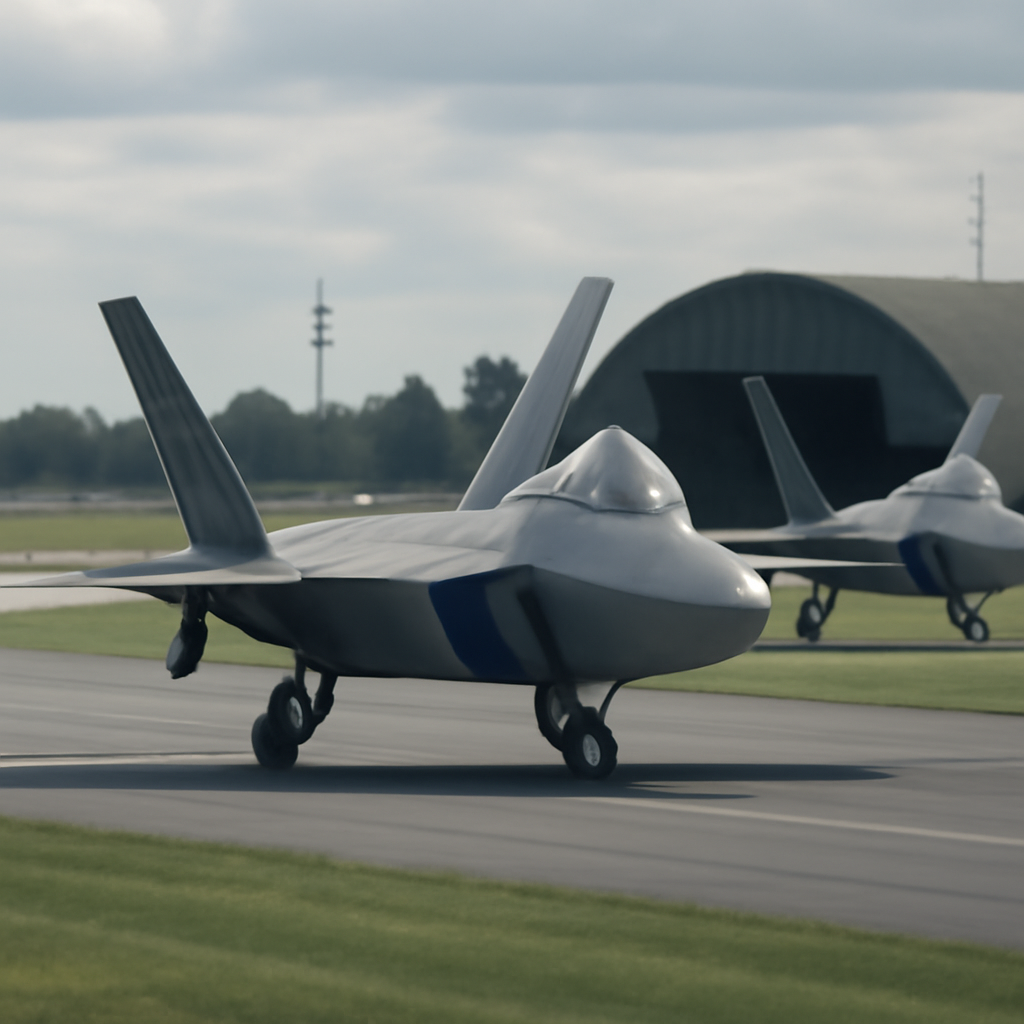
"Raptors executed precision missions against Iranian air defenses, nuclear-related infrastructure and command nodes linked to the Islamic Revolutionary Guard Corps (IRGC)," U.S. Central Command wrote in its Citadel publication.
Movement of F-22 Raptors to RAF Fairford
Ten U.S. Air Force F-22 Raptors arrived at RAF Fairford in the United Kingdom on Friday morning local time, flying from Ovda Air Base in Israel, the reporting shows. The jets were identified as coming from the 1st Fighter Wing at Langley Air Force Base and had been deployed to Ovda since late February to take part in attacks on Iran. Local spotters said the Raptors arrived at Fairford in three waves, and an aviation photographer using the @Saint1Mil handle on X shared photos of the arrival.
Open-source flight trackers and social-media posts followed the flight and its aerial-refueling support. A tweet captured tanker details including Boeing KC-135 Stratotankers listed with serials 60-0343 (BORA 02) and 60-0362 (BORA 01). The same tracking thread also noted flight trends for multiple F-22A Raptors; a separate post indicated that twelve F-22A Raptors had deployed to the region at one point.
CENTCOM’s account of Epic Fury and the Raptors’ missions
CENTCOM’s Citadel publication provided a detailed operational summary of the campaign dubbed Epic Fury. According to CENTCOM, on March 1 F-22s “opened the campaign by suppressing S-300 and Bavar-373 batteries, clearing corridors for follow-on coalition strike aircraft entering defended airspace.” Between March 1 and March 9, the command said the stealth fighters flew more than 200 combat sorties while remaining undetected by Iranian radar networks throughout the operation.
The command said F-22s struck targets connected to the Fordow Fuel Enrichment Plant and Natanz Nuclear Facility, employing GBU-39/B Small Diameter Bombs and GBU-32 Joint Direct Attack Munitions internally to “preserv[e] stealth while striking multiple hardened targets with precision guidance.” CENTCOM also stated the Raptors operated in coordination with B-2 Spirit bombers and EA-18G Growler electronic-attack jets in “layered strike packages designed to overwhelm Iran’s integrated air defenses.” CENTCOM added that Iranian forces launched dozens of surface-to-air missiles during the nine-day campaign and, U.S. officials said, none were successfully tracked or locked onto the stealth fighters.

This site is the portfolio.
OSINTSights runs on Cloudflare Workers, D1, R2, and Vectorize, with an AI pipeline on Hetzner ARM. Nubivance designed, built, and operates it. We do the same for clients.
See what we buildRegional exchange of strikes and diplomatic moves
This arrival at Fairford came amid a renewed exchange of strikes between the U.S. and Iran. The reporting says Iran struck targets in Bahrain, Kuwait and Jordan during a flare-up that was sparked by the IRGC’s attacks on three tanker ships in the Strait of Hormuz. CENTCOM released video material from strikes it conducted on July 8, saying American forces hit approximately 90 Iranian military targets along the coastline, including air-defense systems and coastal surveillance assets.
Political and diplomatic activity accompanied the fighting. The parties had signed a 14-point Memorandum of Understanding on June 17 that provided a 60-day extension of a ceasefire; several reports in the week of the Raptors’ movement described the ceasefire’s status as deteriorating. President Donald Trump declared that the shaky ceasefire had ended, saying on Truth Social that “the Cease Fire is OVER!” and earlier telling reporters, “To me, I think it's over. I don't want to deal with them anymore.” CNN reported that Qatari negotiators, in coordination with the U.S., traveled to Iran to meet officials there, and an American official told CNN the U.S. was “deliberately striking and then pausing to avoid escalation and let diplomacy work out.”
Retrograde of U.S. forces and the question of replacements
The F-22 movement from Ovda to Fairford is part of a broader retrograde of U.S. airpower that the story says has unfolded over recent weeks. On July 1, U.S. Air Force B-52 Stratofortress bombers departed from Fairford after being forward deployed for Epic Fury. The reporting notes other tactical jets have returned home as well — including A-10 Thunderbolt II close attack jets and F-15Es — with some assets replaced in theater and others not. The article quotes an outreach to Air Combat Command and the 1st Fighter Wing for details about whether the Raptors heading back to Langley will be replaced, but it reports that no definitive answer was published.
The piece warns that reconstituting a large force after even a partial drawdown would take time and would “add extreme stress on a force structure that has seen constant deployment surges over the last year.” It also highlights economic and political pressures that weigh on decisions about expanding or contracting the U.S. military footprint in the region.
What this means for the 1st Fighter Wing, Qatari negotiators, and Gulf states’ militaries
- 1st Fighter Wing and Air Combat Command: The arrival at Fairford completes a retrograde movement for at least ten Raptors and raises questions about whether those aircraft will be replaced in CENTCOM’s area of responsibility — a decision the story notes had not been publicly clarified.
- Qatari negotiators and U.S. diplomatic channels: With CNN reporting Qatari negotiators traveling to Iran in coordination with the U.S., the pattern described — deliberate strikes followed by pauses — suggests negotiators are operating amid intermittent military pressure intended to create space for talks.
- Gulf states’ militaries (Bahrain, Kuwait, Jordan): The reporting documents strikes in these countries during the flare-up, underscoring that regional security forces are part of the operational landscape affected by strikes attributed to Iran and by U.S. counter-strikes along the coastline.
The arrival of Raptors at RAF Fairford is both a logistical waypoint and a snapshot of a larger, unsettled arc: a stealth-capable force that contributed to a focused campaign, a partial drawdown that may be reversed only with time and strain, and diplomacy that continues even as leaders publicly declare the ceasefire over. The facts the reporting leaves on the table — who will replace returned assets, how long pauses in strikes will hold, and whether diplomacy can outlast calculated military pressure — remain concrete decisions for commanders and negotiators in the days ahead.