"Carrier qualifications remain an integral part of the E-2 and international military student training pipeline," a CNATRA spokesperson said, underscoring why a small number of student naval aviators still landed aboard a carrier in late June even though carrier quals are no longer required for U.S. strike students.
CNATRA: limited carrier quals continue, driven by timing and availability
The Chief of Naval Air Training (CNATRA) told TWZ that the June evolutions aboard the Nimitz‑class carrier USS Dwight D. Eisenhower involved 26 student naval aviators: 17 E‑2 students, seven international military students, and two strike students. CNATRA made clear that carrier qualifications are not required for strike students, but "if aircraft and deck time are available, we will select a small number of strike students to participate alongside E‑2 and international military students."
CNATRA said the timing of when a student conducts carrier qualifications "is dependent on several factors, including the student’s position in the training pipeline at the time the opportunity becomes available." Those factors include whether a carrier has deck time and aviation assets available and whether a student is at the appropriate phase of training for a carrier qualification evolution.
USS Dwight D. Eisenhower evolution: who flew and what it demonstrated
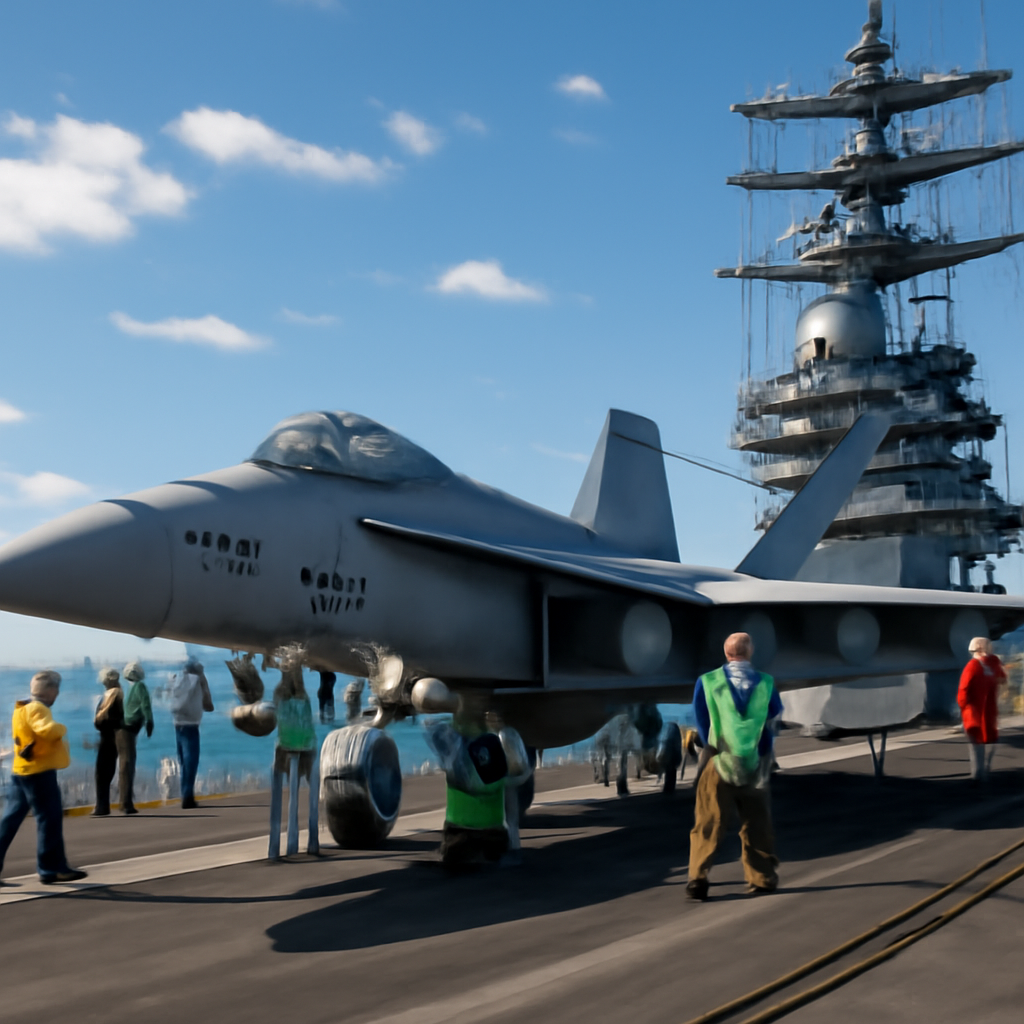
Photographs released at the end of June show T‑45 Goshawk trainers conducting carrier qualifications aboard the Dwight D. Eisenhower. Navy Capt. Travis Suggs, CNATRA operations officer, praised the event in an official Navy news item: "Watching our future pilots and our international military students successfully catch the wire aboard the Dwight D. Eisenhower is a testament to the quality of our training pipelines, the dedication of our instructors, and the immense capability of the ship’s crew."
The presence of international military students and E‑2 pipeline aviators kept carrier quals active for those pipelines even as the strike syllabus no longer requires landings aboard a carrier before winging.

Audit-ready is a season. It shouldn't be.
Evidence in spreadsheets, controls drifting between audits, frameworks multiplying on flat headcount. Nubivance runs continuous compliance on Rapid7 Cyber GRC - SOC 2, HIPAA, ISO 27001, PCI, CMMC.
End the scrambleNAVAIR and UJTS: a ‘system of systems’ approach to preserve FCLP capability
Naval Air Systems Command (NAVAIR) and the UJTS program office say the Undergraduate Jet Training System (UJTS) — the effort to replace the roughly 200 T‑45s in inventory — is being pursued as a comprehensive "system of systems" that includes both aircraft and advanced simulators. Navy Capt. Duane Whitmer, head of the UJTS program office at NAVAIR, emphasized that "the UJTS system must be capable of training student pilots to land on a carrier."
Whitmer noted the T‑45 is planned to be operational through 2040 and that UJTS is in source selection, adding that "any discussion regarding CNATRA carrier qualification syllabus requirements once UJTS is fielded would be premature." He also explained that, while the UJTS RFP does not explicitly mandate Field Carrier Landing Practice (FCLP) touchdowns in the aircraft itself, the program is designed to ensure FCLP training capability exists within the combined system.
The Navy defines FCLP as training that "simulates, as near as practicable, the conditions encountered during carrier landing operations," historically serving as a lead‑in to full carrier qualifications.
Procurement choices: rivals, capabilities, and the role of FCLP
Despite a stated intent to broaden competition by not requiring the next trainer to be capable of FCLP touchdowns, the UJTS competition has narrowed. Sierra Nevada Corporation’s (SNC) Freedom jet remains in contention and is being designed to be capable of conducting FCLP; SNC has partnered with Northrop Grumman and General Atomics on that effort. A Leonardo/Textron team remains in the running with a proposal centered on the M‑346N.
Boeing dropped out of the competition last month, and Lockheed Martin — which had teamed with Korea Aerospace Industries — bowed out in April. The T‑45 and the now‑withdrawn Boeing and Lockheed/KAI proposals were single‑engine designs; both the Freedom jet and the M‑346N proposals are twin‑engine designs. The Navy originally aimed for a T‑45 replacement to enter service in 2028; UJTS now expects to pick a design next year and then proceed to development and deliveries.
What this means for E‑2 students, strike students, and international military students
- E‑2 students: Carrier qualifications remain an explicit training requirement and will be preserved in the near term; the transition to UJTS will seek to keep FCLP capability available within the combined system.
- Strike students: Carrier touch‑downs are no longer required in the strike pipeline, and most prospective strike pilots now may not touch down on a real carrier until after they are winged and flying a fleet aircraft.
- International military students: Carrier qualifications continue to be required for many foreign students training with the Navy, which is why they will still join carrier evolutions when deck time and rosters permit.
The Navy is steering training toward a mixed future of physical aircraft and sophisticated simulators while the T‑45 remains in service through 2040. The path UJTS chooses — whether competitors provide FCLP‑capable aircraft, and how much of carrier‑landing training moves into virtualized environments — will determine whether the occasional live carrier qualifications now seen aboard the Dwight D. Eisenhower become a steady feature for E‑2 and foreign students or a rarer, opportunistic evolution. For now, a small window remains open for some students to "catch the wire" in a Goshawk before the fleet of trainers is fully replaced.
Source: TWZ — Carrier Qualifications Still Happening For A Few Navy Fighter Pilots In Training