“When a ship is deployed overseas for longer than the nominal seven‑month deployment period, that increases the amount of time for equipment on the ship to break, get worn down, or worn out,” said Ron O’Rourke, who retired this year after more than 40 years as a naval analyst for the Congressional Research Service.
Diego Garcia: the only nearby option and its limits
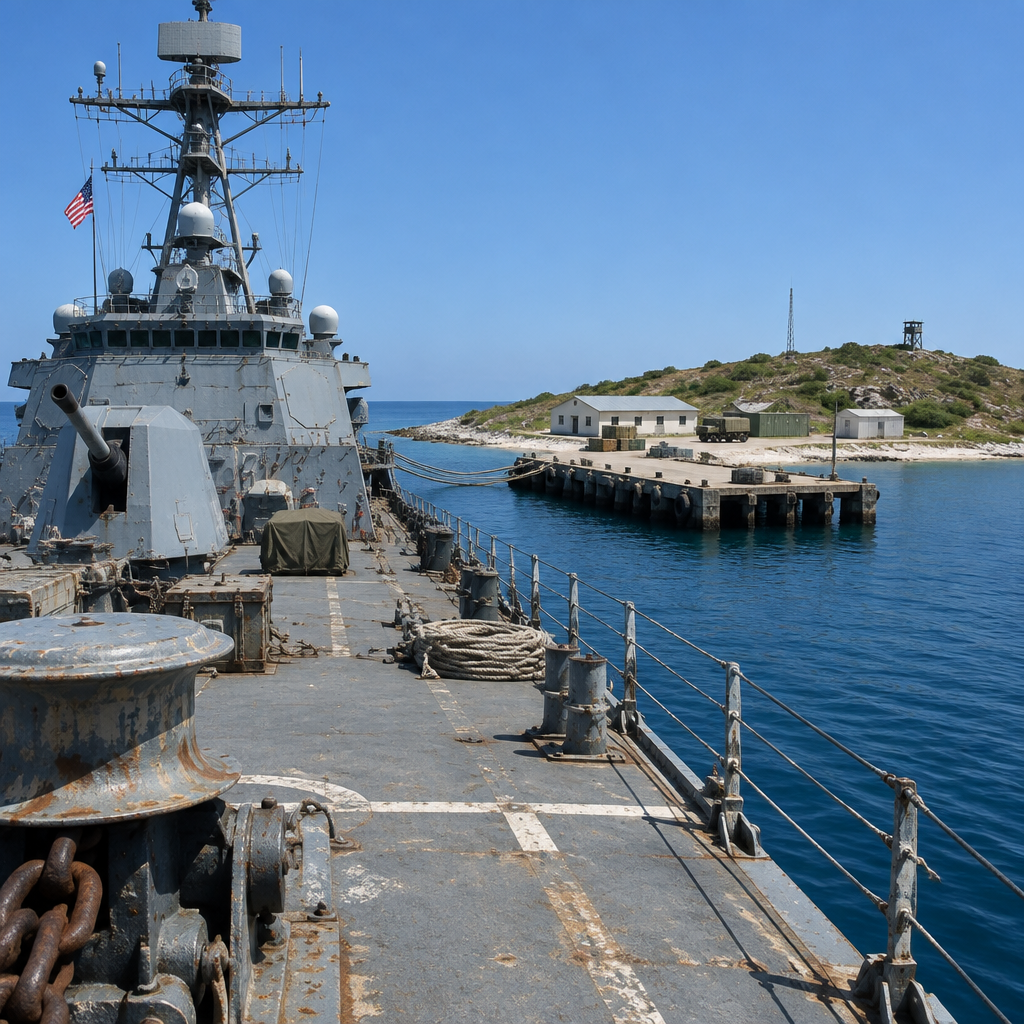
Since Operation Epic Fury began eight months ago, U.S. warships operating in the region have had “basically just one option: Diego Garcia, some 2,500 miles away.” The atoll offers a military supply base and a small town with a handful of restaurants, but it lacks the pierside infrastructure available in traditional port-call hubs such as Bahrain, Dubai, Singapore or Mediterranean ports. That constraint matters because many deployed ships rely on being moored directly to a pier or tender vessel for voyage repair availability—fixing broken gear, remediating rust, painting and similar upkeep.
Record carrier deployments, longer destroyer tours
The Navy itself has acknowledged unusually long deployments: the aircraft carrier Abraham Lincoln returned to receive overdue depot‑level maintenance after a nearly 11‑month, 321‑day deployment, and the carrier Gerald R. Ford previously logged a 326‑day deployment. Navy officials also recently told families in Yokosuka, Japan, that for the foreseeable future they should expect all ships to deploy for 10 to 12 months. A number of Arleigh Burke–class guided‑missile destroyers are on track to surpass the carrier records.

This site is the portfolio.
OSINTSights runs on Cloudflare Workers, D1, R2, and Vectorize, with an AI pipeline on Hetzner ARM. Nubivance designed, built, and operates it. We do the same for clients.
See what we buildDeferred voyage, intermediate, and depot work: cascading effects
The Navy distinguishes basic, intermediate and depot‑level maintenance. Deployed ships undergo extra wear from salt, sea air and sustained operations; missing scheduled voyage and intermediate repairs increases the chance equipment will fail and raises the scope of later depot work. “If you have a period where the total fraction of the Navy being on deployment overseas is elevated above what the notional model calls for, there will be a period downstream where you have to pay the piper,” O’Rourke warned, saying the fraction of the fleet available for future deployment could fall below modeled expectations while the service makes up missed maintenance.
O’Rourke added the Navy has previously “got itself into a hole on conventional surface ship maintenance” due to underestimated planning, scheduling and funding, and that perturbations caused by extended deployments “can add to the Navy’s challenge of digging itself out of that hole.” The service has reiterated the link between depot-level work and readiness: “Regularly scheduled depot‑level maintenance maximizes the lifespan of our Navy vessels and keeps our fleets lethal, modern, and ready to defend the nation,” a recent Navy press release said.
Effects on sailors and families: morale, supplies, and mail
The human consequences of the constrained port‑call picture are visible in several detailed accounts. Guided‑missile destroyers such as the John Finn and the Mustin—forward‑deployed to Yokosuka—have made Diego Garcia their only recent port call. Crew and families report empty ship stores and limited exchange supplies: a John Finn sailor’s spouse said the on‑base store had ice cream but not necessities; a Mustin spouse said her husband found socks but “not shoe polish” during the ship’s only stop since leaving Japan in April.
Mail delays of three to six months, and in some cases longer, have compounded frustrations. A Mustin spouse said she sent six boxes at the end of June and her sailor received one in September and the rest in October. A John Finn spouse said it took four months for a few packages to arrive and that “some that ‘took even longer than six months to get out there.’” Families worry these delays affect ballot access: one spouse said her sailor “said, ‘There has been no conversation about voting because we don’t have time for it.’”
R&R on Diego Garcia is limited, sailors and analysts say. “Please shoot me if that’s the only R&R I’m going to get in 10 months,” Ralph Cossa, chairman of the Pacific Forum, said bluntly. A Navy officer with expertise in maritime security noted that “even deployed ships need time alongside” to perform routine fixes, or crews will return home in worse condition physically and materially than planned.
The Navy declined to discuss readiness or operational specifics, telling reporters it would “not discuss specific readiness rates, operational requirements, force‑allocation deliberations, or future force movements. However, we remain committed to regular maintenance to maximize the lifespan of our Navy vessels and keep our fleets lethal and ready to defend our nation.” For mail, Lt. Cmdr. Bobby Dixon, a ship spokesperson for the carrier George Washington, said sailors there “can expect to receive mail shipped from the states within weeks,” adding “this can take longer when deployed overseas” and that the Navy works with logistics partners to minimize delays.
What this means for Navy leadership, shipyards, and forward‑deployed crews
- Navy leadership: Commanders must balance sustained combat operations with the scheduling realities of voyage, intermediate and depot maintenance. The service’s public statements emphasize commitment to depot work, but leaders face a scheduling tradeoff as many ships remain in theater for 10–12 months.
- Shipyards and maintenance planners: Deferred repairs raise downstream workloads and scheduling complexity. O’Rourke’s “pay the piper” assessment signals a period in which more ships may be in shipyards at once, delaying other planned overhauls and complicating fleet availability forecasts.
- Forward‑deployed crews and families: Sailors face limited R&R, constrained exchanges, longer mail timelines and missed routine maintenance—conditions that produce lower morale and increased equipment wear. A Navy expert warned that deferred maintenance can ultimately shorten a ship’s service life.
The picture that emerges from those at sea, their families, and long‑time analysts is not a single failure but a structural tension: a fleet kept at sea longer to meet an operational demand, and an industrial tail—pierside repair, intermediate fixes, depot yards—that struggles to absorb the backlog. As one Navy expert put it without embellishment, “In the end, these ships will reach their end of service life well before their scheduled date.”
Source: Defense One — The port-call situation is wearing out Navy warships