“Iran has revealed the limitations of US IAMD in the Middle East, as well as depleting its defensive arsenal,” Euan Graham told Breaking Defense, summing up why Canberra is accelerating programs to expand Australia’s layered air- and missile-defense posture.
Project LAND 6504: an accelerated medium-range GBAD push
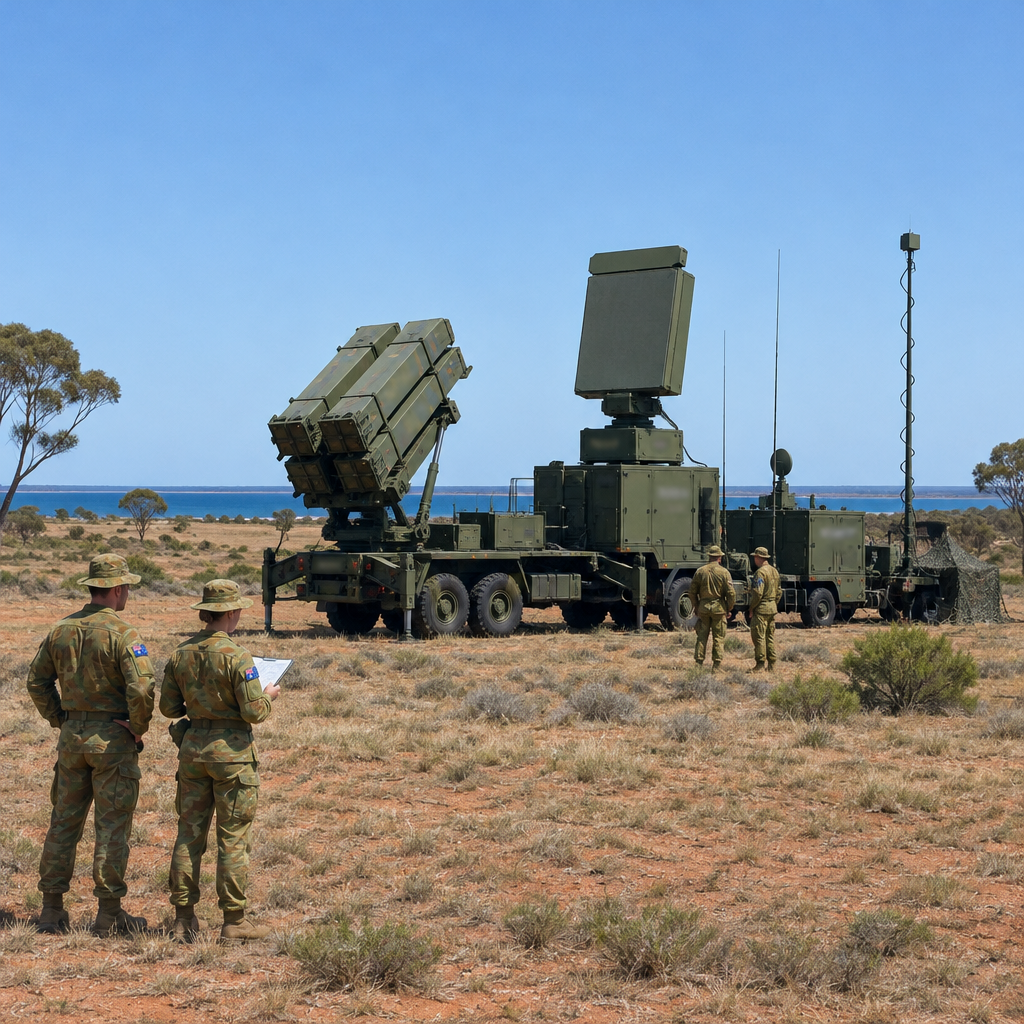
Canberra on Oct. 13 announced it is seeking Expressions of Interest for Project LAND 6504 — Medium Range Ground Based Air Defence — and industry briefing slides shown at the Land Forces defense show in western Australia describe the work as an “acceleration project” focused on “rapid capability delivery.” The slides say the program is prioritizing “proven Military-Off-The-Shelf (MOTS) solutions” and a “clearly defined and achievable Concept of Employment.”
The brief lists specific performance and integration requirements: the selected system must be mobile and deployable, integrated with CEA Technologies’ radars and existing IAMD infrastructure, and able to intercept ballistic missiles in their terminal phase along with subsonic air-breathing missiles. Capabilities marked “highly desirable” include the ability to intercept maneuvering hypersonic and high‑speed cruise missile targets.
Australia expects to issue a formal request for proposals in the early part of 2027, select a winning platform in late 2027, and conduct a live firing with the system at the biennial Talisman Sabre multinational exercise — typically held in July or August — in 2029.
VSRASD and short-range protection for Hunter-class frigates
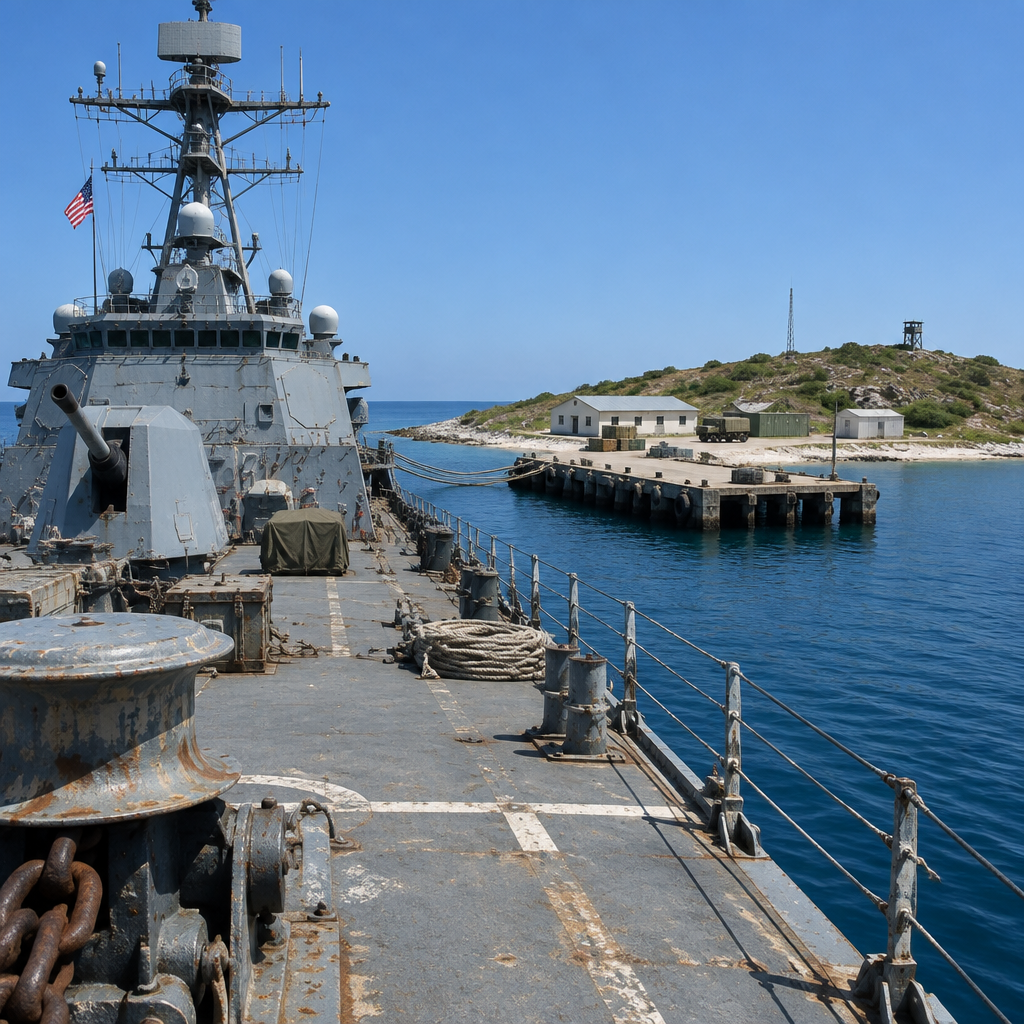
On the maritime side, the Very Short Range Air and Surface Defence (VSRASD) program is seeking systems to protect the Royal Australian Navy’s upcoming Hunter-class frigates from air- and sea-borne drone threats. An RFP posted Sept. 29 on the Australian government’s tenders website states the system “should be able to identify multiple threats at a distance of up to 5,000 metres.”
The RFP calls for a solution that can function as a standalone system but also be integrated into ship systems. Each Hunter-class frigate is to be equipped with one or two of the systems, and the RFP notes there is a possibility the system could be fitted on other classes of Australian naval vessels.

This site is the portfolio.
OSINTSights runs on Cloudflare Workers, D1, R2, and Vectorize, with an AI pipeline on Hetzner ARM. Nubivance designed, built, and operates it. We do the same for clients.
See what we buildJoint air battle management and recent test activity
Australia awarded a contract to Lockheed Martin in September to expand the country’s joint air battle management system. In July, the military test-fired a naval SM-2 air defense missile from an adapted ground launcher, using a CEA Technologies radar and a virtual Aegis combat system — a live demonstration that complements the acquisition track across land and sea domains.
Euan Graham: hardening military targets is still required
Euan Graham, an expert associate at Australia’s National Security College, welcomed the accelerated timeline for LAND 6504 but warned the acquisition alone “will still be unlikely to fill the gap” because Australia must simultaneously protect expeditionary forces, military bases and critical infrastructure. Graham said recent events in the Middle East “reveal the limitations” of regional IAMD and that “China’s capabilities are orders of magnitude greater.”
Graham also underscored that Australia’s geographic isolation is no longer the defensive advantage it once was, noting that developments in cruise missile submarine capabilities could enable surprise attacks on Australian targets such as the submarine base HMAS Stirling, Naval Communications Station Harold Holt (a joint Australian and US naval communication station), and the Jindalee Over-the-Horizon Radar Network infrastructure.
What this means for expeditionary forces, the Royal Australian Navy, and domestic infrastructure
- Expeditionary forces: With LAND 6504 focused on mobility and deployability, expeditionary units will expect a medium-range GBAD capability that can move with deployed forces — but planners will still need additional measures to harden forward bases and logistics hubs.
- Royal Australian Navy: VSRASD’s short-range, 5,000‑metre detection requirement and single- or dual‑unit fit for each Hunter-class frigate signal a layered approach to counter small aerial and surface threats, including drones; integration into ship systems remains a procurement priority.
- Domestic infrastructure operators: Graham’s warnings about critical sites named explicitly — HMAS Stirling, Harold Holt, and the Jindalee Over-the-Horizon Radar Network — put base-hardening and redundancy for communications and radar infrastructure on the defense planning agenda alongside procurement of new intercept systems.
Australia’s current effort combines faster acquisition timelines, concrete performance demands for land and sea systems, and live test activity. The program calendar is clear: an RFP for LAND 6504 early in 2027, selection late that year, and a live firing at Talisman Sabre in 2029. What remains explicit in the record is Graham’s dual prescription — build out integrated air and missile defenses while simultaneously hardening fixed and expeditionary targets — and the open question of whether those two tracks will proceed in parallel and at the necessary pace.