“The standard 203mm mortar bomb weighs around 220 pounds, including approximately 60 pounds of explosive material.”
What Serbia released and what the footage shows
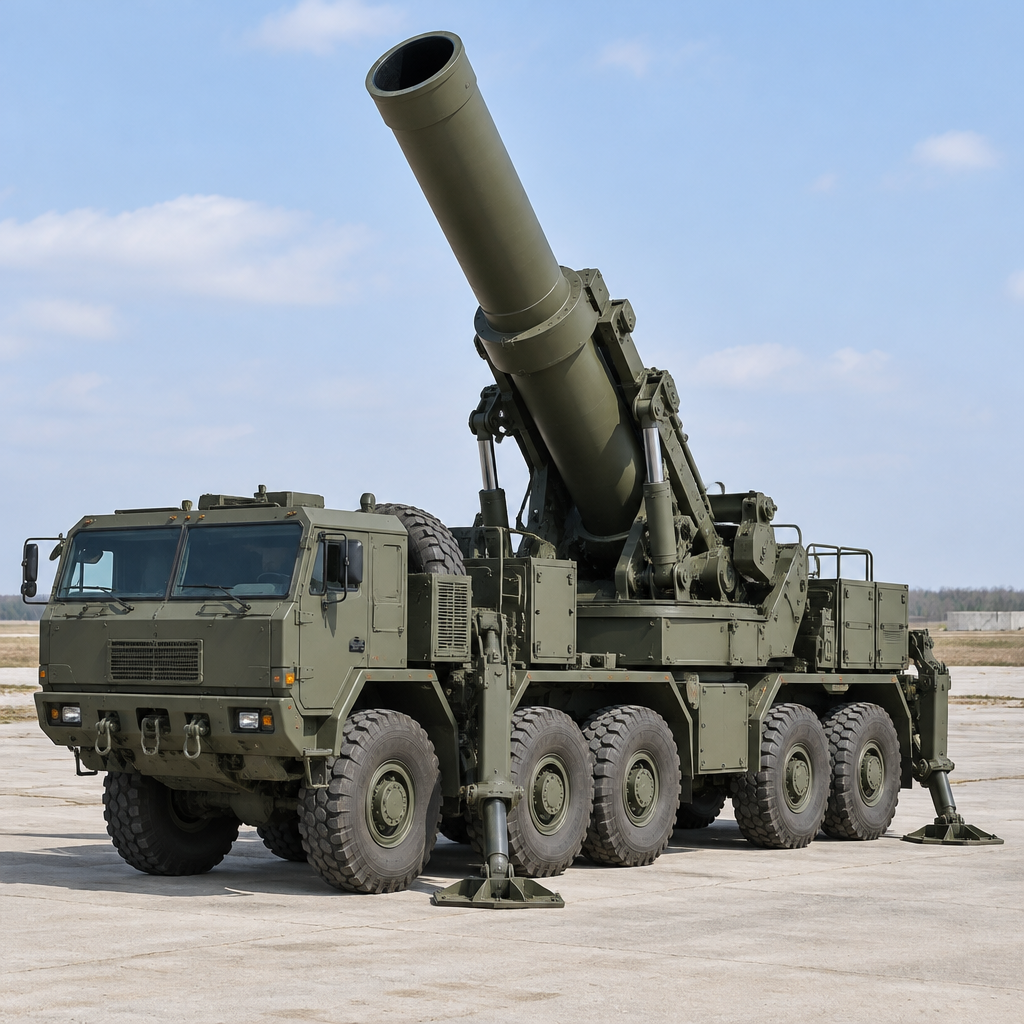
Serbia’s Ministry of Defense published brief footage showing the TSMB M-25 heavy self‑propelled mortar in firing position and discharging rounds. The ministry did not disclose when or where the firing tests took place or whether the video demonstrates the system’s full capabilities. The published clips form part of a larger montage released by the ministry.
Weapon design and lineage: 203mm mortar on a wheeled truck
The system is named Teški Samohodni Minobacač (TSMB, translated as heavy self‑propelled mortar) M‑25 and was developed by Serbia’s state‑owned Military Technical Institute. Its design lineage traces back to the Yugoslav M‑65 155mm howitzer, itself derived from the American M114. The M‑25 mounts a 203mm mortar with a barrel 24 calibers in length and an automated loading mechanism; the barrel elevation ranges from 0° to 75°, and the barrel must return to 0° to accept the next round from the muzzle end.

This site is the portfolio.
OSINTSights runs on Cloudflare Workers, D1, R2, and Vectorize, with an AI pipeline on Hetzner ARM. Nubivance designed, built, and operates it. We do the same for clients.
See what we buildProjectile, effects, and intended uses
The standard 203mm mortar bomb for the M‑25 is roughly 220 pounds, with about 60 pounds of that weight consisting of explosive material. Serbia’s stated destructive radius using impact fuzing is approximately 250 feet. Developers have designed the M‑25 to fire both high‑explosive and concrete‑piercing ammunition, specifically to engage hardened positions and fortifications; they have also provided for rocket‑assisted projectiles to extend range and for precision guidance kits to improve accuracy of compatible rounds.
Mobility and platform trade‑offs: the FAP 2026 truck chassis
The M‑25 is mounted on a FAP 2026 three‑axle 6×6 truck built by Fabrika automobila Priboj. The vehicle offers a road range of about 500 miles and a top road speed near 50 miles per hour, carries an armored cab for a crew of four, and hosts a fire‑control suite that includes an inertial navigation system, a ballistic computer, communications equipment, and a dedicated gunner’s computer. Serbia’s choice of a wheeled, general‑purpose truck emphasizes road mobility, lower acquisition and operating costs, easier maintenance and air transportability. The trade‑off is reduced cross‑country mobility and survivability compared with tracked chassis, a factor the developers accept to enable quicker displacement and “shoot and scoot” tactics.
Performance claims and comparison with the 2S4 Tyulpan
Serbia claims the M‑25 can achieve a rate of fire up to three rounds per minute, enabled by its automated loader. By contrast, Russia’s much larger tracked 2S4 Tyulpan — a 240mm self‑propelled mortar — fires a standard 300‑pound round out to roughly six miles and can reach about 11 miles with rocket‑assisted ammunition; the Tyulpan’s maximum sustained cadence is described as one round every 62 seconds. The M‑25’s total weight is reported at about 19 metric tons, substantially lighter than the Tyulpan’s roughly 27.5 metric tons. The M‑25’s stated maximum range is about seven‑and‑a‑half miles, which positions it as a specialist system: it combines a very large projectile with a compact, mobile wheeled platform rather than attempting to replace longer‑ranged 155mm howitzers.
What this means for the Serbian Armed Forces, Balkan defenders, and artillery logisticians
- Serbian Armed Forces: the M‑25 offers a way to deliver super‑heavy mortar fire from a relatively low‑cost, road‑mobile vehicle and to shift firing sites quickly; the force will need to validate claimed rates of fire, sustained performance, and survivability under realistic operating conditions.
- Balkan defenders and regional planners: the system’s 203mm rounds, concrete‑piercing ammunition and a 250‑foot destructive radius will be of particular concern for fixed fortifications and hardened positions in a regional context dominated by complex terrain.
- Artillery logisticians: handling and supplying 220‑pound mortar bombs — including rocket‑assisted rounds and guidance kits — requires specialized logistics, transport and handling procedures that differ from standard 155mm ammunition chains.
Serbia’s M‑25 presents a distinctive trade‑off: super‑heavy mortar projectiles on a lighter, wheeled platform that favors mobility and cost over cross‑country performance and protection. The ministry’s footage confirms the concept visually but does not supply detailed test results, operational status, or sustained‑fire performance data — facts the military and potential observers will need to establish before assessing the system’s practical battlefield utility.