"It’s an absolute disaster," said one former official involved in the project — a blunt summation of a $533 million experiment that, by the Department of Defense inspector general’s own account, never produced a single usable 155 mm artillery shell.
Mesquite: robots on fire, presses beaten with sledgehammers
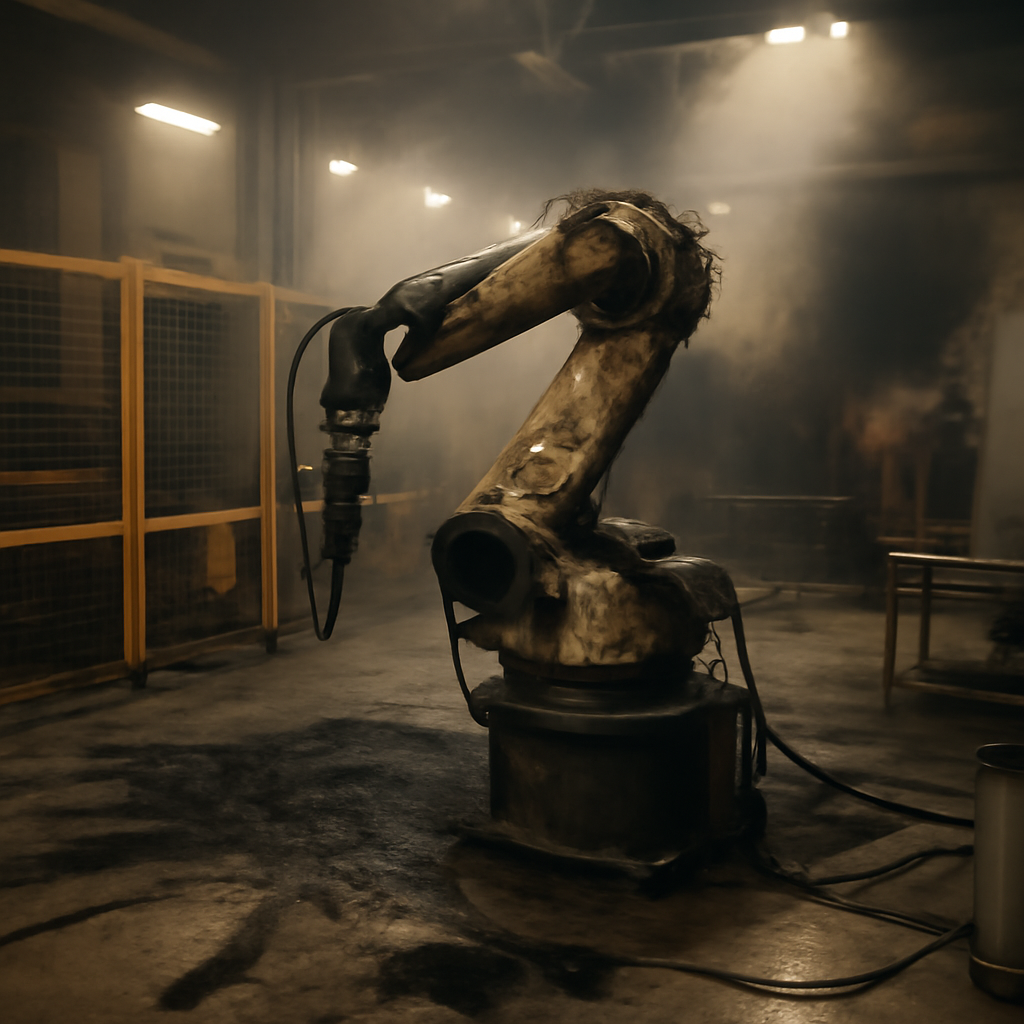
The General Dynamics facility in Mesquite, Texas, opened amid fanfare in May 2024 but quickly became a catalogue of mechanical and managerial failure. Cutting‑edge robotic arms repeatedly caught fire as they moved steel heated to roughly 1,800 degrees; oil drenched the machines and combusted, melting cable insulation and sidelining units for days. Robots swung erratically, smashed into equipment and safety fences, and dropped pieces of steel five feet to the floor. The plant’s signature flow‑forming station often cracked metal beyond repair, and giant press machines required regular pounding with sledgehammers to function.
Workers described thick, acrid smoke and uncomfortably high temperatures — drives in cabinets reached about 140 degrees — and an OSHA complaint about a "respirable hazard" led to an inspection in October 2024; OSHA issued no penalties. By August 2025 the Army ordered work halted on two of three production lines. The inspector general’s July report concluded the facility never produced a usable shell.
Repkon’s flow‑forming pitch and a procurement pathway that moved fast
The project’s technical centerpiece was equipment from Repkon, a Turkish firm that offered a flow‑forming process that General Dynamics executives and Army officials believed could move faster and adapt to multiple calibers. Repkon had not previously held Pentagon contracts and, according to four former officials, its line had never been shown to produce the newer U.S. 155 mm shell from the steel now specified. Repkon told the Army and General Dynamics that active clients elsewhere used the machinery for an older shell design, but the company refused inspections of those lines, citing customer privacy.
Congress in late 2022 loosened contracting rules for Ukraine‑related work, permitting no‑bid awards and the use of undefinitized contracting actions (UCAs). The Army awarded General Dynamics a series of UCAs beginning in November 2022 and contracted for three Repkon production lines without a requirement that the full production process be demonstrated before machinery was installed. One defense executive quoted in the reporting likened UCAs to "building the airplane as you’re flying it."

This site is the portfolio.
OSINTSights runs on Cloudflare Workers, D1, R2, and Vectorize, with an AI pipeline on Hetzner ARM. Nubivance designed, built, and operates it. We do the same for clients.
See what we buildPublic claims, internal failures, and the limits of enforcement
Public statements painted a rosier picture than the factory’s floor. General Dynamics executives told investors the Texas plant was "rapidly increasing ammunition production" even as scheduled first article tests were missed. Army leaders publicly downplayed delays, but internally the service sent letters of concern and in June 2025 considered contract termination. A former Army official cited the prospect that a termination for default would "take years through the legal system" because General Dynamics would contest it.
The Army told the inspector general it will seek recoupment through unspecified discounts on production orders; in December 2025 the government nonetheless made $26.3 million in progress payments for the second and third lines despite neither having produced a usable shell. General Dynamics told the inspector general it "met or exceeded requirements"; the company declined interviews for the reporting and its spokesperson, Jeff Davis, called the article a "materially false and misleading hit piece." The inspector general recommended the Army determine whether the contract was "appropriately issued," how funds were spent, and whether money could be recouped.
AI promises, new partners, and continuing contracts
After halting two lines and parting with most Mesquite staff, General Dynamics announced a new plan to bring in Deterrence, a three‑year‑old company promising "AI‑enabled capabilities" to make the plant function. Deterrence has no prior DoD contracts and the founders have no defense manufacturing track record; one founder formerly worked at Tesla, two others ran a smartphone‑enabled building‑access startup. General Dynamics also pledged $200 million to the project and said it would replace much of the Repkon equipment with traditional machines.
Meanwhile, General Dynamics’ ordnance business has received roughly $2.5 billion in separate awards since the shutdown, and Repkon’s American offshoot — initially named Repkon USA and later changed to Paligen Technologies — won a no‑bid $435 million Army contract to build a TNT factory. Mesquite workers were furloughed or laid off as the company shifted repair plans and technology choices.
What this means for the Army, General Dynamics, and Congress
- The Army: The service faces a financial and reputational problem it is trying to remedy through contract‑level recoupment (unspecified discounts) while it also ordered work halted; the inspector general urged a review of the contract’s issuance and spending.
- General Dynamics: The company remains the incumbent manager of Mesquite, pledged new investment and an AI partner, and continues to win substantial unrelated defense work even as it defends its performance and disputes criticism.
- Congress and procurement policy: Changes that removed competitive bidding and strict limits on UCAs for Ukraine‑related spending enabled the accelerated awards that proponents argued were needed — and that critics, including defense‑spending researcher William Hartung, now cite as examples of a system that can produce expensive failures with limited contractor accountability.
The Mesquite case is, in the Army’s words to the inspector general, a failure that must be assessed for "appropriately issued" contracting and possible recoupment. The plants’ blistering temperatures, flaming robots and unusable output are already a matter of record. The next questions are concrete: will the discounts the Army seeks equal the $533 million taxpayers have been asked to finance, and can the new mix of traditional equipment and AI actually deliver the 20,000 shells a month General Dynamics and the Army now forecast?