"The Pacific seabed is no longer an empty space between nations." — An increasingly contested space: the Pacific seabed and the actors reshaping it
Density as a new strategic variable
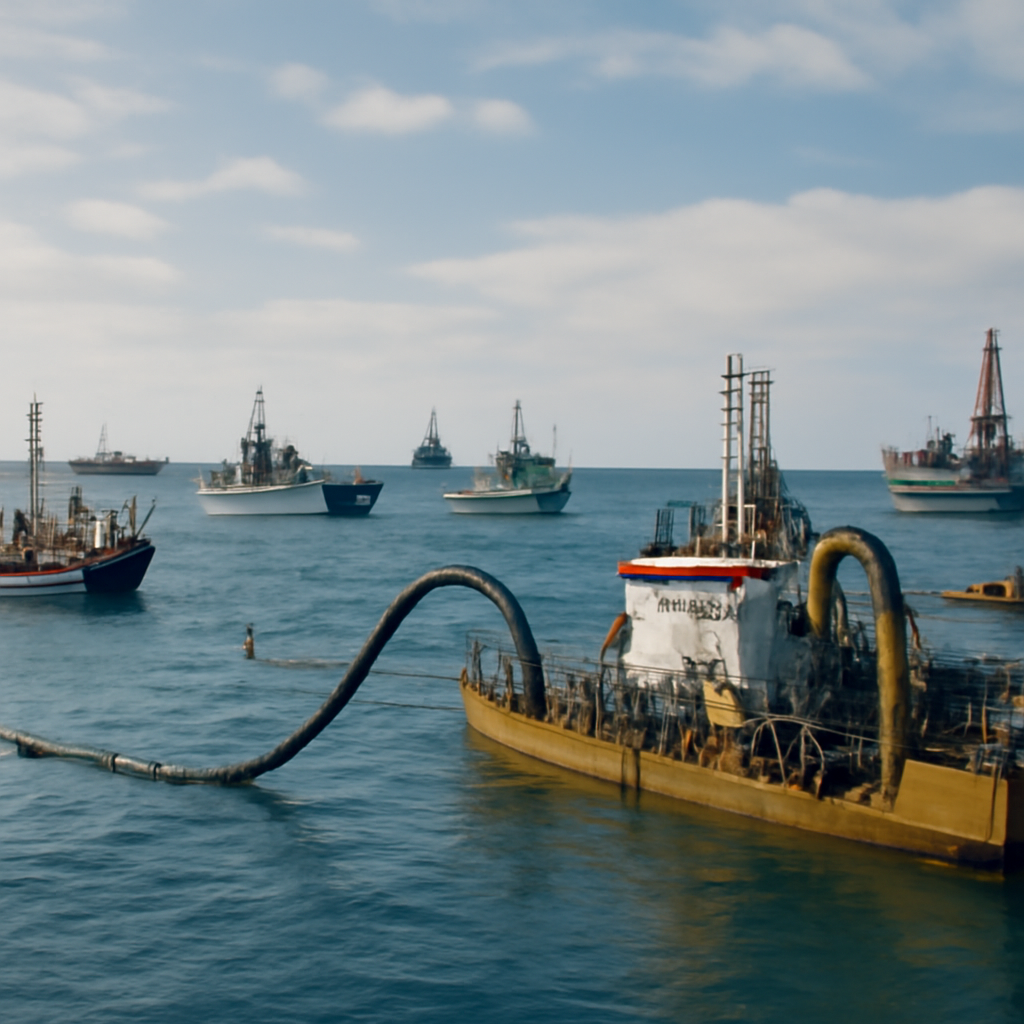
The central argument of the source is straightforward: the Pacific maritime domain is shifting from sparse to crowded, and that crowding is changing how power and risk are distributed. Activities that were once considered discrete—mining, cable routes, military operations, fisheries enforcement and criminal activity—are now converging on the same physical seabed. The source calls this convergence "density," an underappreciated variable that produces friction not from any single actor but from the interaction between many actors and uses occupying the same space.
Seabed minerals and the dependence of small Pacific states
Several Pacific states are exploring deep-sea mining as a potential source of long-term revenue. The source specifically names Nauru, Kiribati, Tonga and the Cook Islands as countries for which seabed minerals could represent significant economic transformation. The technology, specialised vessels, and the financial and logistical systems required exceed the capacity of most small states, creating dependence on external partners to provide financing, infrastructure, and long-term commercial and security arrangements. That dependence, the source warns, results in "structural embeddedness"—an arrangement that narrows the choices available to Pacific states and to Australia before any overt contest begins.

This site is the portfolio.
OSINTSights runs on Cloudflare Workers, D1, R2, and Vectorize, with an AI pipeline on Hetzner ARM. Nubivance designed, built, and operates it. We do the same for clients.
See what we buildSubmarine cables, fixed routes and concentrated repair capacity
Submarine cables carry almost all global digital communications and form the backbone of connectivity across the Indo-Pacific, the source says. Their routes are fixed, landing points are limited, and repair capacity remains concentrated in a small number of specialised vessels. In an environment of strategic competition, these systems are critical dependencies embedded in the seabed and increasingly exposed to grey‑zone risks. The source highlights that other below-surface activities—military submarines, autonomous underwater vehicles, scientific and commercial survey operations—now share the same physical space as cables and prospective mining sites, changing how these systems function.
Organised crime and semi‑submersible trafficking
The seabed’s accessibility is not only a concern for states and corporations. The source points to semi‑submersible trafficking vessels operating across the Pacific as evidence that organised criminal networks are moving across vast distances with limited detection. These vessels exploit the same governance gaps that shape legitimate maritime activity. The source stresses that the importance of this criminal activity lies less in the specific commodities trafficked than in what it demonstrates: the seabed is becoming accessible to a wider range of actors, each using it for different purposes, often without awareness of or accountability to one another.
Policy fragmentation and governance gaps
Current policy frameworks, the source argues, remain siloed and are ill‑suited to the converging seabed. Fisheries are treated through resource policy, cables through telecommunications policy, deep‑sea mining through environmental and economic debate, maritime crime through border and law‑enforcement frameworks, and military activity through Defence. Each approach is valid in isolation, but none fully captures the physical convergence now occurring. The source concludes that the seabed "does not observe those boundaries," and that the greatest risks will emerge from the accumulated weight of an ungoverned system rather than from a single adversary’s action.
What this means for Australia, Pacific states, and external partners
- Australia: The source notes Australia has invested heavily in Pacific partnerships and maritime awareness, but that investment is largely designed for a less crowded environment. Australia faces the challenge of adapting its frameworks to manage a denser seabed where multiple activities intersect.
- Pacific states (Nauru, Kiribati, Tonga, the Cook Islands): These governments may see seabed minerals as economic opportunity, yet they will likely rely on external finance, infrastructure and long‑term arrangements that embed partners structurally into their maritime economies.
- External partners (infrastructure, telecommunications, policing, logistics, development financing actors): The source highlights how a suite of initiatives—when aggregated—can create a structural maritime presence. Individual projects may be justifiable on their own terms, but together they shape how access and activity evolve over time.
The Pacific seabed, once an imagined emptiness between nations, is now a crowded and contested environment whose risks arise from proximity as much as intent. The source leaves a stark choice: adapt governance and policy to manage density, or continue operating with separate rules for domains that increasingly occupy the same space. The seabed, the source warns, will not wait for policy to catch up.