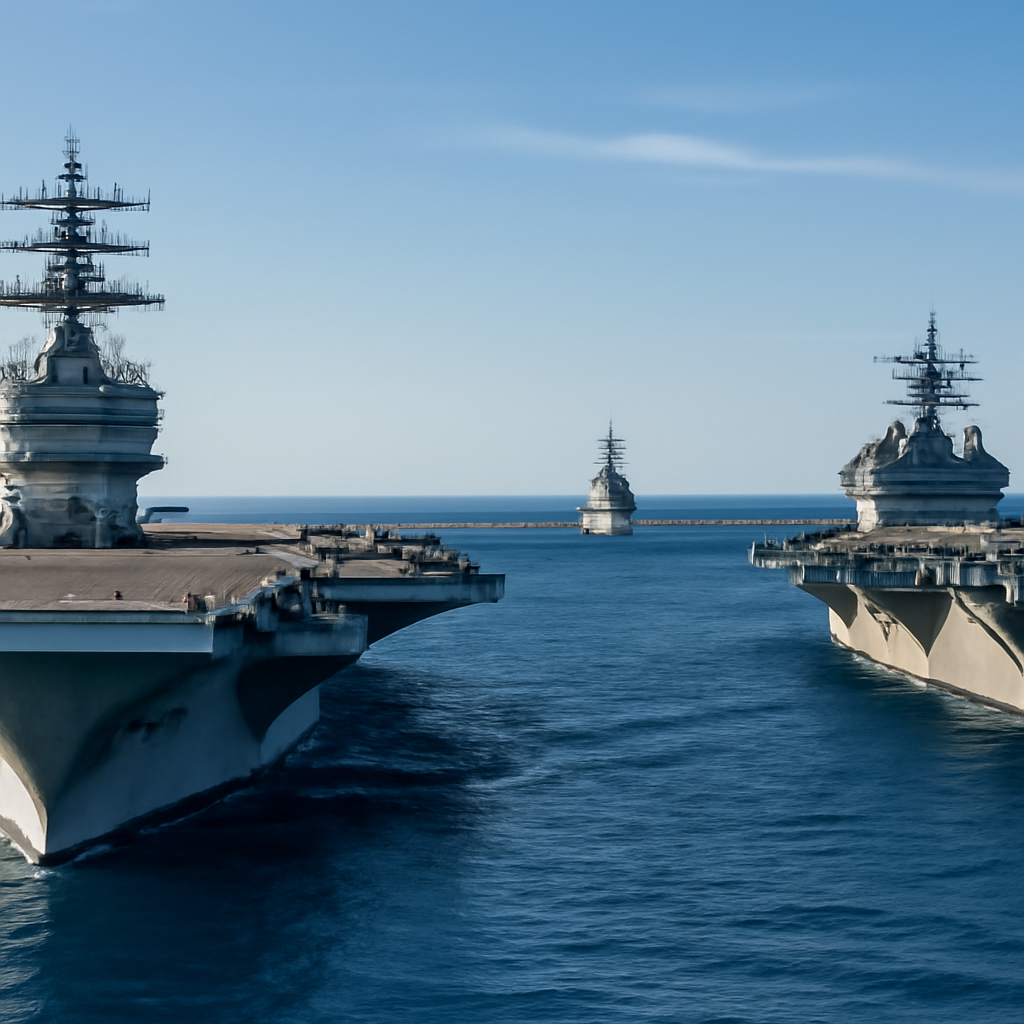
The U.S. now has four big‑deck warships on station in the Middle East — two aircraft carriers, USS Abraham Lincoln and USS George H.W. Bush, and two amphibious assault ships, USS Tripoli and USS Boxer — representing a step up in naval force posture while negotiations with Iran develop.
Concentration of carriers and amphibious ships in CENTCOM
The report shows an elevated U.S. naval presence in the Middle East: two carriers and two amphibious assault ships are on station in the U.S. Central Command area of responsibility. The amphibious ships include USS Tripoli and USS Boxer; the carriers are USS Abraham Lincoln and USS George H.W. Bush. TWZ frames this as a posture change occurring “while negotiations with Iran develop.” The tracker notes that positional indicators are general approximations.
How the Boxer ARG moved: March deployment, disaggregation, and re‑aggregation
USS Boxer’s deployment began on March 18, when the amphibious ready group steamed westbound through the Pacific. Boxer entered the Indian Ocean in early May but did not immediately cross into CENTCOM’s AOR. Instead, the ARG disaggregated: Boxer doubled back to Singapore and the South China Sea — where USS Portland remained — while USS Comstock moved onward to the Middle East. In late June Boxer and Portland transited the Malacca Strait northbound and have since re‑aggregated with Comstock in the CENTCOM AOR.

Audit-ready is a season. It shouldn't be.
Evidence in spreadsheets, controls drifting between audits, frameworks multiplying on flat headcount. Nubivance runs continuous compliance on Rapid7 Cyber GRC - SOC 2, HIPAA, ISO 27001, PCI, CMMC.
End the scrambleCarrier movements and training: Nimitz, Eisenhower, Carl Vinson, Roosevelt, and George Washington
USS Nimitz completed her final transit and arrived in New York City on July 3, anchoring off Stapleton, Staten Island, to participate in International Naval Review (INR) 250 on July 4. Nimitz steamed up the east coast after departing Mayport, Florida, and conducted an ordnance offload prior to the review. The Boeing MQ‑25 Stingray demonstrator (T‑1) was on display during the events.
USS Dwight D. Eisenhower moored in Norfolk on July 2 after a two‑week work‑up supporting Carrier Qualifications (CQ) and East Coast Fleet Replacement Squadrons. According to a release on DVIDS, student naval aviators aboard Eisenhower successfully completed CQ from June 27–30: “The multi‑day training evolution focused on developing the next generation of fleet aviators, specifically highlighting pilots navigating the E‑2 Hawkeye pipeline.” TWZ reports Eisenhower is preparing to deploy in early 2027.
USS Carl Vinson returned to San Diego after flight deck certifications and CQ with Carrier Air Wing 2 from June 25 to July 1. The Navy announced the completion of her nine‑month Planned Incremental Availability; Cmdr. Paul Novess, Carl Vinson’s maintenance officer, said, “Our Sailors’ efforts were vital in preparing Carl Vinson to return to sea.”
In the Pacific, USS Theodore Roosevelt and amphibious assault ship USS Essex concluded the in‑port phase of RIMPAC 2026 at Joint Base Pearl Harbor‑Hickam; the sea phase was set to begin the week of the report, and Roosevelt was reported leaving Pearl Harbor via public AIS data. USS George Washington, after participating in the live‑fire SINKEX of USS Juneau, continued operations in the Western Pacific and was recently spotted in the Philippine Sea conducting flight operations, live‑fire shooting drills, nighttime fast‑rope exercises, small boat evolutions, and flight‑deck physical training. George Washington was operating alongside guided‑missile cruiser USS Robert Smalls, guided‑missile destroyers USS Shoup and USS Benfold, and fast‑attack submarine USS Minnesota.
Airpower posture: B‑52s depart RAF Fairford
TWZ notes a concurrent drawdown of forward‑deployed strategic bombers: plane spotters reported the last B‑52 Stratofortress bombers departing RAF Fairford “last week.” The tracker contrasts the increase in naval big‑deck presence in the Middle East with this reduction of deployed bomber assets.
What this means for carrier air wings, training commands, and CENTCOM
- Carrier air wings and training commands: The completion of CQ cycles on Eisenhower and Carl Vinson, plus public display of MQ‑25 T‑1 systems, indicates continuing emphasis on qualifications and tanker/drone integration ahead of upcoming deployments.
- CENTCOM commanders and amphibious forces: The re‑aggregation of Boxer, Portland, and Comstock increases amphibious and expeditionary options in‑theater at a moment when two carriers are also present, expanding operational flexibility during ongoing negotiations referenced in the report.
- Pacific commanders and allied planners: George Washington’s persistent operations in the Western Pacific, following a SINKEX and combined evolutions with escorts and a submarine, underscore continuing carrier tasking across multiple theaters simultaneously.
The snapshot TWZ provides shows U.S. naval forces spread across three oceans: carriers steaming to ceremonial and training events at home, others operating in the Western Pacific, and a concentrated carrier‑and‑amphibious presence in the Middle East. With INR 250 concluded in New York, RIMPAC’s sea phase starting, and the amphibious ARGs reshuffling into CENTCOM, the Navy is managing a dense, theater‑spanning tempo — and the coming weeks will determine whether that tempo remains elevated as negotiations referenced in the report proceed.
Original TWZ carrier tracker: Where Are The Aircraft Carriers: July 7, 2026



