"The People’s Liberation Army Rocket Force (PLARF) has constructed an unknown type of fixed launch system at the 1st Test and Training District in Jilantai that appears capable of launching multiple missiles," writes Eli Turk in a report published by the China Aerospace Studies Institute (CASI).
What the satellite imagery shows
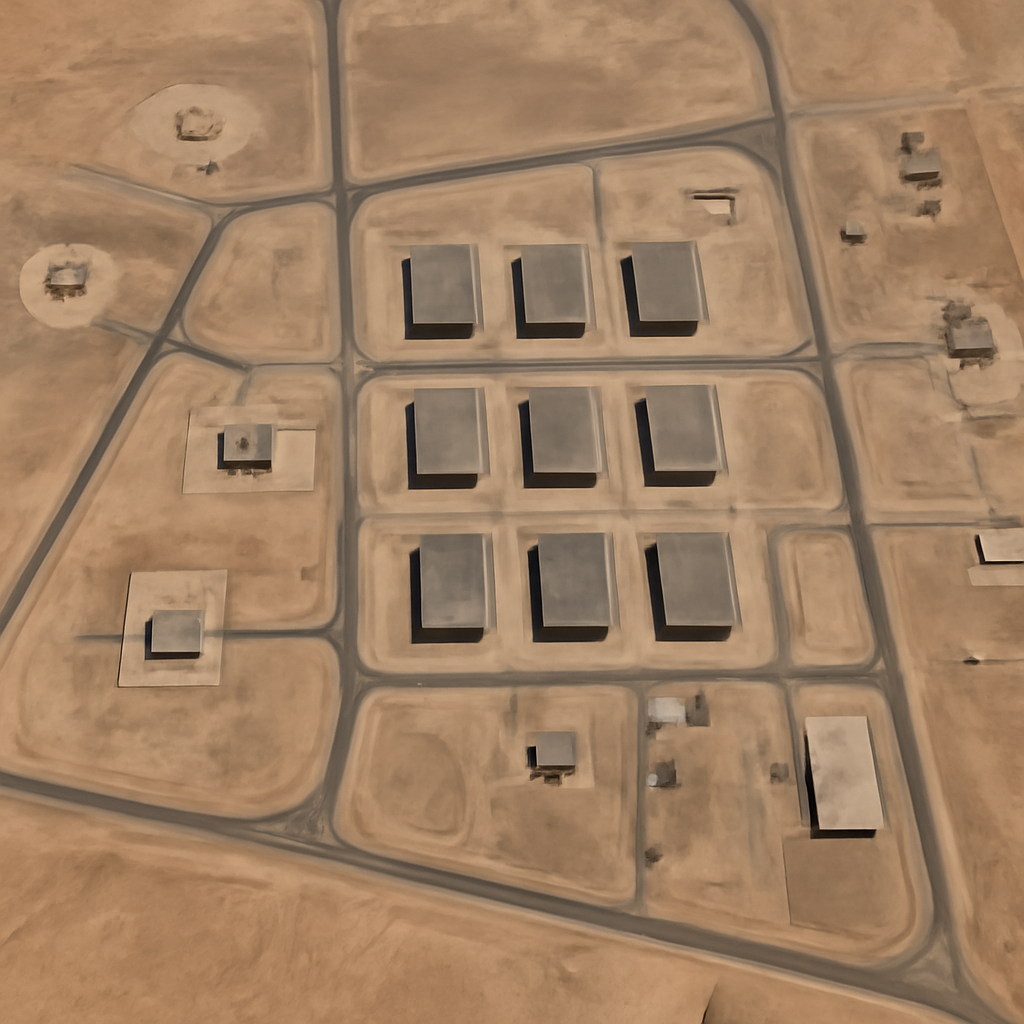
Satellite imagery reviewed and compiled in the CASI report, and supplemented by PlanetLabs imagery cited by TWZ, shows a new pattern of hardened, rectangular structures with retractable roofs at the PLARF’s 1st Test and Training District in Jilantai, Inner Mongolia. Construction reportedly began in late 2022 and, "at least externally, appeared to be near completion by late 2023," according to the report.
Close-up images dated January 28, 2026, and earlier construction images from September and December 2022 show rectangular covers roughly 20 meters (about 65.5 feet) long and just over 6.5 meters (about 21 feet) wide. The covers appear to open by sliding sideways along three large rails. At least one larger nearby structure and the presence of roads connecting the area to an earlier facility northeast of the site were also noted; the tertiary site has multiple large structures inside a visible perimeter wall.
How their dimensions compare with known silos
Excavation imagery captured in September 2022 showed a northern foundation measuring roughly 12.5 meters (about 40 feet) deep at the moment the image was taken. The finished structure, from available imagery prior to installation of a closure door, appeared to be between 6.4 meters and 11.8 meters (21 to 38 feet) deep, the report states.
For comparison, CASI includes imagery of a test silo at Wuzhai whose cover is nearly 22.5 meters (about 74 feet) long and roughly 9 meters (about 29.5 feet) wide; the tubular silo beneath Wuzhai would have to be at least around 40 meters (about 131 feet) deep based on the dimensions of the DF‑5 ICBM. The new Jilantai structures are narrower and, at least superficially, substantially shallower than the Wuzhai ICBM test silo.

The cyber insurance questionnaire just landed. Now what?
SOC 2, HIPAA, insurance renewals - someone has to own security strategy. Nubivance provides fractional CISO leadership without the full-time salary.
Get a security leadPossible missions, missiles, and technical options
Based on the dimensions, Eli Turk assesses the Jilantai launch structures are likely too small and shallow to house traditional ICBMs. Turk writes the shorter depth "suggests that it may support short‑range ballistic missiles (SRBMs), medium‑range ballistic missiles (MRBMs), and cruise missiles." Using missile length as a guide, Turk notes an MRBM-class missile such as the DF‑21 (roughly 10 meters long) or the DF‑17 (roughly 11 meters long) could be supported if the launch interior is near the upper end of estimated depth.
Turk also raises several operational concepts: the structures might store a small number of missiles horizontally and erect them vertically before launch, but a vertical launch system inside the hardened structure may be more efficient — enabling massed fires, reduced signatures, and the flexibility to employ different munitions from a single launcher simultaneously. How missiles would be loaded is unclear; a specialized loading vehicle or crane might be required, and there is "no indication that the structures allow for road‑mobile transporter‑erector‑launchers to simply drive inside and fire through the open roof."
The report additionally notes the line between ballistic missiles and ground‑based interceptors or anti‑satellite interceptors can be blurred, citing silo‑launched interceptors such as the U.S. Ground‑Based Interceptor and Russia’s A‑135 as examples of silo‑launched designs. Turk nevertheless highlights that Jilantai primarily serves the PLARF, which "is not known to have a major missile or air defense role," and that imagery shows "no signs of radars or other features associated with these missions."
What this means for the PLARF, the U.S. military, and regional policymakers
- The PLARF: The structures could expand PLARF options for fixed, hardened launchers supporting a range of shorter‑range ballistic or cruise missiles, or they may serve specialized testing roles; a deeper foundation, if present, would change the assessment.
- The U.S. military and intelligence analysts: The new site adds to recent observable trends in China’s hardened infrastructure and will require continued imagery analysis to determine interior depth, launcher count, and loading/erection methods before firm operational judgments can be made.
- Regional policymakers (including Taiwan and neighbors): Turk posits the systems "might reflect an intent to field a conventional quick‑strike capability for a counter‑intervention mission set, or possibly to conduct strikes against Taiwan," noting that fixed launchers could enable rapid preparatory strikes but also could create “use or lose” incentives in a crisis.
Outstanding operational and programmatic questions
Turk emphasizes several open questions that imagery alone cannot yet resolve: how many such systems the PLARF might ultimately construct; which PLARF Base will receive them; the exact mission sets they are intended to support; and whether the foundations are deeper than they appear from exterior imagery, which would alter missile class assessments. The report cautions that the structures could also conceal non‑launcher assets or be primarily for testing rather than operational deployments.
CASI first called attention to the two new structures in a report published yesterday and included a standard institutional disclaimer that "the opinions, conclusions, and recommendations expressed or implied within are solely those of the author" and "do not necessarily represent the views of the Air University, the Department of the Air Force, the Department of Defense, or any other U.S. government agency."
For the moment, the Jilantai rectangles are a clear piece of new, hardened infrastructure that fits a broader pattern of enclosure and protective construction at Chinese military sites. Whether they mark the emergence of a new fixed launcher regime for shorter‑range strike forces, a testing facility, or something else entirely will depend on what later imagery, on‑site evidence, or official disclosures reveal.