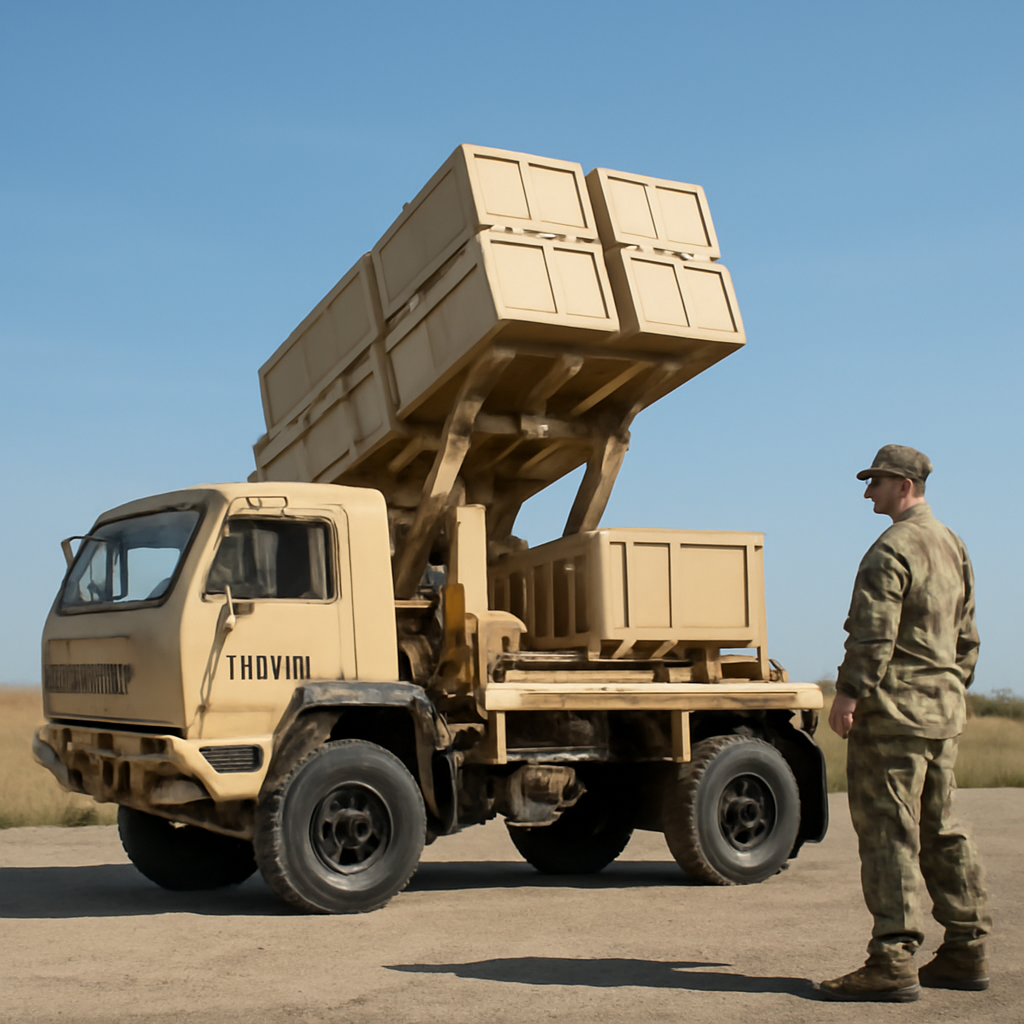
What happens when a soldier wades off a landing craft in the Pacific and is immediately surrounded by cooperating drones — airborne observers, small loitering munitions, and ground robots all feeding one tactical picture to that soldier’s helmet? Once the stuff of speculative fiction, senior Army leaders now say that scenario is a plausible near-term reality. The Army’s service secretary recently told Defense One she expects “drone-and-soldier teams” to be fielded within a few years, signaling a significant shift in how ground forces might operate across the Indo-Pacific. At the heart of that shift is manned-unmanned teaming, a concept simple to describe yet fiendishly complex to implement.
Manned-unmanned teaming: A new operational paradigm
Manned-unmanned teaming envisions tightly networked formations in which human squads and commanders operate alongside swarms of unmanned aerial and ground systems. The goal is to extend reach, increase persistence, and complicate an adversary’s targeting problem by dispersing many cheap, expendable nodes across a battlespace. Small unmanned aerial systems (sUAS) provide persistent overhead surveillance and communications relay; loitering munitions and expendable sensors seize fleeting targeting windows; unmanned ground vehicles handle route clearance, logistics, or forward observation; and secure, low-latency networking with edge AI fuses data into a shared tactical picture for the human warfighter.
The human remains central: critical decisions about the use of lethal force, complex judgment under uncertainty, and interpretation of rules of engagement still rest with people. What changes is tempo and footprint. Robots can loiter for hours, deliver real-time sensor feeds, and force an opponent to defend against many low-cost, distributed threats rather than a few high-value platforms.
Background: why now and why the Pacific
Over the last decade the U.S. military accelerated efforts to integrate autonomous and remotely operated systems into traditional formations. Manned-unmanned teaming has proven valuable in aviation — helicopter-drone pairings are already in use — and the Army wants to extend that approach to infantry, armor, and engineer units. Three trends are converging to make this possible: rapid improvements in sensors and AI that let machines perceive and collaborate; rising threats in the Indo-Pacific that favor distributed, networked forces across vast maritime and littoral spaces; and a desire to limit risk to personnel by assigning the riskiest reconnaissance and attrition tasks to unmanned systems.
The Indo-Pacific theater amplifies both the appeal and the difficulty. Island chains, long distances, and anti-access/area-denial (A2/AD) capabilities make persistent sensing and distributed operations critical. At the same time, contested electromagnetic environments, threats to space-based navigation and communications, and logistics over vast distances mean resilient networking and autonomous on-board decision making are essential, not optional.
How it would operate on the ground
In a deployed manned-unmanned team, a small infantry element might move under the concealment and overwatch of sUAS that provide real-time imagery and relay comms across network gaps. Loitering munitions and expendable sensors latch onto fleeting opportunities, enabling rapid engagement when commanders authorize strikes. Unmanned ground vehicles perform mundane but dangerous tasks such as route clearance, casualty evacuation, and resupply. Edge AI reduces operator burden by pre-processing sensor data into a cohesive tactical picture, but human operators retain final authority over lethal actions.
Challenges: technology, doctrine, trust
Turning this vision into practice faces major hurdles:
– Communications resilience: Mesh networks and satellites can be jammed or spoofed. Forces operating far from robust infrastructure must perform with degraded or intermittent connectivity.
– Software assurance and AI reliability: Edge AI that helps distinguish friend from foe or recommends lethal options must be rigorously tested and transparent to avoid catastrophic mistakes.
– Logistics and sustainment: Deploying, repairing, and resupplying many unmanned systems across island chains will strain maintenance and supply lines.
– Legal and ethical policy: Rules of engagement, accountability for autonomous weapons, and allied legal interpretations must be reconciled before wide-scale fielding.
– Training and human factors: Trust between soldiers and machines is earned through realistic training under contested conditions so crews can anticipate system behavior and cope when systems fail.
Perspectives from industry, policy, and the field
Technologists welcome the pace of change, pointing to faster processors, improved sensors, and advances in distributed autonomy that make near-term fielding credible. They favor modular, open architectures so upgrades and cybersecurity patches can be delivered without replacing entire platforms. Policymakers eye manned-unmanned teaming as a way to boost operational tempo and complicate adversary planning, while budget officials weigh life‑cycle costs and sustainment burdens. Soldiers and small-unit leaders are cautiously optimistic: they want capabilities that increase situational awareness and reduce risk, but they won’t trust systems that demand bespoke logistics or fragile links in austere environments.
Strategic risks: escalation and proliferation
Manned-unmanned teaming offers operational advantage but also strategic peril. Lowering the marginal cost of force projection — more sensors and weapons deployed cheaply — could encourage more frequent coercive or kinetic actions. Autonomous swarms complicate attribution and raise the risk of miscalculation in crises, especially if communications are limited. Proliferation is a concern too: many enabling technologies are commercially available and accessible to state and non-state actors alike.
What to watch next
Concrete signs the Army’s vision is becoming reality include pilot deployments in contested-environment exercises, publication of doctrine clarifying command relationships and human control, procurement of robust networking stacks, and allied integration demonstrations. Equally important are clear legal and ethical frameworks governing autonomous systems and transparent testing that builds operator and public confidence.
Conclusion
Manned-unmanned teaming promises to transform ground warfare by blending human judgment with the persistence and dispersion of robotic systems. In the Pacific, where scale and denial environments demand distributed, resilient approaches, it could provide decisive advantages — but only if leaders solve hard problems of communications resilience, software assurance, logistics, and trust. The technology may arrive first; the harder work will be ensuring human judgment remains central and preventing a future where decisions once too fraught for machines are outsourced by default. Who ultimately decides when a networked drone takes a shot will determine whether manned-unmanned teaming is a must-have capability or a risky leap into an unpredictable future.