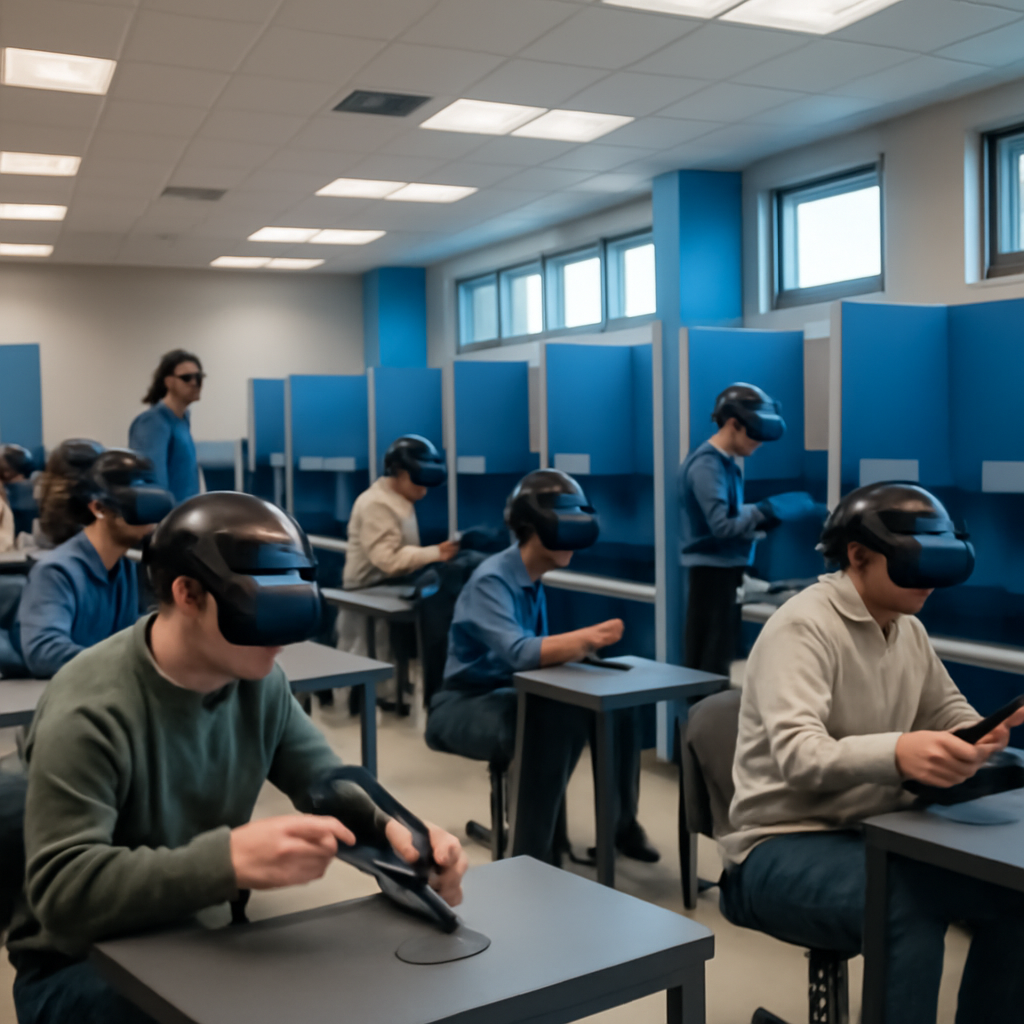
“If you’ve never worked with your hands before, or used a welding torch, it can feel intimidating,” Brian Blanchette, president of Ingalls Shipbuilding, told Defense One — and the solution in Pascagoula, Miss., is a 48‑station, climate‑controlled virtual‑reality welding lab that lets novices practice far more than a single day at a steel booth.
Ingalls Shipbuilding and Mississippi Gulf Coast Community College roll out VR welding
Ingalls Shipbuilding and Mississippi Gulf Coast Community College opened the VR welding lab in January 2025. The classroom-style facility holds 48 training stations and has been used by about 1,000 students, including apprentices and new employees, before they advance to traditional instruction, the report says. The workstation setup includes blue plastic panels with lime‑green QR codes that mimic welding material plates and welder helmets equipped with small cameras and screens that transform the plastic into virtual steel.
Training design: more practice, realtime feedback — but not the feel of fire
The lab is air‑conditioned and designed to give entry‑level students what trainers describe as far more hands‑on time than conventional booths. Defense One reports the VR environment delivers roughly 10 times more practice at melting metal in the same class time as standard welding booths. Trainees receive visual aids measuring torch position, speed, angle and distance; the system aggregates these into a scorecard that highlights progress and areas for improvement.
Scoring is explicit: students can aim for a top score of 99, and must achieve a 90 or above to progress to the next activity. An instructor in the classroom summarized the limits of the medium plainly: “I can’t teach ‘feel’ in here,” they said; “all I can teach is ‘place’.” The reporter noted that the software “is really responsive” and reported a personal first‑try score of 92 on a basic step.

This site is the portfolio.
OSINTSights runs on Cloudflare Workers, D1, R2, and Vectorize, with an AI pipeline on Hetzner ARM. Nubivance designed, built, and operates it. We do the same for clients.
See what we buildSpace Command’s HQ move: a timeline and a headcount
Separately, Gen. Stephen Whiting, who leads Space Command, said at the Space and Missile Defense Symposium that the command’s new facility in Huntsville, Ala., will have about 200 personnel by year’s end — up from 113 at Redstone Arsenal today and just 20 in March. Whiting added, “We plan to have over half our headquarters staff on the Arsenal by the end of 2028, and the entire command fully moved by 2032.” The command opened its first operational facility at Redstone in April, per the report.
L3Harris opens maritime production facility in Providence
L3Harris has opened a 50,000‑square‑foot maritime production facility at ProvPort in Providence, R.I. The company said the space will be used to “integrate and test advanced undersea training systems for the U.S. Navy” and allies, according to a company news release cited in the briefing.
Other procurement and corporate moves cited in the brief
- Vatn Systems signed a research deal with Taiwan’s national science and technology institute to explore defense uses of autonomous undersea vessels; the company last year signed a deal with South Korean shipbuilder Hanwha Defense.
- U.S. Southern Command awarded HII’s tech division a $2.2 billion task order for intelligence, surveillance, and reconnaissance kit.
- DARPA released a request for information on next‑generation hypersonic cruise missiles.
- Boeing is selling its eVTOL business to Archer Aviation in exchange for a stake in Archer plus piloted air taxis and unmanned aircraft systems.
- Joby Aviation is acquiring Resonant Sciences for around $500 million; Resonant’s release described the company as having “classified infrastructure…established production operations and longstanding customer relationships, as well as a deeply experienced technical team.” The briefing also notes Cerberus Capital Management has invested in Resonant Sciences since 2023 and that Cerberus was co‑founded by Deputy Defense Secretary Steve Feinberg.
How apprentices, naval trainers, and procurement officers are affected
Apprentices and new hires: The VR lab gives them a low‑pressure, classroom environment and substantially more repeat practice before they touch real torches; roughly 1,000 trainees have completed the VR phase and then moved on to traditional instruction.
Naval and undersea trainers: L3Harris’s new Providence facility is explicitly set to “integrate and test advanced undersea training systems for the U.S. Navy” and allies, providing a dedicated production and test space for undersea training hardware and software.
Procurement and program managers: Large task orders and corporate deals — including HII’s $2.2 billion task order for ISR kit and DARPA’s RFI on hypersonic cruise missiles — indicate active acquisition channels across training, ISR, and advanced weapon concepts that will intersect with industrial expansions like the Providence facility and private investments such as the Joby‑Resonant transaction.
The record in this brief is emphatic on two practical fronts: investing in scalable, repeatable training tools for skilled trades such as welding, and expanding physical capacity to assemble and test undersea systems. The VR welding lab in Pascagoula is already a training pipeline feeder — 1,000 trainees and counting — while the Providence production center and the series of procurement moves cited together point to a near‑term phase of activity in undersea training and ISR supply chains. The next concrete markers to watch in the public record will be the continued throughput of trained apprentices into shipyard work, and how soon the Providence facility begins full integration and testing operations for U.S. Navy programs.