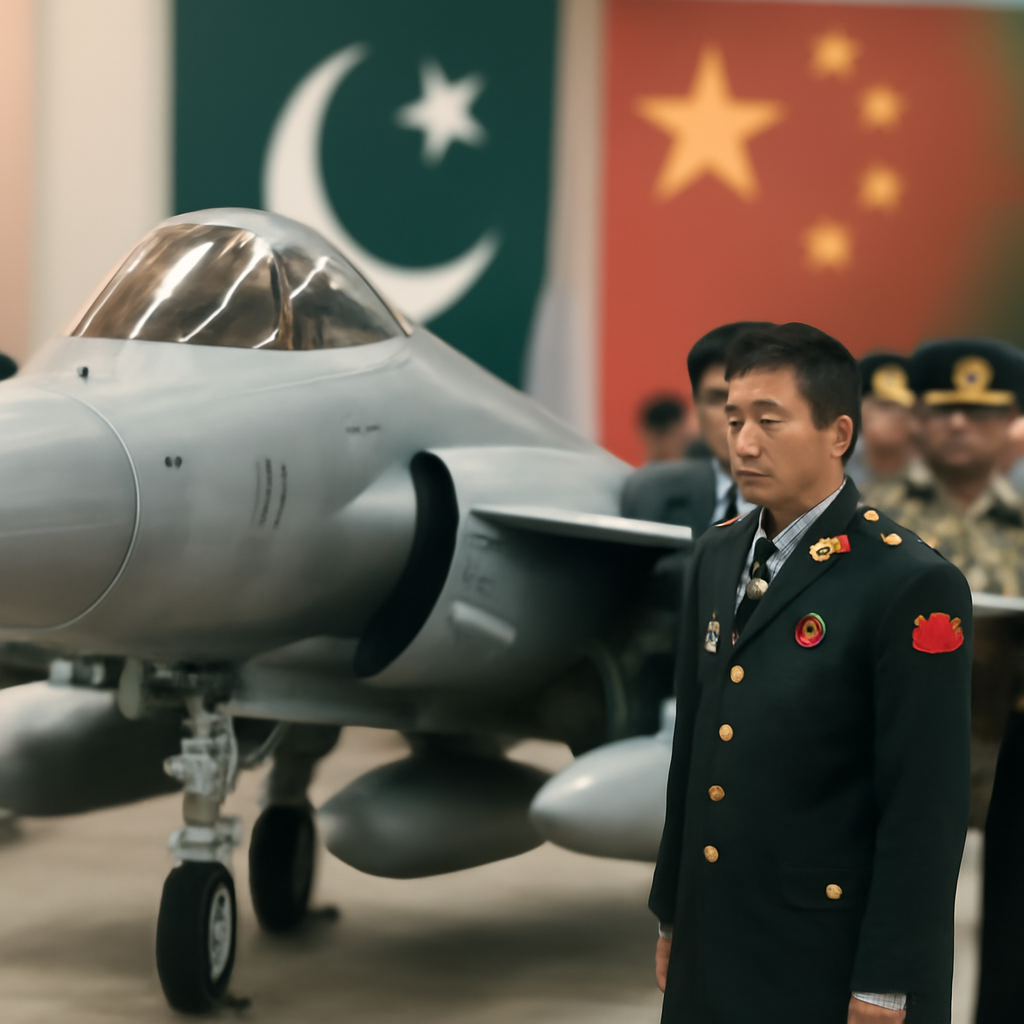
"Pakistan was the fifth-largest importer of major arms from 2021 to 2025, and 80% of those imports came from China, according to the Stockholm International Peace Research Institute (SIPRI)." That stark share, up from 73% in 2016–2020, frames a defence market increasingly routed to one supplier.
China’s dominant share and SIPRI’s data
SIPRI’s figures anchor the story: Pakistan bought enough major arms from 2021–2025 to rank fifth among importers, and fully 80% of those purchases came from China. The earlier five‑year period, 2016–2020, saw a Chinese share of 73%, underscoring a trend rather than a one‑off spike. The public numbers explain why analysts and manufacturers track Pakistan closely — it is a market where a single external supplier now supplies most of the hardware.
Predictable, multi‑billion‑dollar procurement cycles and the PAF’s 2030s plan
Even as Pakistan faces fiscal constraints, its procurement cycles remain large and predictable. The source material states Pakistan continues to run multi‑billion‑dollar procurement cycles and that the Pakistan Air Force will undertake its next major cycle in the 2030s. That planned program is described as largely focused on replacing F-16A/B Block-15s and on building a next‑generation air warfare system‑of‑systems. Those predictable cycles help explain why both suppliers and strategists watch timing and technical scope carefully.

Audit-ready is a season. It shouldn't be.
Evidence in spreadsheets, controls drifting between audits, frameworks multiplying on flat headcount. Nubivance runs continuous compliance on Rapid7 Cyber GRC - SOC 2, HIPAA, ISO 27001, PCI, CMMC.
End the scrambleUnlicensed MRO at Pakistan Aeronautical Complex, including Pratt & Whitney Canada PT6 work
One recurring demand‑side practice named in the reporting is unlicensed maintenance, repair, and overhaul (MRO) activity at Pakistan Aeronautical Complex (PAC). The source explicitly cites PAC’s work on the Pratt & Whitney Canada PT6 engine line as an example. That pattern—performing MRO without OEM licensing—features in the analysis as a deterrent to non‑Chinese original equipment manufacturers who might otherwise sell or co‑produce with Pakistan.
Original conversion programs run without the airframe OEM: Sea Sultan LRMPA and the Lineage 1000E
The Pakistan Navy is described as running original conversion programs without the airframe OEM involved. Two concrete items are named: the Sea Sultan long‑range maritime patrol aircraft (LRMPA) and an Embraer Lineage 1000E conversion. The reporting frames these programs as examples of a demand‑side habit—modifying, converting, or repurposing platforms independently of the original manufacturer—that can dissuade OEMs who expect authorized, collaborative modification processes.
Security‑control regime, NESCOM, PAEC, and wary external partners
The third demand‑side factor the source highlights is Pakistan’s security‑control regime. That regime, the reporting says, keeps the National Engineering and Scientific Commission (NESCOM) and the Pakistan Atomic Energy Commission (PAEC) away from willing partners. The piece names several such partners that are effectively kept at arm’s length: Turkish Aerospace, Leonardo, and Bombardier. Taken together with the unlicensed MRO and independent conversion programs, the security‑control constraint is presented as an explanatory factor for why many non‑Chinese OEMs have moved away from deep engagement.
Supply‑side export controls are acknowledged in the reporting as part of the explanation for China’s central role, but the central claim is that demand‑side behaviours — the three recurring habits above — also push business toward China. The reporting therefore reframes a supply‑centric explanation as incomplete without accounting for how Pakistan’s own procurement and industrial practices shape partner choices.
The PAF’s next major procurement window in the 2030s, aimed at replacing F-16A/B Block-15s and creating a system‑of‑systems, will be a clear inflection point. The sourcing decisions made for that cycle will reflect both external controls and the internal practices described here: PAC’s MRO approach, the Navy’s conversion programs, and the security‑control regime that limits interaction between NESCOM, PAEC, and named external firms.
Those facts leave a straightforward question for Pakistan and for manufacturers watching Islamabad: will demand‑side habits change enough to invite broader multinational participation, or will predictable procurement cycles continue to favor the supplier whose processes align with the status quo? How that question is answered in the run‑up to the 2030s procurement cycle will determine whether the current pattern—80% of major imports from China—endures.
Read the original reporting: https://quwa.org/pakistan/market-intelligence/pakistan-buys-80-of-its-arms-from-china-its-own-rules-are-part-of-why/



