“The upgraded aircraft will be able to carry more munitions to meet new national requirements,” a Turkish Aerospace official said, as the company prepares a second line for the Anka 3 that boosts payload capacity to 1.75 tons from about 1.3 tons on the original platform.
Second production line, November opening and near-term rollout
Turkish Aerospace has completed construction of a second production line for the Anka 3 unmanned combat aerial vehicle and plans to open that line in November, a company official told Breaking Defense. The official said the first aircraft to be built on the new line is expected to roll out “soon” and then undergo flight testing. The Turkish armed forces have ordered 80 Anka 3 UCAVs, with first delivery expected in 2027.
What the upgraded Anka 3 is built to do
The new Anka 3 variant will feature a larger airframe and an expected payload capacity of 1.75 tons, a significant increase from roughly 1.3 tons on the original Anka 3 prototype, according to company comments. Turkish Aerospace describes the Anka 3 as a combat drone designed for strike and other missions; the aircraft can reach high-subsonic speeds and operate at altitudes of up to 40,000 feet.

Audit-ready is a season. It shouldn't be.
Evidence in spreadsheets, controls drifting between audits, frameworks multiplying on flat headcount. Nubivance runs continuous compliance on Rapid7 Cyber GRC - SOC 2, HIPAA, ISO 27001, PCI, CMMC.
End the scrambleDemonstrations and hardware on display during Atış Serbest
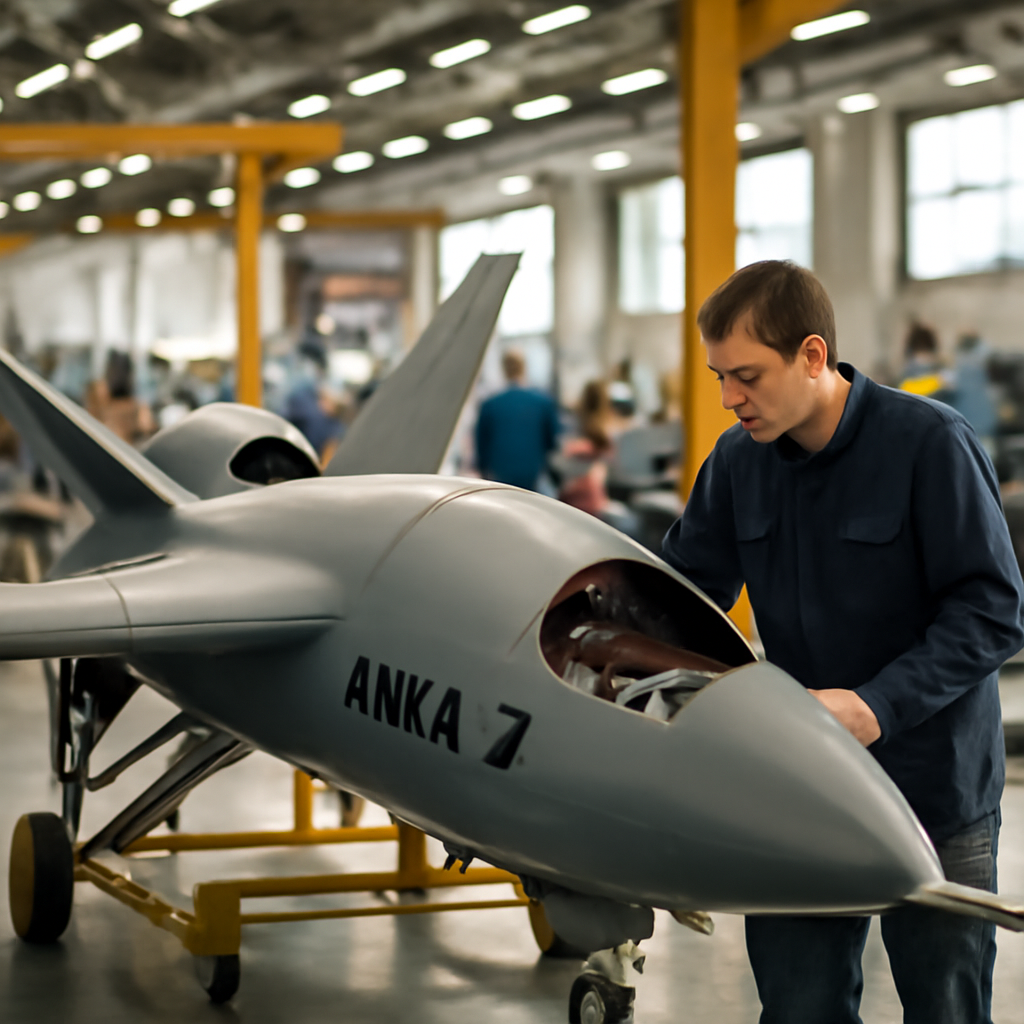
Reporters who toured Turkish Aerospace’s Ankara facility were invited as part of coverage of the Atış Serbest exercise. During that visit, the media saw the first prototype of the original Anka 3 currently in flight testing. In the same hangar, eight Anka medium-altitude long-endurance (MALE) UAVs were visible at different stages of final assembly — some lacking fixed wings, others missing parts of their fuselages — while a ninth Anka was being prepared for test flights.
Also on display were Aksungur multirole MALE drones, and, alongside the Anka 3 prototype, two recently unveiled systems: the Ayaz turbojet-powered one-way attack UAV and the Super Şimşek kamikaze drone. A company official reported that both systems “successfully conducted dive attacks and struck their targets during the Atış Serbest exercise, marking their first use with live warheads.”
The visit included a tour of Turkish Aerospace’s final assembly line for helicopters — specifically T70 utility helicopters, T129 Atak helicopters and T625 Gökbey utility helicopters — though the company’s KAAN fifth-generation fighter jet and the Hürjet trainer/light-attack aircraft were absent from the display.
KAAN, Hürjet, and export signals — what Madrid and procurement leaders will watch
Company officials said prototype 1 (P1) of the KAAN fighter is being prepared for flight testing. Turkish Aerospace’s initial KAAN prototype (P0) made a maiden flight in 2024, and P1 is slated to be the first jet to be delivered to the Turkish armed forces.
On Hürjet, Turkish Aerospace CEO Mehmet Demiroğlu said Madrid has signed an agreement to purchase 30 Hürjet aircraft and that “Madrid is planning to buy another 15 trainers.” For procurement leaders and foreign buyers, that combination of export activity and active prototype work signals parallel pacing of production lines, flight testing and export commitments to manage.
How the Turkish armed forces, Turkish Aerospace, and international buyers are positioned
- The Turkish armed forces: They have a defined order for 80 Anka 3 UCAVs with the first delivery expected in 2027 and will be the primary recipient of the increased payload capability intended to meet “new national requirements.”
- Turkish Aerospace: The company is scaling industrial output by bringing a second production line online, preparing the first build from that line for imminent rollout and continuing flight testing of the original Anka 3 prototype while advancing other airframes in final assembly.
- Madrid and other buyers: Spain has a signed agreement for 30 Hürjet aircraft and, per the CEO’s statement, plans to acquire an additional 15 trainers — a concrete export trajectory that places the Hürjet program alongside ongoing work on KAAN and the expanded Anka 3 production effort.
The facts on the ground are straightforward: a second Anka 3 production line is complete, a bigger airframe with a 1.75-ton payload is headed to assembly, flight testing and delivery follow on a near-term timeline, and parallel programs from helicopters to jet prototypes continue to move through Turkish Aerospace’s facilities. The company’s moves tie production capacity to stated national requirements and export plans; the immediate watchpoints are the upcoming rollout from the new line, the results of flight tests, and the pacing of the first deliveries expected in 2027.