"Today’s delivery from the historic Marietta line represents far more than a new airframe; it marks the foundation of our future strategic deterrence posture,” Capt. Roger Davis, program manager for the Navy’s Airborne Strategic Command, Control, and Communications program office (PMA-271), said after the handover on Oct. 15, 2026.
Lockheed Martin delivers the airframe in Marietta on Oct. 15
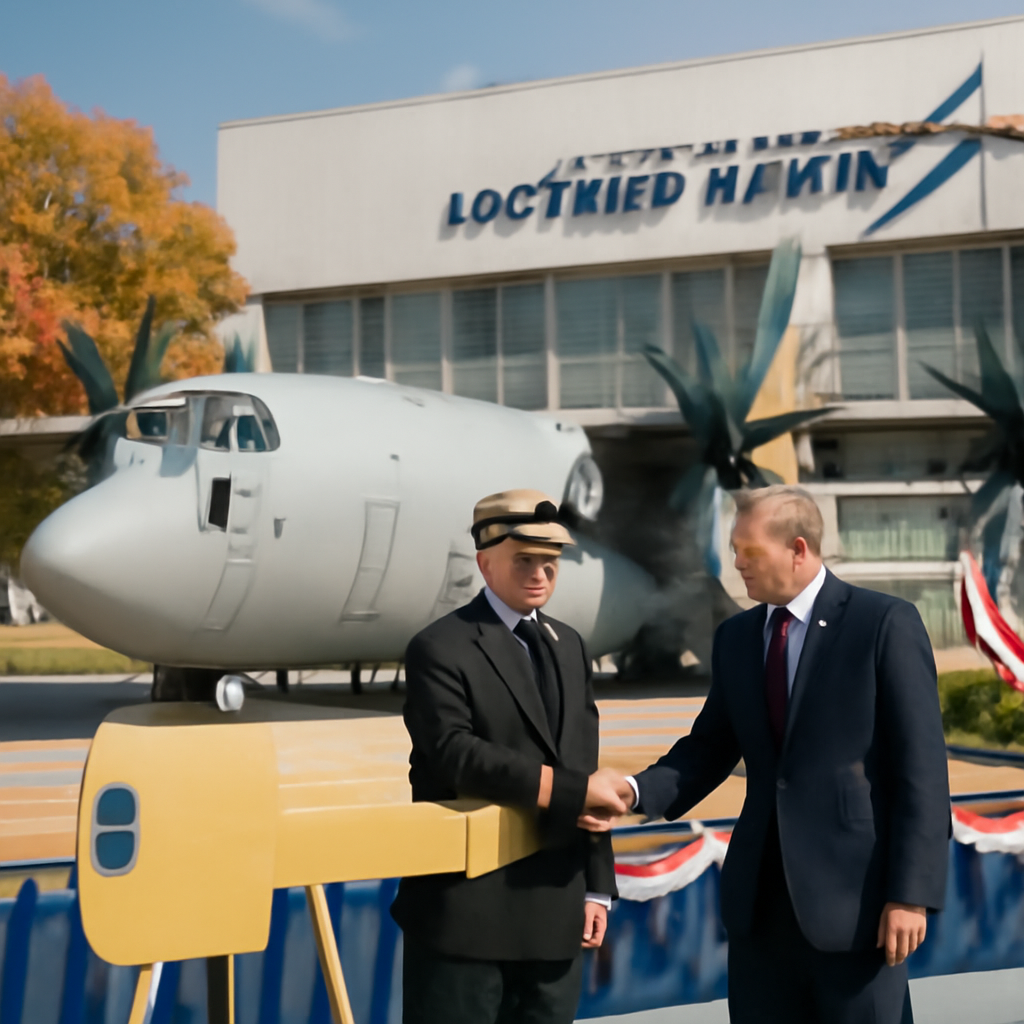
Lockheed Martin handed over the first C-130J-30 Hercules airframe destined to become an E-130J Phoenix II at its Marietta, Georgia, facility on Oct. 15, 2026. The aircraft is the first of three C-130J-30s the Navy initially procured in September 2024 and will move to Northrop Grumman for mission-systems conversion. A ceremonial key was presented during the delivery; Capt. Roger Davis presented that key to Capt. David Gardner, commodore of Strategic Communications Wing 1 (SCW 1), as part of the event.
Northrop Grumman will convert; Collins Aerospace supplying VLF equipment
After delivery, the C-130J-30 will be transferred to Northrop Grumman, the E-130J program’s prime contractor and mission-systems integrator, for conversion into the TACAMO-configured E-130J. Collins Aerospace is providing the very low frequency (VLF) communications system — a key component of the TACAMO mission that enables communications with submerged ballistic missile submarines. The E-130J conversion will include an equivalent to the E-6B’s long trailing wire antenna for VLF transmissions and requirements for hardening against electromagnetic pulse (EMP) effects from nuclear detonations.

This site is the portfolio.
OSINTSights runs on Cloudflare Workers, D1, R2, and Vectorize, with an AI pipeline on Hetzner ARM. Nubivance designed, built, and operates it. We do the same for clients.
See what we buildProgram scale: 31 E-130Js planned; three aircraft initially procured
The Navy plans to acquire 31 E-130Js, nearly doubling the current fleet of 16 E-6B Mercuries. That 31-aircraft total is broken down in the program plan as six developmental aircraft and 25 production examples, although the source states it remains unclear how many of the developmental aircraft will ultimately be available for operational use. The three C-130J-30s procured in September 2024 represent the initial tranche that will establish conversion and testing pathways before broader production and fielding.
GAO warning and operational trade-offs tied to a smaller airframe
The Government Accountability Office has previously warned that integrating specialized TACAMO mission equipment into the smaller C-130J-30 airframe could affect operational availability and create additional engineering and manufacturing difficulties. Commentary in the program’s coverage notes trade-offs inherent in shifting from an airliner-sized E-6B to a turboprop C-130J-30: the C-130J-30 will not match the E-6B’s speed or altitude, which could affect how quickly a platform gets on station and its ability to fly above weather. At the same time, the C-130J-30 opens the ability to operate from a larger number of air bases and tertiary locations — a capability the Navy has identified as valuable if larger bases are rendered unusable.
What this means for Strategic Communications Wing 1, PMA-271, Northrop Grumman and the Air Force
- Strategic Communications Wing 1 and operational crews: SCW 1 will be the operational recipient of TACAMO aircraft once conversions and testing are complete; the delivery and ceremonial key presentation to Capt. David Gardner indicate the wing’s central role in eventual fleet operations.
- PMA-271 and the Navy program office: PMA-271 will oversee conversion, mission-systems integration, and the developmental flight-testing sequence that precedes operational fielding. The program office’s stated objective is to preserve an “unshakeable communications lifeline” to the ballistic missile submarine fleet.
- Northrop Grumman and Collins Aerospace: Northrop Grumman will perform the mission-systems integration and conversion work; Collins Aerospace is supplying the VLF system that is essential to maintaining communications with submerged submarines. Both contractors must address the engineering and manufacturing challenges noted by the GAO.
- The Air Force and the Looking Glass mission: The Navy plans for the E-130J to assume the TACAMO mission while the Air Force pursues a separate effort to replace the Looking Glass airborne command post capability that the E-6B also supports.
Following delivery, the first E-130J airframe will undergo mission-systems modification, ground testing, and developmental flight testing; it is not yet an operational TACAMO platform. The Navy’s transition from the aging E-6B Mercury fleet to a turboprop E-130J is explicitly positioned to sustain one of the most critical links in the U.S. nuclear command, control, and communications architecture as the Mercuries become increasingly difficult to sustain. How quickly the conversion, integration, and testing path moves — and how many of the developmental aircraft enter operational service — are the concrete next milestones the program must meet.