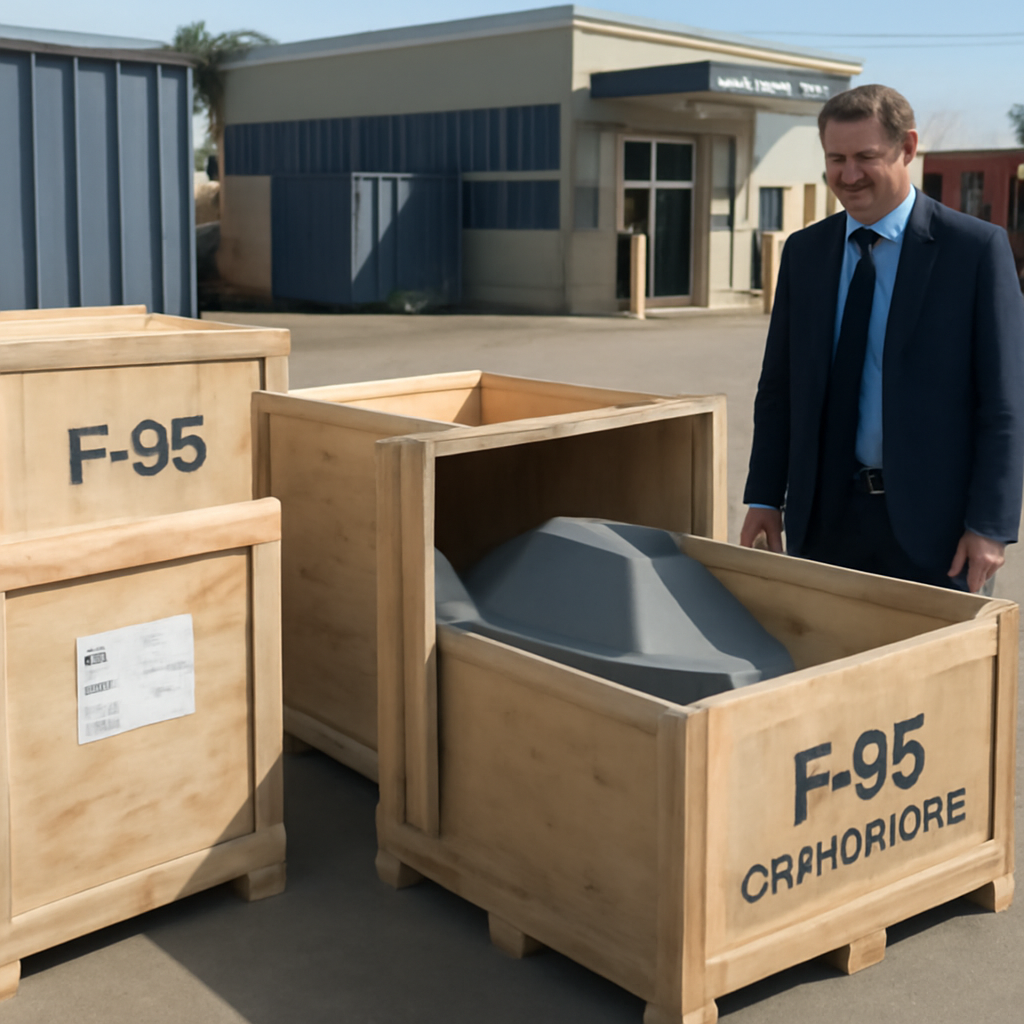
"We're not talking about sensitive parts here," Australia’s defense minister Richard Marles said as Canberra moved to downplay a report that several F‑35 components shipped from Australia were diverted to Hong Kong.
Richard Marles and Canberra's posture
Marles told reporters, according to a government transcript, that Australia is "examining very much everything that has occurred at the Australian end," while expressing confidence in Canberra's engagement with the F‑35 program and with Lockheed Martin. He referred detailed questions about the nature of the missing components to the U.S. government and Lockheed, but said his "understanding" was that the items were not sensitive.
F-35 Joint Program Office: retrieval, investigation, safeguards
The Pentagon's F‑35 Joint Program Office said officials "are aware of a shipment issue of unserviceable F‑35 Lightning II components." Its spokesperson added that Pentagon officials "are actively working with U.S. authorities and industry partners to retrieve these components, investigate the incident, and place safeguards to avoid a future occurrence."

Audit-ready is a season. It shouldn't be.
Evidence in spreadsheets, controls drifting between audits, frameworks multiplying on flat headcount. Nubivance runs continuous compliance on Rapid7 Cyber GRC - SOC 2, HIPAA, ISO 27001, PCI, CMMC.
End the scrambleLockheed Martin: unserviceable parts, "low risk for exploitation"
A Lockheed spokesperson echoed that the company "continues to work closely with the U.S. Government following this incident and we have complied fully with all laws, policies, and export‑control regulations." The company said the missing components "are unserviceable and deemed low risk for exploitation," and that it "manage[s] every shipment with the highest levels of caution and security to protect the integrity of the program and the interests of our partners and customers."
The shipment, Hong Kong, and the canopy
POLITICO first reported on Sept. 18 that a collection of F‑35 parts handled by a Lockheed "intermediary" and bound for the United States for repairs was apparently diverted after leaving Australia and wound up in Hong Kong. That shipment reportedly included one of the F‑35's canopies — described by POLITICO as coated in radar‑absorbing material that is key to masking the fighter's signature — and that canopy was reported still missing.
The report and subsequent comments have prompted explicit concern that the waylaid shipment could allow the Chinese government, which has strengthened its control over Hong Kong, to gain access to technologies tied to stealth capability. Breaking Defense noted that compromising stealth components could help an adversary better understand how to counter the aircraft, or provide lessons for other advanced aircraft projects; the piece also recalled that Beijing has dismissed longstanding allegations it stole F‑35 plans.
Global spares pool, customers, and GAO findings
The F‑35 program spans 20 global customers, with another possible customer after the State Department cleared a sale for Saudi Arabia, the report said. The global spares pool is owned by government entities but managed by Lockheed, and components are distributed across dozens of domestic and international facilities.
Breaking Defense cited a 2023 Government Accountability Office report that found over 1 million F‑35 parts, collectively valued at $85 million, were unaccounted for and warned the number could be much higher. The GAO observed that a shortage of parts has been a key factor behind disappointing readiness rates, prompting officials in recent years to seek larger inventories of spares.
What this means for the Pentagon, Lockheed Martin, and Beijing
- Pentagon's F‑35 Joint Program Office: is already coordinating retrieval, a formal investigation, and the imposition of safeguards, per its public statement.
- Lockheed Martin: has asserted compliance with export controls, described the items as unserviceable and low risk, and said it is working closely with the U.S. Government to address the incident.
- Beijing: is named in the report as the principal external concern — the diversion to Hong Kong "is sure to raise fears" that the Chinese government could gain access to stealth‑related materials, even as the source notes Beijing has dismissed prior allegations of theft.
The immediate facts are narrow: Canberra says it does not believe the parts were sensitive; the Pentagon and Lockheed say they are working to retrieve components and investigate; and reporting identifies a canopy coated with radar‑absorbing material as among the diverted items. What remains to be seen — and what the official statements make the central task — is whether the components are recovered and whether the ongoing inquiries yield changes to shipment safeguards or to how the global spares pool is managed.