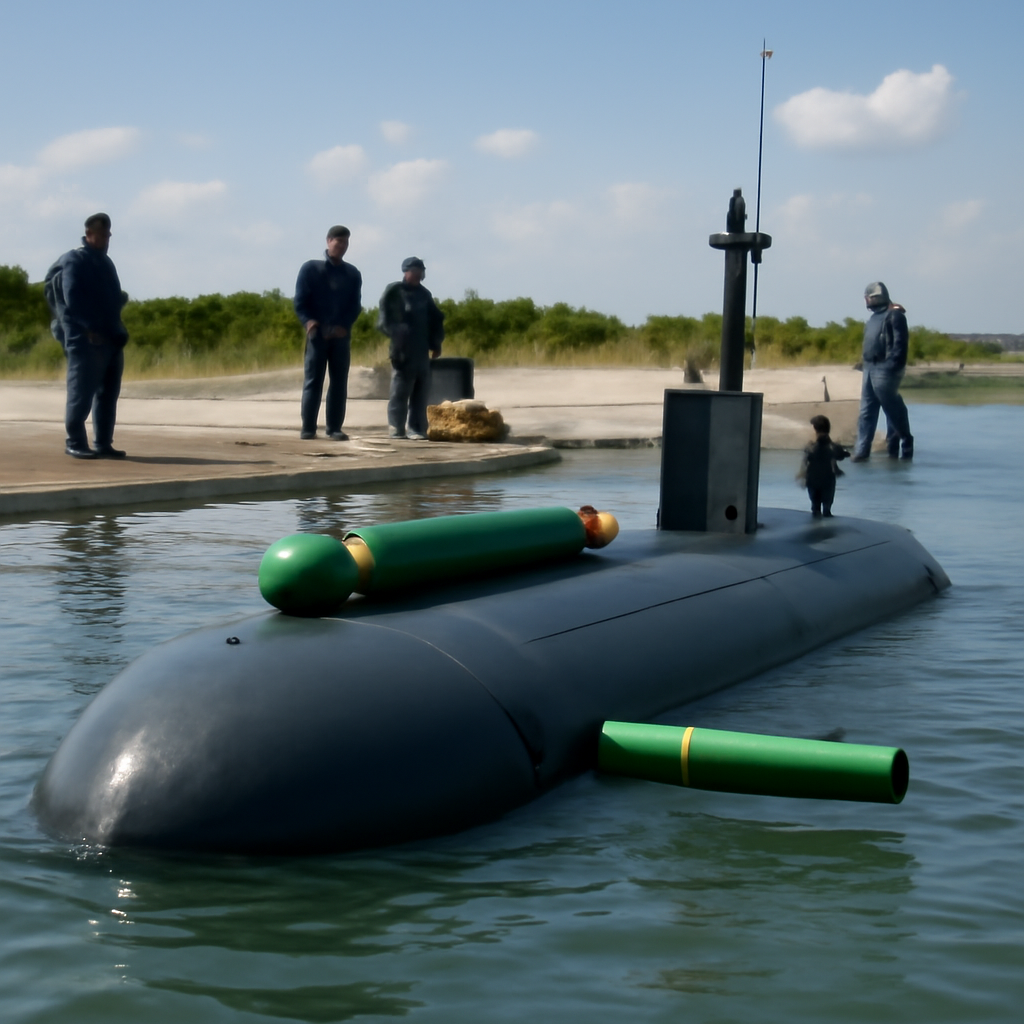
The September 13 test at BUTEC: who, where, and what happened
On September 13, 2026, the U.S. Navy and the Royal Navy conducted a proof-of-concept trial at the British Underwater Test & Evaluation Center (BUTEC) in Scotland in which a British Excalibur uncrewed underwater vehicle (UUV) fired a U.S. Mk 48 heavyweight torpedo. Personnel from the Defense Innovation Unit (DIU), the Naval Undersea Warfare Center Keyport Division (NUWC Keyport), and unspecified industry partners participated, the U.S. Navy said. The Navy later published video captures showing the Excalibur slung with the torpedo and the weapon’s subsequent release into the water.
Excalibur, Project Cetus, Project Broadsword and Trial Iron: the hardware and the hookup
Excalibur is an extra-large UUV developed by U.K. firm MSubs under Project Cetus. The vehicle is nearly 40 feet (12 meters) long and weighs about 19 metric tons; it includes a sizable internal payload bay that, according to the U.S. Navy, is not large enough to carry a full Mk 48 internally. For the September test the Mk 48 was carried external to Excalibur — a capability enabled by two follow-on efforts, called Project Broadsword and Trial Iron, which integrated a U.S. kinetic payload onto a U.K. autonomous hull.
The Mk 48 torpedo itself is about 19 feet long and 21 inches in diameter and has been upgraded over the years; the Navy has moved on to the Mk 48 Mod 8 variant. The Department of the Navy Rapid Capabilities Office (DONRCO) approved the Broadsword effort in February 2026, and the project was executed in less than seven months, the Navy said.

Audit-ready is a season. It shouldn't be.
Evidence in spreadsheets, controls drifting between audits, frameworks multiplying on flat headcount. Nubivance runs continuous compliance on Rapid7 Cyber GRC - SOC 2, HIPAA, ISO 27001, PCI, CMMC.
End the scrambleStatements, intent, and the tactical picture the services painted
U.S. Navy Adm. Daryl Caudle, the Chief of Naval Operations, called the trial “a historic first for allied undersea warfare,” saying it validated “our shared vision for true interchangeability.” Luke Pollard, U.K. Minister of State for Defence Readiness and Industry, told LBC radio the test represented “a substantial increase in our lethality,” noting that torpedoes can now be fired not only by crewed Astute-class submarines but also by uncrewed systems.
The Navy’s press release framed the capability in terms of force structure and economics: “By converting commercial and allied uncrewed undersea hulls into high-end strike assets, the partnership drastically alters the cost-exchange ratio in contested maritime environments,” the release said. The services described armed UUVs as complementary to crewed warships and submarines, able to enter higher-risk areas ahead of manned units and offer an immediate option to engage threats.
Launch, recovery, and logistics: practical questions on the table
Video released by the U.S. Navy shows the Excalibur being introduced to the water in Scotland using a commercial truck-mounted crane. How Excalibur was controlled during the test and whether the torpedo was launched at a target are not disclosed. The Navy acknowledged continuing questions about how future large UUVs will be deployed and recovered at sea.
U.S. shipbuilders Huntington Ingalls Industries (HII) and General Dynamics National Steel and Shipbuilding Company (NASSCO) have been working on options for launching and retrieving large UUVs from surface warships; examples include a 2022 test of a prototype portable cradle developed by HII. The Navy also noted external carriage on the hulls of ships and submarines as a future possibility. Separately, the services are exploring smaller, lighter weapons better suited to drone platforms, in addition to full-size torpedoes like the Mk 48.
What this means for the Royal Navy, the U.S. Navy, and the Royal Australian Navy
- Royal Navy: Excalibur and the external-launch work under Project Broadsword and Trial Iron offer a way to increase persistent undersea presence without adding crewed submarines; the capability is presented as one means to relieve pressure on a limited number of Astute-class boats by taking on hazardous forward tasks.
- U.S. Navy: The demonstration advances AUKUS Pillar II interoperability goals and validates weapon interchangeability with allied autonomous vessels; the service is also pursuing other large UUVs such as Boeing’s Orca XLUUV, which the Navy said conducted a 1,000-nautical-mile transit in the Pacific that the service announced in August.
- Royal Australian Navy: The U.S. Navy said it is planning another allied demonstration under Project Cutlass that will use an Anduril Dive-XL; Australia is already acquiring a militarized Dive-XL called Ghost Shark. The services intend Project Cutlass to tackle payload integration, command-and-control, and tactical employment scenarios.
The September 13 trial is both milestone and experiment: it proved a mechanical, electrical and software hookup that lets a U.S. kinetic weapon ride on — and be released from — a U.K. autonomous hull. It also left clear, practical questions standing: how will control and targeting be managed, how will recovery and at-sea launch scale from cranes to shipboard systems, and how quickly will allied forces standardize interchangeability across different UUV families? The services have named the next steps themselves — further demonstrations such as Project Cutlass and continued development of Orca and other XLUUVs — and the answers to those concrete plans will determine whether this proof-of-concept becomes routine undersea practice.